The title is excellent, given that the author Brad Jacobs did in fact make a few billion dollars.
The book itself is fine to read, but also fine to skip if you aren’t yourself burning to build a billion dollar company through excellent management and mergers and acquisitions. I certainly don’t care to, which Jacobs says would make me a bad hire for one of his companies:
I only hire people who are motivated to make a lot of money…. If an candidate says to me ‘I’m not motivated by money’, I suspect either they’re not being candid or they lack the hunger that’s necessary to succeed
The book has plenty of hard-driving sentiments like this that you’d expect from a self-made billionaire:
Fire C players
For the first time ever, an American company, Exxon, had reported quarterly earnings in excess of $1 billion. The words “obscene profits” flashed on my TV screen, and I remember thinking “That sounds pretty good! Maybe I ought to check out the oil sector.” [This part I agree with, economic theory predicts that entrepreneurs will enter the sectors with the highest profits and its what I’d do if I wanted to make money, though in practice I think it is surprisingly rare for would-be entrepreneurs to choose this way -JB]
“The CEO trait most closely correlated with organizational success is high IQ” [specifically more important than EQ]
But Jacobs balances these ideas with some surprisingly hippy-like attitudes. Jacobs went to Bennington College and almost had a career as a jazz keyboardist. Chapter 1 is titled “How to Rearrange Your Brain”, and emphasizes the importance of meditation. Page 21 is basically “have you ever really looked at your hands, man… do it, it’s a trip”
I don’t want to spend even one hour around people who are unkind. An organization is like a party. You only want to invite people who bring the vibe up
Though perhaps this hippy/anti-hippy balance shouldn’t be surprising for someone who says one of the main things he asks about potential hires is “can this person think dialectically”.
Strongly recommend the book if you want to follow Jacobs’ path; weakly recommend it as a general management/self-help book or way to learn about markets.
Declining fertility rates have been in the news a lot lately, and with good reason. Some countries, such as South Korea, have seen massive declines in fertility rates, and they face huge social problems and population decline resulting from these declining rates. But does the United States face the same problem?
To be clear, fertility rates are down in the US. Using the most common measure, the total fertility rate, births per woman in the US fell from a peak of over 3.5 births at the peak of the Baby Boom in the late 1950s and early 1960s, to around 2 births per woman in the 1990s and 2000s, and fell further to 1.6 births in 2023 (note: it had been around 2 births in the 1930s as well — the Baby Boom was a very real).
But the total fertility rate, or the number of births per woman of child-bearing age (usually 15-49) in a particular year is not a perfect measure. As Saloni Dattani clearly explains, if the timing of births is changing, this can make the TFR temporarily fluctuate. If women on average are delaying births to a later age, the TFR will fall initially even if women end up having the exact same number of children.
An alternative measure suggested by Dattani is the completed cohort fertility rate. This measure looks at the total number of children that women from a particular birth year in a country have throughout their child-bearing years. This rate also shows a decline for the US, but it is much more gradual: for women born in the 1930s (who would eventually become mothers during the Baby Boom), they peaked at about 3.25 births per woman, which declined to right at about 2.0 births in the 1950s (the Baby Boomers themselves), and has gradually risen since then to about 2.20 for women born in the early 1970s.
How does the US completed cohort fertility rate compare with other countries?
Tennis elbow (or these days, pickleball elbow) is a painful, debilitating condition that affects around 2% of adults at any given time. Active tennis players have about a 50% chance of being stricken at some point. If you give it a chance to heal, it usually goes away within a year, but that is a long time to be in pain or disabled.
The traditional technical name for this condition is “lateral epicondylitis.” That suffix “…itis” implies inflammation, but it is now known that typical inflammation markers are generally absent. So, the new jargon is the deliberately ambiguous “tendinosis” or even “tendinopathy.” It seems to be caused by accumulated damage to the very end of the tendon that anchors the muscles which are attached to the back of your hand. Those muscles that let you tilt your hand up; if you grip something hard and try to hold something steady, those muscles contract in a big way. The micro tears seem to occur right about where that tendon attaches to a little knob of bone at the very outside of your elbow joint:
This condition is somewhat frustrating for doctors and for patients, since there’s not a single clear effective treatment. Although injecting Cortisone type anti-inflammatories gives short-term pain relief, it seems to adversely affect longer term outcomes, so those shots are less common than 20 years ago. Therapists throw all sorts of techniques at it, including NSAIDs, heat, cold, exercises, braces, shock waves, acupuncture, injections of blood extracts, and so on. All these may help, though for every study that shows positive results for a given treatment there seems to be one that doesn’t.
I have a personal interest in this subject, since I have a long-standing for propensity towards tennis elbow. I had to stop playing tennis many years ago because of it. More recently, I spent the day helping on a work project, installing sheet rock to repair flood damage in a someone’s home. After a day gripping a powered drill driver, the old tennis elbow flared up significantly.
In the course of my internet search, I ran across a very promising study that seems to have been largely neglected. It is also a sweet piece of science.
An orthopedist named Jerrold Gorski started reflecting on the common observation that tennis elbow often feels worst upon waking up in the morning. That made him wonder whether something was going on in the night that caused the condition to worsen. Which led him to hypothesize that tennis elbow might be helped by changing a patient’s sleep posture. Prior studies showed that X people spend some 55% of the night sleeping with their arm crooked up overhead, something like this:
That position could keep stress on the tendon all night, and inhibit it from healing. Dr. Gorski also noted that in the literature there are other examples of sleep posture or waking postures making a difference in treating various orthopedic conditions.
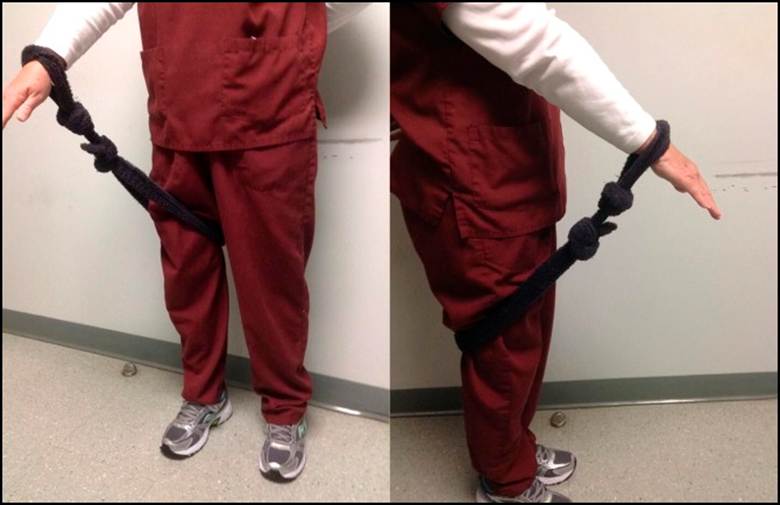
And so, like a good scientist, he devised an experiment to test his hypothesis. He came up with a very simple technique of using a bathrobe belt, which is soft and wide, to restrain the arm during sleep. You simply tie a large loop at one end that goes around the thigh, and a smaller loop at the other that fits snuggly around the wrist. If all goes well, this rigging well prevent will keep the arm down close to the side all night, so it cannot get crunched under the head:
Dr. Gorski tried tried this out with 39 tennis elbow patients. Six of them apparently could not tolerate being roped for the night, so they were designated as “treatment failures”, or effectively a control group. The other 33 patients stuck with the protocol, although most of them, like the 6 “treatment failures”, complained about interference with going to sleep or staying asleep.
There was a fairly dramatic difference in outcomes. The six treatment failures had ongoing tennis elbow symptoms that persisted unchanged over the initial 3-month study period. Of the thirty-three patients who stuck with the protocol, 66% reported improvement within 1 month, and 100% of them improved within 3 months. Those are really good results.
Obviously, it’s not a perfect study. It only claims to be a prospective study. Nevertheless, the results were so promising, and the treatment was so inexpensive and harmless and noninvasive, I would’ve thought that it would get a lot of attention. But looking in Google Scholar for citations, I only saw seven articles that cited it. Two of those articles were letters to the editor by the author, Dr. Gorksi himself, seemingly trying to draw due attention to his promising study, and one citation was in an article that got retracted. This leaves only 4 independent citations in the medical literature all of which, as best I could tell, were about touting some other treatment, and just nodded in passing to Dr. Gorski’s work. So, essentially crickets. One can only speculate on why the medical profession has not paid more attention to a treatment which requires nothing more than an office visit and demo with a strip of cloth.
I want to give a shout-out to the UK-based “Sports Injury Physio” website, which, in a very helpful and comprehensive article on tennis elbow care, noted:
Sleeping with your elbow straight is usually a gamechanger. There is something about keeping the elbow bent for long periods that irritates tennis elbow and makes the pain worse. It can be a bit challenging to figure out how to keep your elbow straight while tossing and turning in bed, but my patients who manage this report big improvements in their pain.
That endorsement piqued my interest. The Wikipedia article on tennis elbow also mentions this treatment clearly. With my nascent tennis elbow, I decided to try it for myself. Using a bowline knot (which does not slip), I tied a loop at one end of a bathrobe belt just big enough to wriggle my hand through, and a larger loop at the bottom to go around my thigh:
It is somewhat awkward to sleep with this on, but it is entirely bearable if you set your mind to it and plan ahead, e.g., where to position your nighttime tissue box. After only two nights on this protocol, I am now waking up with no pain in my elbow. Thanks, doc.
“Who serves in secret police forces? Throughout history, units such as Hitler’s Gestapo, Stalin’s NKVD, or Assad’s Air Force Intelligence Directorate have been at the core of state repression. Secret police agents surveil, torture, and even kill potential enemies within the elite and society at large. Why would anyone do such dirty work for the regime? Are these people sadistic psychopaths, sectarian fanatics, or forced by the regime to terrorize the population? While this may be the case for some individuals, we believe that the typical profile of secret police agents is shaped by the logic of bureaucratic careers.”
The details and history in the paper are illuminating. The economic logic is simple, but it remains fascinating to be reminded of how far the reinforcing incentives of shame, power, and labor market demand can go when trying to understand the world. To recap the obvious
For some the opportunity for cruelty is benefit and others a cost, no doubt heterogeneous across context for many (but not all). The selection effects into ICE officers is obvious.
Shame selects as well. The larger the fraction of the American public that view ICE behavior as shameful and cruel, the fewer and more specific the individuals who will select in.
Labor demand for individuals is heterogeneous in multiple dimension, but it always weaker for those who are broadly incompetent.
Combine those three and you get what we are observing: those with the weakest opportunities in the labor market are selecting into ICE service because they face the lowest opportunity cost. If there is a positive correlation between enjoying cruelty and weak labor market opportunties (which I am willing to believe there is. Few enjoy working with ill-adjusted, cruel people), then the broad incompetence selected into ICE ranks will be stronger. If being ill-adjusted and cruel limits the scale of your social network, leaving you isolated and lonely, then the expected shame of ICE services is lower, selecting for still greater cruelty within officers. Through this mechanism cruelty and incompetence don’t just correlate, they reinforce, until you are left with a very specific set of individuals exercising violent discretion.
To be clear this isn’t a complex or profound model. The individual insights are obvious, but it remains useful to consider them within the framework of a toy model because they emphasize how mutually-reinforcing incentives can create shocking institutional outcomes.
Efforts to establish the death toll in the Iranian protests are confounded by the regime’s internet blockade, but even the most conservative estimates take the tally way beyond some of the most brutal political crackdowns in modern history.
Even the lowest estimates—between 2,000 and 3,000—have surged past the death tolls in unrest during protests in 2019 and 2022.
I have sadly seen much higher estimates circulating which may be confirmed eventually.
I’m writing because I am catching up on the backlog of The Answer is Transaction Costs (TAITC), a podcast hosted by Michael Munger. Specifically, in an episode published August 27, 2024, a listener writes asking about what seems to be the extremely costly practice of interviewing college applicants prior to acceptance.
As it turns out, I work at a private university that enacted an interview policy in a quasi-random way and the university president gave me permission to share.
Initially, my university did not interview standard applicants. Our aid packages were poorly designed because applicants tend to look similar on paper. There was a pooling equilibrium at the application stage. As a result, we accepted a high proportion and offered some generous aid packages to students who were not good mission fits and we neglected some who were. Aid packages are scarce resources, and we didn’t have enough information to economize on them well.
The situation was impossible for the admissions team. The amount of aid that they could award was endogenous to the number of applicant deposits because student attendance drives revenue. But, the deposits were endogenous to the aid packages offered! There was a separating equilibrium where some good students attended along with some students who were a poor fit and were over-awarded aid. The latter attended one or two semesters before departing the university, harming retention and revenues. Great but under-awarded students tended not to attend our university. Student morale was also low due to poor fits and their friends leaving.
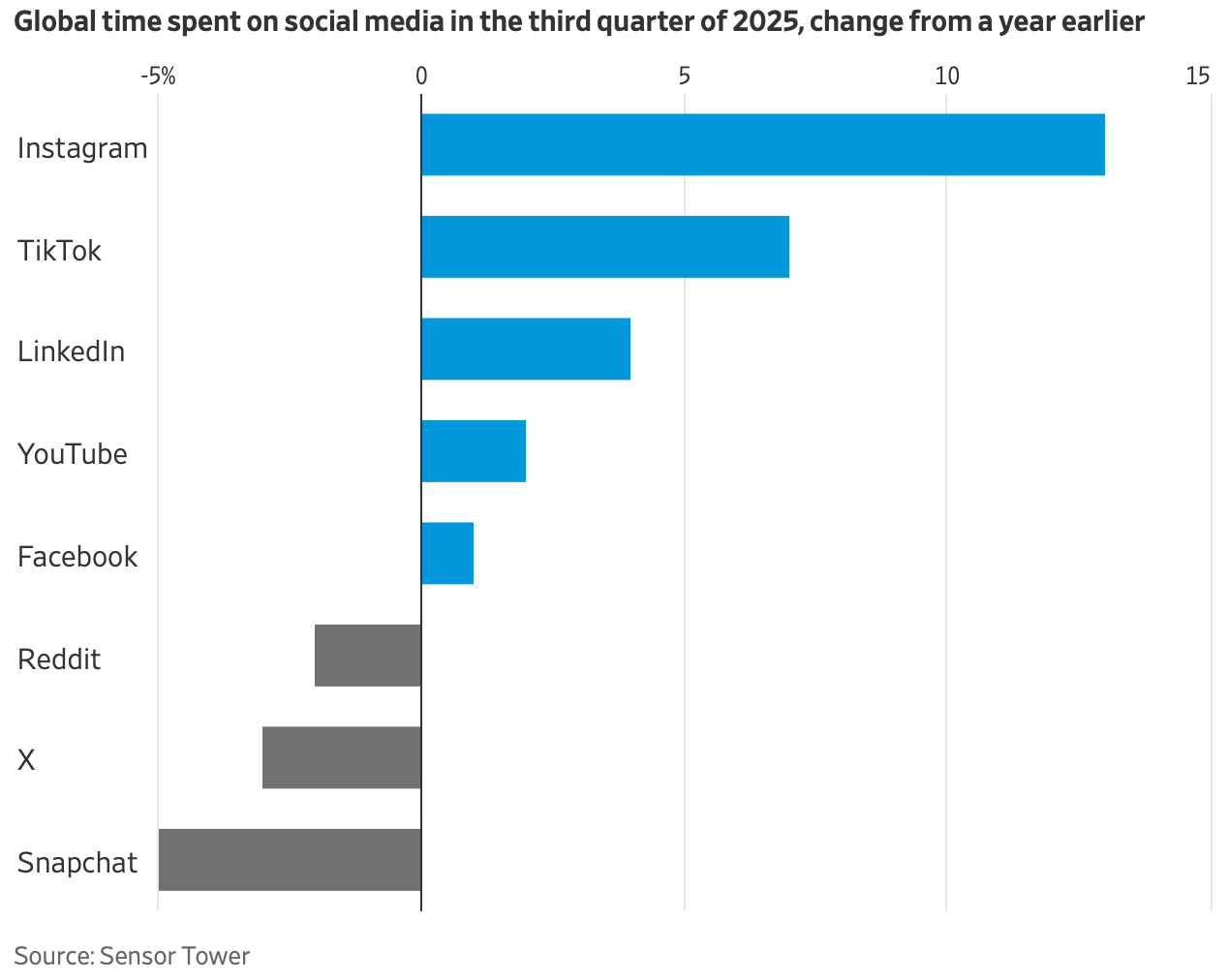
Even before Elon Musk gutted X’s content moderation, James Bailey was tired of the shouting. “It’s like a cursed artifact that gives you great power to keep up with what’s going on, but at the cost of subtly corrupting your soul,” said the 38-year-old Providence College economics professor.
He retreated. This year, he realized he was spending five to 10 minutes a day on a site he used to ignore.
The WSJ reporter contacted me after seeing my previous post about LinkedIn here, explaining how I think LinkedIn has improved as a way to share and read articles, and was always good as a way to keep up with former students. Just in the short time since the WSJ article came out, I finally used LinkedIn for one of its official purposes, hiring, where it worked wonders helping to fill a last-minute vacancy.
If you don’t trust me or the WSJ to identify the hot social network, lets see what the actual cool kids are up to
One of the major goals of the new Trump administration, particularly the DOGE unit, was to shrink the size of the federal government’s budget. Did they achieve this goal?
Last spring both my co-blogger Zachary and I pointed to a tool from the Brookings Institution to track federal spending, pulling in data directly from the US Treasury in a convenient format. Back in March I said “this will be a useful tool to follow going forward.” Now we have a full year of spending data for 2025.
When we look at total spending for Calendar Year 2025, it was about $318 billion higher than 2024, or about 4 percent higher. So, it seems that by that measure, the cuts that the Trump administration made were too small to overcome the other areas that grew.
But…
It may be more useful to remove some spending from the equation. In particular, entitlement programs and interest spending are very large spending categories that aren’t subject to the annual budgeting process. Of course, any program is ultimately under the control of Congress, so it’s a little bit of a cheat to remove Social Security and Medicare, but those programs are on autopilot with respect to the annual federal budget process. They are worth talking about, but they are probably worth talking about separately (especially because they have their own funding mechanisms). And interest on the debt isn’t something a President can control directly: it can only be reduced in future years by closing the budget gap today.
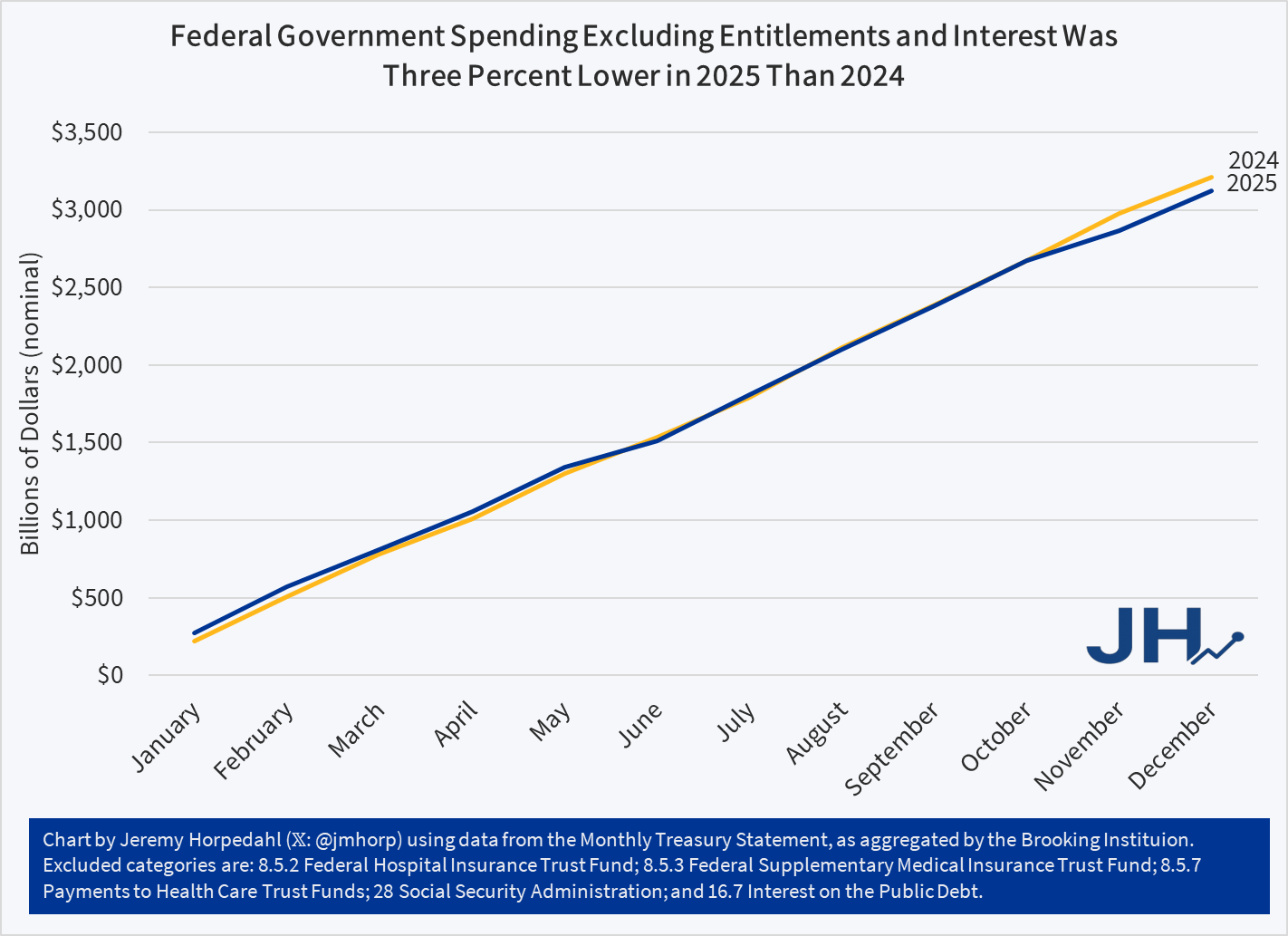
Removing those programs — which constitute about $4.8 trillion of the $7.9 trillion in 2025 spending (so a lot!) — gives you this chart (note: figures have been slightly updated with more complete data since I originally posted this chart):
Federal spending by this measure was about $85 Billion lower in 2025 than the prior year, or about 5 percent. And that’s in nominal terms: it is an even bigger cut if we adjust for inflation. Notice too that the pattern fits what we might expect: spending was slightly higher in the first half of the year (before any Trump changes could have had much of an effect), almost exactly equal for most of the second half, and then slightly below once we get to November and December (after the Deferred Resignation Program layoffs in October). If we ignore the first two months of the year (when it would have been really hard for Trump to have an effect), the drop in spending is about 8 percent.
What were the biggest cuts that led to the $85 billion drop? Keep in mind that some programs increased spending, such as military spending, so there are more than $85 billion in cuts. Using the Daily Treasury Statement categories, here are the big ones:
Federal Financing Bank (Treasury): $59 billion
Department of Education: $46.8 billion
USAID: $30.2 billion
EPA: $17 billion (though EPA seems to have gone on a spending binge at the end of 2024. Compared with 2023, the first Trump year was 50% higher!)
Federal Employee Insurance Payment (OPM): $16.3 billion
Those are all the programs I could find that declined by at least $1 billion, totaling a little over $200 billion. There were some other highly salient cuts that were under a billion dollars (such as the Corporation for Public Broadcasting, which was completely eliminated). Looking at that list I don’t think there is an easy way to sum up a “theme,” but I think the real theme is that if the Trump administration wants 2026 discretionary spending to be even lower than 2025, they will really need some major action from Congress. These cuts are mostly low-hanging fruit, and some are long-running goals of the GOP (such as Dept. of Education, foreign aid, and public television).
Of course, to really get federal spending under control, Congress will have to tackle entitlement reform and shrink the budget deficit to lower interest costs. Social Security, Medicare, and interest payments — the bulk of federal spending, over 60% of the total — increase by 9% in 2025. Again, it was probably unreasonable to expect Trump and Congress to have done anything major with them in a single year, but something must be done soon: the Social Security Old Age trust fund will be depleted in about 8 years, and the Medicare Part A trust fund will be depleted in about 10 years.
This will be a longer-than-usual post, since I will try to include all the steps I used to grow salad ingredients in a compact (AeroGarden-type) hydroponics system. I hope this encourages readers to try this for themselves. See my previous post for an introduction to the hardware, including small modifications I made to it. I used a less-expensive ($45), reliable 18-hole MUGFA model here, but all the AeroGardens and its many knockoffs should work similarly. Most plant roots need access to oxygen as well as to water; these hydroponic units allow the upper few inches of the root to sit in a (moist) “grow sponge” up out of the water to help with aerobic metabolism.
Step 1. Unbox the hydroponics unit, set up per instructions near a power outlet. Fill tank close to upper volume marking.
Step 2. Add nutrients to the water in the tank: usually there are two small plastic bottles, one with nutrient mix “A” and the other with nutrient mix “B”, initially as dry granules. Add water to the fill lines of each of these bottles with the granules, shake till dissolved. (You can’t mix the A and B solutions directly together without dilution, because some components would precipitate out as solids. So, you must add first one solution, then the other, to the large amount of water in the tank.)
There is more than one way to do this. I pulled the deck off the tank, used a large measuring cup to get water from my sink into the tank, a little below the full line. For say 5 liters of water, I add about 25 ml of nutrient Solution A, stir well, then add 25 ml of Solution B and stir. You could also keep the deck on, have the circulation pump running, and slowly pour the nutrient solutions in through the fill hole (frontmost center hole in the deck). You don’t have to be precise on amounts.
Step 3. Put the plastic baskets (sponge supports) in their holes in the deck, and put the conical porous planting sponges/plugs in the baskets. Let the sponges soak up water and swell. (This pre-wetting may not be necessary; it just worked for me).
Step 4. Plant the seeds: Each sponge has a narrow hole in its top. You need to get your seed down to the bottom of the hole. I pulled one moist sponge out at a time and propped it upright in a little holder on a table where I could work on it. I used the end of plastic bread tie to pick up seeds from a little plate and poke them down to the bottom of the hole. You have to make a judgment call how many seeds to plant in each hole. Lettuce seeds are large and pretty reliable, so I used two lettuce seeds for each lettuce sponge. Same for arugula (turns out that it was better to NOT pre-soak the arugula seeds, contrary to popular wisdom). If both seeds sprout, it’s OK to have two lettuce plants per hole, though you may not get much more production than from one plant per hole. For parsley, where I wanted 2-3 plants per hole, I used three seeds each. For the tiny thyme seeds, I used about 5 seeds, figuring I could thin if they all came up. For cilantro, I used two pre-soaked seeds. I really wanted chives, but they are hard to sprout in these hydroponics units. I used five chive seeds each in two holes, but they never really sprouted, so I ended up planting something else in their holes.
I chose all fairly low-growing plants, no basil or tomatoes. Larger plants such as micro-dwarf tomatoes can be grown in these hydroponics units; also basil, though need to aggressively keep cutting it back. It may be best to choose all low or all high plants for a given grow campaign. See this Reddit thread for more discussion of growing things in a MUGFA unit.
Once all the plugs are back in their holders, you stick a light-blocking sticker on top of each basket. Each sticker has a hole in the middle where the plants can grow up through, but they block most of the light from hitting the grow sponge, to prevent algae growth. Then pop a clear plastic seeding cover dome on top of each hole, and you are done. The cover domes keep the seeds extra moist for sprouting; remove the domes after sprouting. Make sure the circulation pump is running and the grow lights are on (typically cycling on 16 hours/off 8 hours). This seems like a lot of work describing it here, but it goes fast once you have the rhythm. Once this setup stage is done, you can just sit back and let everything unfold, no muss, no fuss. Here is the seeded, covered state of affairs:
Picture: Seeds placed in grow sponges on Jan 14. Note green light-blocking stickers, and clear cover domes to keep seeds moist for germination. The overhead sunlamp has a lot of blue and red LEDs (which the plants use for photosynthesis), which gives all these photos a purple cast.
Jan 28 (Two weeks after planting): seedlings. Note some unused holes are covered, to keep light out of the nutrient solution in the tank. The center hole in front is used for refilling the tank.
Feb 6. Showing roots of an arugula plant, 23 days after planting.
Step 5. Maintenance during 2-4 month grow cycle. Monitor water level via viewing port in front. Top up as needed. Add nutrients as you add water (approx. 5 ml of Solution A and 5 ml Solution B, per liter of added water). The water will not go down very fast during the first month, but once plants get established, water will likely be needed every 5-10 days.
Optional: Supposedly it helps to keep the acidity (pH) of the nutrient solution in the range of 5.5-6.5. I think most users don’t bother checking this, since the nutrient solutions are buffered to try to keep pH in balance. Being a retired chemical engineer, I got this General Hydroponics kit for measuring and adjusting pH. On several occasions, the pH in the tank was about 6.5. That was probably perfectly fine, but I went ahead and added about 1/8 teaspoon of the pH lowering solution, to bring it down to about 6.0. I also got a meter for measuring Electrical Conductivity/Total Dissolved Solids to monitor that parameter, but it was not necessary.
Feb 16: After a month, some greens are ready to snip the outer leaves. Lettuces (buttercrunch, red oak, romaine) on the right, herbs on the left.
~~~~~~~~~~~~~~~~~~~~~~~~~~~~~~~~~~~~~~~~~~~
Feb 17: Harvesting a small salad or sandwich filler every 2-3 days now.
March 6: Full sized, regular small harvests. All the lettuces worked great, buttercrunch is especially soft and sweet. Arugula (from the mustard plant family) gave a spicy edge. Italian parsley and thyme added flavor. The cilantro was slower growing, and only gave a few sprigs total.
Closeup March 16 (three months), just before closing out the grow cycle. Arugula foreground, lettuce top and right, thyme on left, Italian parsley upper left corner.
Step 6. Close out grow cycle. At some point, typically 2-4 months, it is time to bring a grow cycle to a close. I suppose with something like dwarf tomatoes, you could keep going longer, though you might need to pull the deck up and trim the roots periodically. In my case, after three months, the arugula and cilantro were starting to bolt, though the lettuce, thyme, and parsley were still going strong. As of mid-March, my focus turned to outside planting, so I harvested all the remaining crops on the MUGFA, turned off the power, and gently pulled the deck off the tank. The whole space under the deck was a tangled mass of roots. I used kitchen shears to cut roots loose, enough to pull all the grow sponges and baskets out. The sponges got discarded, and the baskets saved for next time. I peeled off and saved the round green light-blocking stickers for re-use. I cleared all the rootlets from the filter sponge on the pump inlet. Then I washed out the tank per instructions. It took maybe 45 minutes for all this clean-out, to leave the unit ready for a next round of growing.
Stay tuned for a future blog post on growing watercress, which went really well this past fall. Looking to the future: In Jan 2026 I plan to do a replant of this 18-hole (blocked down to 14-holes) MUGFA device, sowing less lettuce (since we buy that anyway) but more arugula/Italian parsley/thyme for nutritious flavorings. For replacement nutrients and grow sponges, I got a Haligo hydroponics kit like this (about $12).
Growing these salad/sandwich ingredients in the kitchen under a built-in sunlamp provided good cheer and a bit of healthy food during the dark winter months. The clean hydroponic setup removed concerns about insect pests or under/overwatering. It was a hobby; at this toy scale it did not “save money”, though from these learnings I could probably rig a larger homemade hydroponics setup which might reduce grocery costs. This exercise led to fun conversations with visitors and children, and was a reminder that nearly everything we eat comes from water, nutrients, and light, directly or indirectly.
The confluence of politics, recent interest in agent-based computational modeling, and Pluribus have convinced me now is the time to write about the “Cooperative Corridor”. At one point I thought about making this the theme of a book, but my research has become overwhelmingly about criminal justice, so it got permanently sidelined. But hey, a blog post floating in the primordial ether of the internet is better than a book that never actually gets written.
It’s cooperation all the way down
Economic policy discussions are riddled with “Theories of Everything”. Two of my favorites are the “Housing” and “Insurance” theories of everything. Housing concerns such huge fractions of household wealth, expenditures, and risk exposure that the political climate at any moment in time can be reduced to what policy or leader voters think is the most expedient route to paying their mortgage or lowering their rent. Similarly, the decision making of economic agents can, through a surprisingly modest number of logical contortions, always be reduced to efforts to acquire, produce, or exchange insurance against risk. These aren’t “monocausal” theories of history so much as attempts to distill a conversation to a one or two variable model. They’re rhetorical tools as much as anything.
My mental model of the world is that it is cooperation all the way down. Everything humans do within the social space i.e. external to themselves, is about coping with obstacles to cooperating with others. It is a fundamental truth that humans are, relative to most other species, useless on our own. There are whole genres of “survival” reality television predicated on this concept. If you drop a human sans tools or support in the wilderness, they will likely die within a matter of days. This makes for bad television, so they are typically equipped with a fundamental tool (e.g. firestarting flint, steel knife, cooking pot, composite bow, etc) after months of planning and training for this specific moment (along with a crew trained to intervene if/when the individual is on the precipice of actual death). Even then, it is considered quite the achievement to survive 30 days, by the end of which even the most accomplished are teetering on entering the great beyond. No, I’m afraid there is no way around the fact that humans are squishy, nutritious, and desperately in need of each other. Loneliness is death.
Counterintuitive as it may be, this absolute and unqualified dependence on others doesn’t make cooperation with others all that much easier. This is the lesson of the Prisoner’s Dilemma, that our cooperation and coordination isn’t pre-ordained by need or even optimality. Within a given singular moment it is often in each of our’s best interest to defect on the other, serving our own interests at their expense.
Which isn’t to say that we don’t overcome the Prisoner’s Dilemma every day, constantly, without even thinking about it. Our lived experience, hell, our very survival, is evidence that we have manifested myriad ways to cooperate with others despite our immediate incentives. What distinguishes the different spaces within which we carry out our lives is the manner in which we facilitate these daily acts of cooperation.
Kin
The first and fundamental way to solve the prisoner’s dilemma is to change the payoffs so that each player’s dominant strategy is no longer to defect but instead to cooperate. If you look at the payoff matrix below, the classic problem is that no matter what one player does (Cooperate or Defect), the optimal self-interested response is always to Defect. Before we get into strategies to elicit cooperation, we should start with the most obvious mechanism to evade the dilemma: to care about the outcome experienced by the other. Yes, strong pro-social preferences can eliminate the Prisoner’s Dilemma, but that is a big assumption amongst strangers. Among kin, however, it’s much easier. Family has always been the first and foremost solution. Parents don’t have a prisoner’s dilemma with their children. It doesn’t take a large leap of imagination to see how kin relationships would help familial groups coordinate hunting and foraging or il Cosa Nostra ensuring no one squeals to the cops.
Kinship remains the first solution, but it doesn’t scale. Blood relations dilute fast. I’m confident my brother won’t defect on me. My third-cousin twice removed? Not so much. The reality is that family can only take you so far. If you want to achieve cooperation at scale, if you want to achieve something like the wealth and grandeur of the modern world, you’re going to need strategies and institutions.
Strategies
There are many, if not countless, ways to support cooperation among non-kin. Rather than give an entire course in game theory, I’ll instead just enumerate a few core strategies.
Tit-for-Tat = always copy your opponent’s previous strategy
Grim Trigger = always cooperate until your opponent defects, then never cooperate again
Walk Away = always cooperate, but migrate away from prior defectors to minimize future interaction
The Prisoner’s Dilemma is far, far easier to solve amongst players who can reasonably expect to interact again in the future. The logic underlying all of these strategies is commonly known as The Folk Theorem, which is the broad observation that all cooperation games are far easier to solve, with a multitude of cooperation solutions, if there is i) repeated interaction and ii) an indeterminate end point of future cooperation.
Strategies can facilitate cooperation with strangers, which means we can achieve far greater scale. But not as much as we observe in the modern world, with millions of people contributing to the survival of strangers over vast landscapes and across oceans. For that we’re going to need institutions.
Institutions
Leviathan is simply Thomas Hobbes’ framework for how government solves the Prisoner’s Dilemma. We concentrate power and authority within a singular institution that we happily allow to coerce us into cooperation on the understanding that our fellow citizens will be coerced into cooperating as well. That coercion can force cooperation at scales not previously achievable. It can build roads and raise armies. This scale of cooperation is the wellspring for both some of the greatest human achievements and our absolutely darkest and most heinous sins. Sometimes both at same time.
Governments can achieve tremendous scale, but there remain limits. My mental framing has always been that individual strategies scale linearly (4 people is twice as good as 2 people) and governments scale geometrically (i.e. an infantry’s power is always thrice its number). Geometric scaling is better, but governments always eventually run into the limits of their reach. Coercion becomes clumsy and sclerotic at scale. There’s a reason there has never been a global government, why empires collapse.
Markets can achieve scale unthinkable by governments because their reach is untethered to geography. Markets are networks. They scale exponentially. They solve the prisoner’s dilemma through repeated interaction and reputation. The information contained in prices supports search and discovery processes that both support forming new relationships while also creating sufficient uncertainty about future interactions. Cooperation is a dominant strategy. This scale of cooperation, of course, is not without critical limitations. Absent coercion there is no hope for uniformity or unanimity. No completeness. Public goods requiring uniform commitment or sacrifice are never possible within markets. The welfare of individuals outside of individual acts of cooperation (i.e. externalities) is not weighed in the balance.
There are other institutions that solve the prisoner’s dilemma. Religions, military units, sororities…the list goes forever. This article is already going to be too long, so I’ll start getting to the point. Much of the fundamental disagreement within politics and society at large is what comprises our preferred balance of institutions for supporting and maintaining cooperation, who we want to cooperate with, and the myths we want to tell ourselves about who we are or aren’t dependent on.
The Cooperative Corridor
Wealth depends on cooperation at scale. Wealth brings health and prosperity, but it also brings power. The “cooperation game” might be the common or important game, but it isn’t the only game being played. Wealth can be brought to bear by one individual on another to extract their resources. This is colloquially referred to as “being a jerk”. Perhaps more importantly, groups can bring their wealth to bear to extract the resources from another group. This is colloquially referred to as “warfare”.
Governments are an excellent mechanism for warfare. All due respect to the mercenary armies of history (Landsknechts, Condottieri, etc.), but markets are not well-suited to coordinate attack and defense. Which isn’t to say markets aren’t necessary inputs to warfare. This is, in fact, the rub: governments are good at coordinating resources in warfare, but markets are far better at generating those resources. A pure government society may defeat a pure market society in a war game, but a government-controlled society whose resources are produced via market-coordinated cooperation dominates any society dominated by a singular institution.
This all adds up to what I refer to as the Cooperative Corridor. A society of individuals needs to cooperate to grow and thrive. A culture of cooperation can be exploited, however, by both individuals who take advantage of cooperative members and aggressive (extractive) rival groups. Institutions and individual strategies have to converge on a solution that threads this needle. One answer might appear to be to simply cooperate with fellow in-group members while not cooperating with out-group individuals. This is no doubt the origin of so many bigotries—the belief that you can solve the paradox of cooperation by explicitly defining out-group individuals. Throw in the explicit purging of prior members who fail to cooperate, and you’ve got what might seem a viable cultural solution. The thing about bigotry, besides being morally repugnant, is that it doesn’t scale. The in-group will, by definition, always be smaller than the out-group. Bigotry is a trap. Your group will never benefit from the economies of scale as much as other groups that manage to foster cooperation between as many individuals as possible, including those outside the group.
[SPOILERS AHEAD if you haven’t watched through Episode 6]
You’ve been warned, so here’s the spoilers. An RNA code was received through space, spread across the human species, and now all but a handful of humans are part of a collective hive mind whose consciousnesses have been fully merged. That’s the basic part. The bit that is relevant to our discussion is the revelation that members of the hive mind 1) Can’t harm any other living creature. Literally. They cannot harvest crops, let alone eat meat. 2) They cannot be aggressive towards other creatures, cannot lie to them, cannot it seems even rival them for resources. 3) The human race is going to experience mass starvation as a result of this. Billions will die.
In other words, a cooperation strategy has emerged that spreads biologically at a scale it cannot support. It is also highly vulnerable to predation. If a rival species were to emerge in parallel, it would undermine, exploit, enslave, and eventually destroy it. The whole story borders on a parable of how a species like Homo sapiens could destroy and replace a rival like Homo neanderthalensis.
Cultural strategies are selected within corridors of success. Too independent, you die alone. Too cooperative, you die exploited. Too bigoted, you are overwhelmed by the wealth and power of more cosmopolitan rivals. Too cosmopolitan, you starve to death for failure to produce and consume resources. Don’t make the mistake of thinking the “corridor of success” is narrow or even remotely symmetric, though. On the “infinitely bigoted” to “infinitely cosmopolitan” parameter space, a society is likely to dominate it’s more bigoted rivals with almost any value less than “infinitely cosmopolitan.” So long as members of society are willing to harvest and consume legumes, you’re probably going to be fine (no, this isn’t a screed against vegetarianism, which is highly scalable. Veganism, conversely does have a much higher hurdle to get over…). So long as a group is willing to defend itself from violent expropriation by outsiders, they’re probably going to be fine. Only a sociopathic fool would see empathy as an inherent societal weakness. Empathy, in the long run, is how you win.
How this relates to political arguments
I almost wrote “current political arguments”, but I tend to think disagreements about institutions of cooperation are pretty much all of politics and comparative governance. We’re arguing about instititutions of in-group, out-group, and collective cooperation when we argue about the merits of property rights, regulation, immigration, trade, annexing territory, war. When we confront racism, nationalism, and bigotry, we we are fighting against forces that want to shrink the sphere of cooperation and leverage the resources of the collective to expropriate resources of those confined or exiled to the out-group. These are very old arguments.
The good news is that inclusiveness and cosmopolitanism are economically dominant. They will always produce more resources. But being economically and morally superior doesn’t mean they are necessarily going to prevail. The world is a complex and chaotic system. The pull towards entropy is unrelenting. And, in the case of cultural institutions and human cooperation, the purely entropic state is a Hobbesian jungle of independent and isolated familial tribes living short, brutish lives. Avoiding such outcomes requires active resistance.














 Economist Writing Every Day
