Rather than accepting that work, grief, and love may transform us, Lumon divides experience from identity. An adult who is primarily asking, “Who do I want to become?” likely would reject the Lumon…
Read more at the link above. Remember that the first words spoken in Season 1 were “Who are you?” Maybe Russ Roberts should do a whole podcast on this show.
During a rare slower week in the summer (thanks to my sister) I was able to binge Season 2. The genre could be described as Science Fiction. S2 does answer some of the questions raised in S1 but ends with a new cliffhanger to bring you back for Season 3. If you want to enjoy the show, the trick for me was not to take it too seriously. Ben Stiller is a producer and you can see traces of what feels like Zoolander humor to me.
I think the dialog is great. The sibling relationship and marital disputes and office inside jokes feel realistic.
As I said about Season 1, this show could be, among other things, a meditation on AI alignment. When you think enough about AI alignment, I guess you start seeing it in your TV shows. I wrote about that previously in: Artificial Intelligence in the Basement of Lumon Industries
Other previous posts on Severance, based on Season 1:
I am not an attentive soccer (football) follower, but it was hard to ignore the 2026 FIFA World Cup being played in my own country (or at least my own continent). I tuned in for more and more games as the play progressed. Spain progressed further and further along, and finally won the gold.
This was not a one-off fluke. Spain won the World Cup in 2010, and has dominated European soccer for the past 3-4 years. Spain also won the most recent women’s World Cup in 2023. My inquiring mind naturally wanted to know what was behind this success. Spain’s population (49 million) is below that of England, France, or of Germany, so it is not simply having a huge demographic to pull from.
When this question was posted on Reddit, a Spanish fan gave this answer:
This is an interesting question with a lot of possible answers.
The most evident one is the Olympic Games of Barcelona 1992. This created a huge shockwave in Spain, which was still a little bit “isolated” from the rest of the world. The preparation of these games and their success made Spain invest a lot of money on sports infrastructure, trainers and programs, which directly impacted on the accomplishments of the big Spanish sportsmen of that generation: Rafa Nadal, Pau Gasol, Fernando Alonso, the whole Spanish football team 2008-2012 and many others. The success of the modern Spanish football team is supported by them.
But it also has a more deep and old reason. Before the 21st century the Spanish football team, even if they didnt win titles, managed to get good positions in international tournaments. Why? Spaniards have been, traditionally, smaller and weaker than the other Europeans (even if that has obviously changed). We couldn’t engage on physical play with the Dutch, Germans, French, English etc. that ran faster and were stronger than us. We don’t even have that many physical players TODAY. So, we had to rely on mentality and skill.
So the team started to become recognized by their fierce attitude, their relentless energy and attacking spirit, gaining the nickname of “La furia Roja” (red fury). And also had to rely on skill, passes, building the game from behind and being more tactical and strategical on the field. This set the foundations for the modern “tiki-taka“, the Barça and Spanish playstyle that basically created modern football. These two things, plus Barcelona ’92 were the perfect mix to create a football tradition for many years.
Poking around the AI and Wikipedia and other sources, I found that this reply did a good job summarizing the sources of Spain’s success. I will just elaborate on a few aspects here.
Certainly, the Spanish technique of rapid, relentless passing (so-called tiki-taka) to maintain possession and to draw the opponent out of position to create scoring opportunities was in full view in this World Cup. It is more efficient and effective to rapidly move the ball than to run your players around. The specifics of this style actually puzzled me when I watched it. In my brief, undistinguished non-career in intramural soccer, I was taught to receive a pass by controlling it with typically two taps, then maybe kick it onward with a third “touch”. But the Spanish players would take an incoming pass and just whack it onward with only one “touch.” That takes exquisite control; get that wrong by just a hair on one of those dozens and dozens of taps back and forth, and there goes your possession.
The internet agrees that Spanish teams historically could not compete head-to-head physically with a team full of hulking northern Europeans, and so they deliberately came up with this alternative playing style that relied on skillful control, not brute strength or size. Another strategic decision by Spanish coaches (trusting in their team’s ball control skills to maintain possession) is to play the defenders up-field, closer to the opponent’s goal, where they can play a role in building attacking pressure.
This playing style depends heavily on teamwork, and is the style promoted through all levels of the Spanish junior/farm teams as well. The whole team operates like a hive-mind organism, with players thinking several moves ahead and trusting the others to do the right thing at the right time. Unlike some other teams, this system is not dependent on one or two superstars to carry the load. I found the Spanish play to be an inspiring facet this year of “the beautiful game.”
I read Straw Dogs, a critique of modern society by English political philosopher John Gray, shortly after it was published in 2002. (No relation to the movie with the same name). Wikipedia summarizes the author’s view as, “Gray blames humanism, and its central view of humanity, for much of the destruction of the natural world, and sees technology as just a tool by which humans will continue destroying the planet and each other.” I cannot recommend the book as a whole – the reader is left in a state of despairing passivity. My AI justly notes, “Critiques of John Gray’s Straw Dogs: Thoughts on Humans and Other Animals generally center on its extreme pessimism, logical inconsistencies, and rhetorical excesses.”
All that said, the book did contain many interesting observations. One line of thought that struck me at the time was that, with increasing efficiencies in the production of basic goods and services, more and more human effort will go into simply entertaining or “distracting” each other:
The days when the economy was dominated by agriculture are long gone. Those of industry are nearly over. Economic life is no longer geared chiefly to production. To what then is it geared? To distraction. Contemporary capitalism is prodigiously productive, but the imperative that drives is not productivity. It is to keep boredom at bay. With wants so quickly sated, the economy soon comes to depend on the manufacture of ever more exotic needs.
I was reminded of that line of thought when, at a recent gathering of PhD chemical engineers, I heard that one of our number has become somewhat well-known for a late-career shift. She goes by the name Andrea Hulamyhoop these days. (I happen to know her real last name and approximate age, but she wishes to keep those private).
Her father was a chemical engineering professor, and she earned a PhD in the discipline at Princeton University. She was just going along living a fairly normal sort of life, with a regular job, when without warning, it happened:
Then one day, she saw a girl hula hooping. “She looked really free and happy, and I thought, interesting, maybe I’ll try it.” A few minutes at a time quickly became an obsession. Turns out, there are whole online communities of hula hoopers who share tips and support. Conferences. And many shows and events looking for a pro to dazzle and inspire audiences.
“The hula hoop has changed everything in my life,” she says. “I didn’t know I could become a fit, sporty person. I didn’t know I was one. I love performing, and I love people, and I love parties.
“I always thought my life was a bit OK. My kids were grown up. I was enjoying my job,” she says. “But you know, we kind of think, is this all there is? And then to realize there’s this whole world — it’s been incredible. I’m happier than I’ve ever been in my life.”
Andrea Hulamyhoop doesn’t just swirl a hoop around her waist. She can twirl multiple hoops around multiple body parts, with style. She is perhaps best known for her appearance on America’s Got Talent in 2025, where she smashed previous records by bending over and twirling a hoop around her rear end for just over an hour and fifteen minutes. The crowd went wild.
The physics of this feat seem almost impossible, but seeing is believing. Andrea gives a gracious tutorial here.
When I asked who is the most famous holder of a Princeton chemical engineering PhD, both ChatGPT and Claude insisted that former GE president Jack Welch is more well-known than Andrea the butt-hooper, but I doubt that is true below a certain audience age bracket. She has some 17,000 Instagram followers. I’d be willing to bet that in a crowd of under-40’s today, if you asked “Have you heard about the guy who was president of GE in the 1980’s and 90’s?” or “Have you heard about the gal who can twirl a hula hoop on her butt?”, Andrea Hulamyhoop would win.
All this brought back to my mind the notion that as a society we are able to afford to devote a great deal of time to sheer entertainment, rather than growing potatoes. A comment by a certain @petesounds9321 on Andrea’s epic 2025 AGT YouTube showed he had evidently not read Straw Dogs:
“I’d say we need more scientists than hula hoopers but hey…maybe I’m way off.”
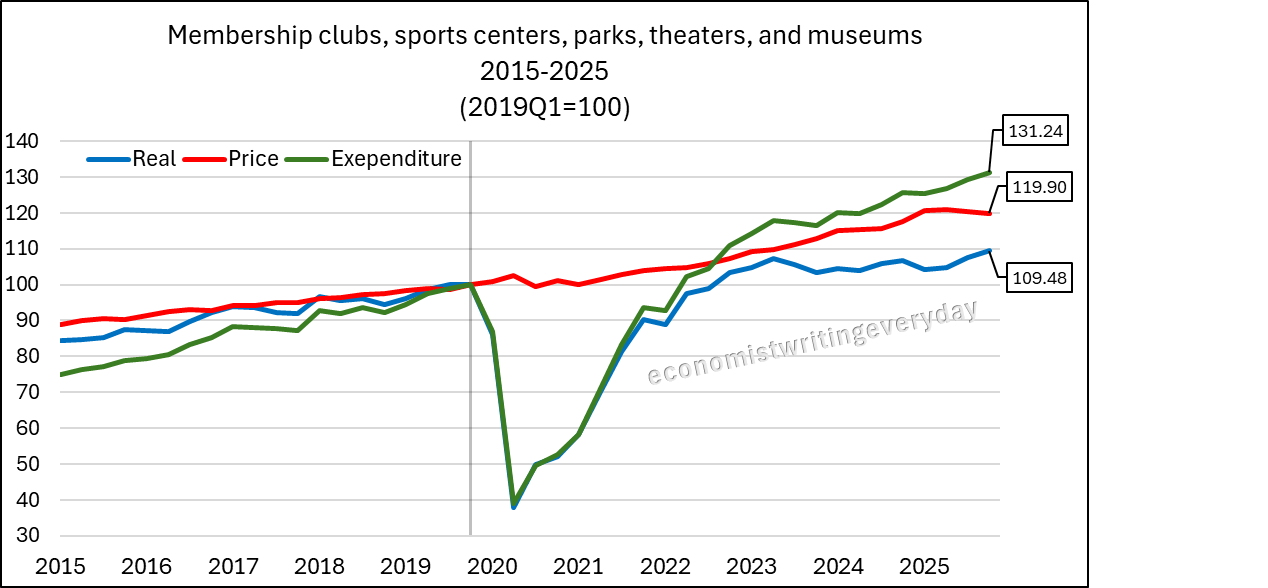
Economists talk about the ‘Covid Shock’ in 2020 because it was a mostly unpredictable event that had big, measurable effects. People spent a lot less time being in close quarters. Especially hit hard were movie theaters, and other events spaces.
In the several years prior to Covid, “Recreational Service” industry sales had been chugging along, growing at healthy annual rate of 3.4% (inflation adjusted). This category of services includes clubs, sports centers, theaters, and museums. In the blink of an eye, the covid shock drastically reduced spending in that category by more than 60%. See the graph below.
Unfortunately, we don’t have disaggregated series for the components of “Recreational Services”. But we do know that movie theaters were already well past their hay-day. Theaters had been closing and consolidating for more than a decade and ticket sales were down. Many give credit to the popularity of streaming video services and other digital media alternatives. Covid added insult to injury.
Now, going to a movie theater is exceptional. As a teenager in the early naughts, I’d go to the theater easily half a dozen times per year. Now, I don’t think that I’ve gone six times in the last five years. Real growth in the entire recreational service category has grown annually by an anemic 1.8% since 2019. It’s not dead, but that’s also the total industry. I’ve heard the news stories of sports events making a big comeback. I’ve not heard anything like that for movie theaters.
I went to the movies recently and it is not what you remember.
I learned about the children’s cartoon Gravity Falls this year from my kids.
Bluey is wonderful for kids and adults, but it does feel like a baby show since the younger dog Bingo is 4. If you are getting out of the baby stage with kids, Gravity Falls is great next step with 12-year-old twins. The jokes are funny, especially for American parents today who would have grown up with the cultural references.
Gravity Falls has emotional depth. These days the young folks are in “situationships” trying not to catch feelings (I hear). In Gravity Falls, everyone catches feelings so hard. It’s tragically beautiful like Anna Karenina. You can watch it on Disney+ and YouTube.
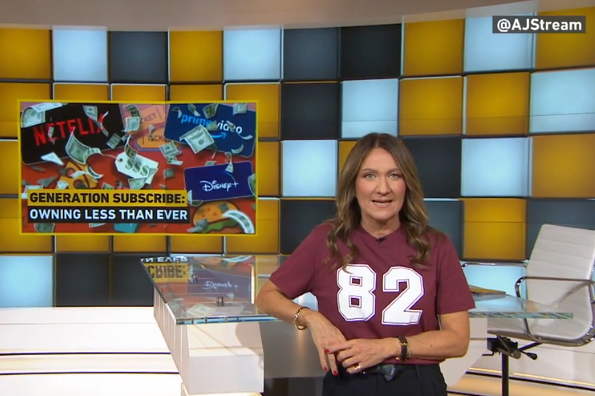
Our episode began with some clips from TikTok of young people expressing anger over feeling trapped in “the subscription economy.” Watch our show at the link above to see.
The subscription economy is a business model shift where consumers pay recurring fees for ongoing access to products/services (like Netflix, SaaS) instead of one-time purchases, focusing on “access over ownership” for predictable revenue. Gen Z feels upset that they are getting charged for subscriptions, some of which they simply forgot to cancel. They have nostalgia for the days of toting a zipper case of CDs onto the yellow school bus in 2004.
My commentary starts around minute 5:30 in the show. The first thing I point out is that, by and large, we have more entertainment available to us at a lower price than people did in that bygone era of mostly cable TV and physical discs. (This is a bit like the point I made on The Stream in March 2025 about how fast fashion represents more stuff for consumers at lower prices, which is good.)
In the episode, we discussed how people can still buy CDs today. Sanya Dosani made the point that, “there’s a place for buying and a place for renting.” Everyone should be aware of how cheap DVDs, books, and CDs are at rummage sales in the United States in 2025. You can get a music album for 50 cents. Some youths have (re)discovered that DVD players are cheaper than a year of streaming subscription costs.
Around minute 17, I got to bring up my research about intellectual property, digital goods, and morality.
We find that people do not feel bad about taking the digital goods, or “pirating.” We even find that, in a controlled experiment with no previous context for what we might call intellectual property protection, the creators of these digital goods do not call such taking stealing either. It seems to be understood that folks will take and share if they can.
The proposed reason for artificially restricting the taking and resale of intellectual property is that creators need a way to profit from providing a public good. (Intellectual property rights in the U.S. Constitution are covered by Article I, Section 8.)
I said in the interview, “If you were able to just give a song to all of your friends, you probably would, and then that artist might not be able to make songs the next year.”
Thus, I suggested, “The subscription economy is a reaction to the fact that most people don’t view it as wrong to take things they can take and not necessarily pay for them. Companies had to find a new way to be able to make money and stay in business.”
I’ll clarify that I have not done quantitative research to prove that subscription models emerged causally because of pirating. I’m speculating. Another side to this is that people simply want to stream and companies are providing exactly what people want (despite the complaints circulating on TikTok). People reminisce about the “golden days” of early Netflix, but most people forget that the company was losing money at that time. Media production and distribution companies have to make money to stay in business.
At the end, the host asked me, “… what does it mean for who we are as humans, more of an existential question, where we are going with this age?”
That’s a deeper question than you might expect for a conversation about CD-ROMs. However, people do care about having some tangible form of art about them. Think of the ancients buried alongside beads and dolls. Netflix will never be the only thing that people want. As for Gen Z being upset about convenient Spotify, “what does it mean for who we are” has got to be part of it.
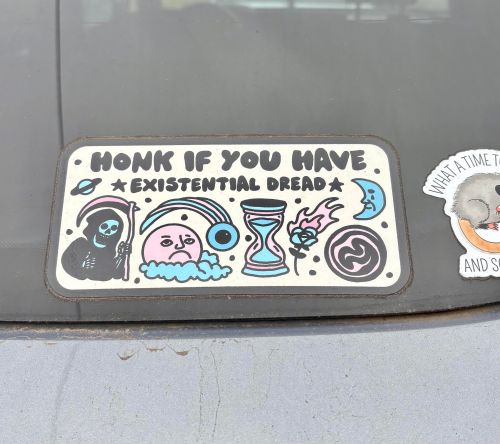
As an aside, furthermore, I’ll say here on the blog that Gen Z is by some measures the most entertained generation in history. For spiritual, not financial, reasons, I encourage them to cancel their subscriptions, take out their AirPods, and feel the silence and dread for a week.
I don’t spend a lot of time watching TV, but sometimes I do for fun. If you loved The Office and Parks and Recreation, then here are two new shows that are currently free on Netflix (September 2025).
I normally ignore lawyer shows (and cop/crime shows). But my first recommendation is an Australian lawyer show called Fisk.
Summary: A corporate lawyer must take a job at a suburban law firm after her life implodes in Sydney, and struggles to find her feet navigating grief, money, family, and entitlement.
I have only seen the first three episodes. I have no idea where the story is going, and I love that. Right now Helen has started a new job and is trying to get back on her feet after a divorce. I think it’s safe to say that the character is neurodivergent. The tone reminds me of Ricky Gervais’s The Office (maybe because Australian humor is close to British humor).
Like most Americans, I first discovered Leanne Morgan on Instagram. The real comedian has an interesting story (what Henry Oliver might call a Late Bloomer). So, I was excited when her TV show finally dropped. The first episode might not have hooked me if I didn’t already like her. I thought it picked up as the season went on, and I enjoyed the whole thing. It’s a bit like 30 Rock complete with an appearance by Jack McBrayer.
Satire news shows are, in my opinion, one of the higher forms of art that my country has produced (and an example of our exports). “Meet Tariff Tilly, the perfect replacement for the 37 dolls your kid does not need” from The Daily Show
“Tariff Tilly” builds. There is even a comment on interest rates (addressed in my previous post).
The Chair on Netflix is entertaining and I’d recommend it to EWED readers.
Plot, via Wikipedia: Professor Ji-Yoon Kim is the newly appointed chair of the English department at Pembroke University. The first woman chosen for the position, she attempts to ensure the tenure of a young black colleague, negotiate her relationship with her crush, friend, and well-known colleague Bill Dobson, and parent her strong-willed adopted daughter.
Something I like about the writing is that there is genuine suspense. Going into the last episode, I didn’t know what would happen with the romance or the threat of job dismissals.
The show is funny, occasionally. If you are looking for something easy to watch in 30-minute episodes at the end of the day that won’t leave you too upset, this will work.
Some of the issues they raise deserve serious treatment, but the serious treatment will not be found in The Chair. It’s for Netflix, with binge watching potential. Without offering any spoilers, I’d say they supply the kind of ending that viewers want. You need not overthink it.
I did go see the Barbie movie (last month I had to put up someone else’s blog about it). Kate McKinnon and the Birkenstock choice is my favorite part. You can catch part of that scene in the middle of the trailer.
Here is America Ferrera’s monologue:
It is literally impossible to be a woman. You are so beautiful, and so smart, and it kills me that you don’t think you’re good enough. Like, we have to always be extraordinary, but somehow we’re always doing it wrong.
You have to be thin, but not too thin. And you can never say you want to be thin. You have to say you want to be healthy, but also you have to be thin. You have to have money, but you can’t ask for money because that’s crass. You have to be a boss, but you can’t be mean. You have to lead, but you can’t squash other people’s ideas. You’re supposed to love being a mother, but don’t talk about your kids all the damn time. You have to be a career woman but also always be looking out for other people.
You have to answer for men’s bad behavior, which is insane, but if you point that out, you’re accused of complaining. You’re supposed to stay pretty for men, but not so pretty that you tempt them too much or that you threaten other women because you’re supposed to be a part of the sisterhood…
Movies and Money
The Barbie movie is doing well commercially. So many other special projects, such as the all-female remake of Ghostbusters, flopped at the box office. Barbie and Taylor Swift concert tickets were serving as the primary examples of spending in “Hot Profit Summer“. Congratulations to Greta Gerwig on a huge success.
Barbie has unresolved existential angst, universe portals, mother-daughter conflicts and fight scenes. To that extent, Barbie reminds me of Everything Everywhere All At Once. The big commercial successes within the same decade often share key components. Earlier I wrote about how Frozen and The Queen’s Gambitare similar.
One could write a very serious post about the Barbie movie and the portrayal of female reality. Instead, let’s acknowledge that the movie is fun, just like American life generally. No one needs Kate McKinnon (to survive). We get to watch her on TV because the world is rich now. Not only has child mortality fallen because of economic development, but life has gotten more fun.
I noted this when I reviewed the movie Austenland. The film shows that when an American woman goes to a Regency-era simulation she gets bored.
… afternoons spent on needlepoint projects were not so much painful as boring to the heroine. Boring. Matt Ridley tells us in The Rational Optimist that life in pre-modern England was more miserable than we imagine in terms of health outcomes. An underrated feature of modernity is how much more interesting the world is now that we can read widely and travel and tweet. If you were rich enough to escape endless manual labor in 1810, your options for leisure time were still very limited.
John Maynard Keynes predicted that future people would only work for 15 hours per week. Why, then, did the Barbie dolls (who don’t need money) talk so much about careers? President Barbie and Doctor Barbie seem happy.
Do we keep working past 15 hours a week because it is fun? (Tyler says it is in Big Business.)
Would it be accurate to say that professionals spend less than 15 hours a week on tasks that they truly hate? Maybe striding down a clean hallway to a meeting with coffee in hand is what we like to do? Or is that a strictly American phenomenon?
Interestingly, the human mom character (America Ferrera) does not love her job. She is not President or a Doctor. Would she prefer to be unemployed?
I want to know if the career barbies sell, but I could not find the data. The Guinness Book of World Records indicates that the best-selling Barbie is “Totally Hair Barbie”.