The Arithmetic of Family Punctuality

My children are getting more capable. They get more responsibility that comes with the independence that capability implies. Specifically, when getting ready in the morning they like to leave so that they arrive at school just barely on time. Except, when something comes up, they are rushed, flustered, short-tempered, and tardy. They lament that “if only the unforeseeable event X hadn’t happened, I would have been on time”.

It doesn’t matter what X is. Maybe they forgot to pack a lunch, or set out their clothes, or they have a flat tire on their bikes, or… whatever. The specific time-consuming event is unforeseeable. But, that *any* time-consuming event will occur is very foreseeable. What’s a Bayesian to do?

Before we even start the analysis, let’s acknowledge that being perfectly on time for some event usually involves stress and a lack of preparedness. Yes, you were ‘on time’, but given the probability of heavier traffic, difficulty finding a parking spot, or whatever, we know that tardiness is just one unforeseen event away.

Individual Punctuality

How long does it take to get somewhere? It takes both travel time and time preparing to depart. Let’s just generally call this ‘preparation’ time. Let’s assume that you complete everything that you would complete. That means that you aren’t forgoing a shower or breakfast or whatever lower priority you might choose to forgo to arrive at some obligation punctually.

Random events can occur either as you travel to work or as you prepare to depart, but let’s place the random travel events to the side and focus on what one can do to get out of the house ‘on time’. In my personal case, my children have a 30min interval during which they can arrive at school. They almost never arrive in the first 15min of that interval. That’s more of a policy choice than an accident. They don’t want to sit in a cold gymnasium for 20min if it’s avoidable. So, their planned arrival time has an effective 15min window.

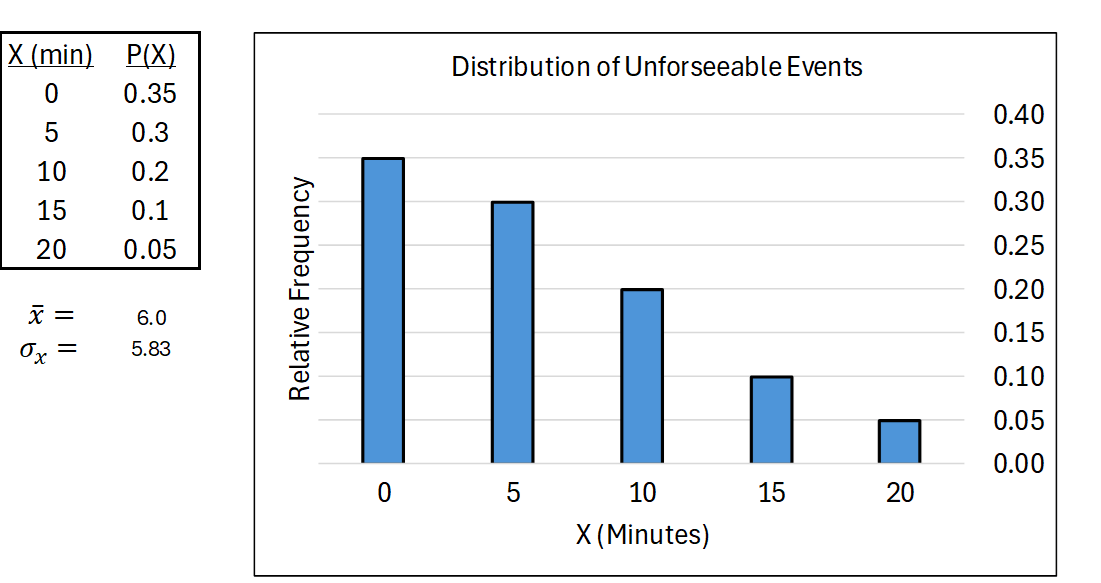
Here is the problem. A time-consuming random event, X, is a right-skewed random variable. Discretely, the modal day includes X=0min. Though the most common delays are greater than 0min. See the distribution below. A 0min random event occurs 35% of the time. But, a time-consuming event happens 65% of the time. So, if you try to arrive exactly on time to your obligation, then you will be punctual 35% of the time and you will be tardy 65% of the time. That’s not a good look and not a good reputation to build – and that’s apart from building a habit of imprudence and the material consequence of not being ready for the task at hand.

Someone with just enough insight to be dangerous might say ‘Ah! Instead, leave with enough time to accommodate the expected unforeseen event’. Mathematically, that’s the weighted average. In this case, that’s six minutes. So, if you plan to arrive 6min early, then you will be punctual – on average. But even that’s not really what we’re after. We’d like to be on time for a preponderance of the days. Building in a 6-minute buffer does two things. 1) Every time that there is a 0min or 5min unforeseen event, you get to your destination 6min or 1min early. That’s good for your nerves, performance, and reputation. But, that also means that you’re late whenever there is a 10min, 15min, or 20min unforeseen event – and those occur 35% of the time!

Continue reading

How Much To Trust Research Papers? My Rules Of Thumb

  1. Trust literatures over single papers
  2. Common sense and Bayes’ Rule agree: extraordinary claims require extraordinary evidence
  3. Trust more when papers publicly share their data and code
  4. Trust higher-ranked journals more up to the level of top subfields (e.g. Journal of Health Economics, Journal of Labor Economics), but top general-interest journals can be prone to relaxing standards for sensationalist or ideologically favored claims (e.g. The Lancet, PNAS, Science/Nature when covering social science)
  5. More recent is better for empirical papers, data and methods have tended to improve with time
  6. Overall effects are more trustworthy than interaction or subgroup effects, the latter two are easier to p-hack and necessarily have lower statistical power
  7. Trust large experiments most, then quasi-experiments, then small experiments, then traditional regression (add some controls and hope for the best)
  8. The real effect size is half what the paper claims

That last is inspired by a special issue of Nature out today on the replicability of social science research. An exception to rule #4, this is an excellent project I will write more about soon.

Unweighted Bayesians get Eaten By Wolves

A village charges a boy with watching the flock and raising the alarm if wolves show up. The boy decides to have a little fun and shout out false alarms, much to the chagrin of the villagers. Then an actual wolf shows up, the boy shouts his warning, but the villagers are proper Bayesians who, having learned from their mistakes, ignore the boy. The wolves have a field day, eating the flock, the boy, and his entire village.

I may have augmented Aesop’s classic fable with that last bit.

The boy is certainly a crushing failure at his job, but here’s the thing: the village is equally foolish, if not more so. The boy revealed his type, he’s bad at his job, but the village failed to react accordingly. They updated their beliefs but not their institutions. “We were good Bayesians” will look great on their tombstones.

They had three options.

A) Update their belief about the boy and ignore him.

This is what they did and look where that got them. Nine out of ten wolves agree that Good Bayesians are nutritious and delicious.

B) Update their beliefs about the boy, but continue to check on the flock when the boy raises the alarm.

They should have weighted their responses. Much like Pascal taking religion seriously because eternal torment was such a big punishment, you have to weight you expected probability of truth in the alarm against the scale of the downside if it is true. You can’t risk being wrong when it comes to existential threats.

C) Update their beliefs about the boy and immediately replace him with someone more reliable.

It’s all fine and good to be right about the boy being a lying jerk but that doesn’t fix your problem. You need to replace him with someone who can reliably do the job.

So this is a post about fascism. Some think that fascism is already here, others dismiss this as alarmism, others splititng the difference claiming that we are in some state of semi- or quasi-fascism. Within the claims that it is all alarmism, what I hear are the echoes of villagers annoyed by 50 years of claims that conservative politics were riddled with fascism, that Republicans were fascists, that everything they didn’t like was neoliberalism, fascism, or neoliberal fascism. Get called a wolf enough times and you might stop believing that wolves even exist.

Even if I am sympathetic, that doesn’t get you off the hook. It hasn’t been fascism for 50 years will look pretty on your tombstone.

Let’s return to our options

  • A) Don’t believe the people who have been shouting about fascism for years, but take seriously new voices raising the alarm.
  • B) Find a set of people who, exogenous to current events, you would and do trust and take their warnings seriously.
  • C) Don’t believe anyone who shouts fascism, because shouting fascism is itself evidence they are non-serious people.
  • D) Start monitoring the world yourself

Both A) and B) are sensible choices! If you’ve Bayesian updated yourself into not trusting claims of fascism from wide swaths of the commentariat, political leaders, and broader public, that’s fine, but you’ve got to find someone you trust. And if that leads you to a null set, then D) you’re going to have to do it yourself. Good luck with that. It takes a lot of time, expertise, and discipline not to end up the fascism-equivalent of an anti-vaxxer who “did their own research.”

Because let me tell you, C) is the route to perdition in all things Bayesian. Once your beliefs are mired in a recursive loop of confirmation bias, it’s all downhill. Every day will be just a little dumber than the one before. And that’s the real Orwellian curse of fascism.