My children are getting more capable. They get more responsibility that comes with the independence that capability implies. Specifically, when getting ready in the morning they like to leave so that they arrive at school just barely on time. Except, when something comes up, they are rushed, flustered, short-tempered, and tardy. They lament that “if only the unforeseeable event X hadn’t happened, I would have been on time”.
It doesn’t matter what X is. Maybe they forgot to pack a lunch, or set out their clothes, or they have a flat tire on their bikes, or… whatever. The specific time-consuming event is unforeseeable. But, that *any* time-consuming event will occur is very foreseeable. What’s a Bayesian to do?
Before we even start the analysis, let’s acknowledge that being perfectly on time for some event usually involves stress and a lack of preparedness. Yes, you were ‘on time’, but given the probability of heavier traffic, difficulty finding a parking spot, or whatever, we know that tardiness is just one unforeseen event away.
Individual Punctuality
How long does it take to get somewhere? It takes both travel time and time preparing to depart. Let’s just generally call this ‘preparation’ time. Let’s assume that you complete everything that you would complete. That means that you aren’t forgoing a shower or breakfast or whatever lower priority you might choose to forgo to arrive at some obligation punctually.
Random events can occur either as you travel to work or as you prepare to depart, but let’s place the random travel events to the side and focus on what one can do to get out of the house ‘on time’. In my personal case, my children have a 30min interval during which they can arrive at school. They almost never arrive in the first 15min of that interval. That’s more of a policy choice than an accident. They don’t want to sit in a cold gymnasium for 20min if it’s avoidable. So, their planned arrival time has an effective 15min window.
Here is the problem. A time-consuming random event, X, is a right-skewed random variable. Discretely, the modal day includes X=0min. Though the most common delays are greater than 0min. See the distribution below. A 0min random event occurs 35% of the time. But, a time-consuming event happens 65% of the time. So, if you try to arrive exactly on time to your obligation, then you will be punctual 35% of the time and you will be tardy 65% of the time. That’s not a good look and not a good reputation to build – and that’s apart from building a habit of imprudence and the material consequence of not being ready for the task at hand.
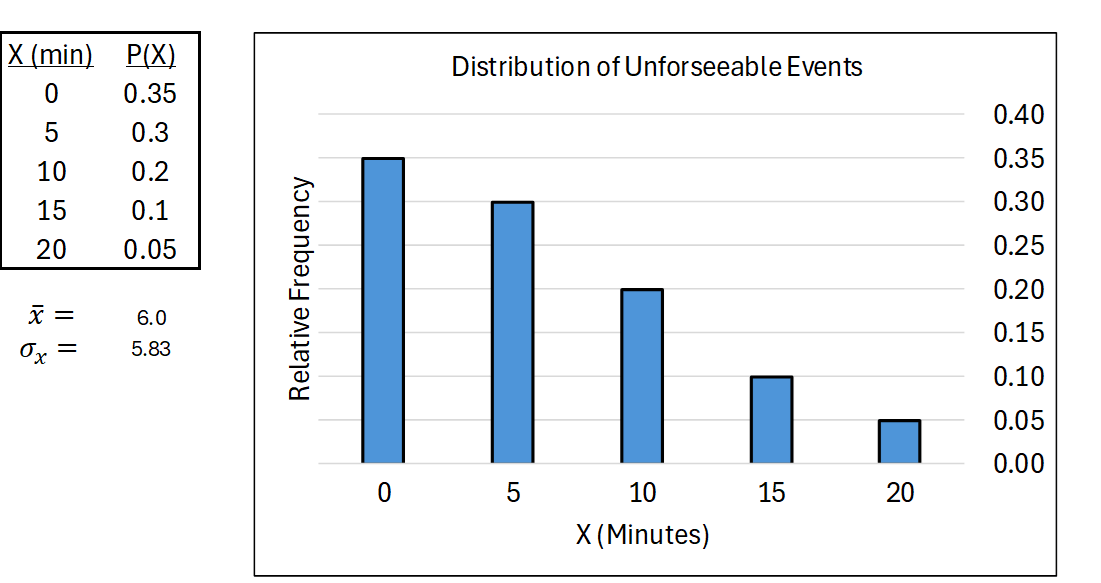
Someone with just enough insight to be dangerous might say ‘Ah! Instead, leave with enough time to accommodate the expected unforeseen event’. Mathematically, that’s the weighted average. In this case, that’s six minutes. So, if you plan to arrive 6min early, then you will be punctual – on average. But even that’s not really what we’re after. We’d like to be on time for a preponderance of the days. Building in a 6-minute buffer does two things. 1) Every time that there is a 0min or 5min unforeseen event, you get to your destination 6min or 1min early. That’s good for your nerves, performance, and reputation. But, that also means that you’re late whenever there is a 10min, 15min, or 20min unforeseen event – and those occur 35% of the time!
Continue reading
