When we recently traded in for a newer car, we were handed two fobs. These are push-button start cars, so you absolutely need a fob to drive one. An old-fashioned metal key will not work. Even the hidden metal key in your fob is only good for unlocking the door, not for starting the car. Since life has schooled me that things get lost, I asked how much it would cost to get a spare fob made at time of purchase, hoping I might catch a break. Nope, the dealer cost would be $436. Ouch.
So, I later asked AI what to do. I was advised to have a non-dealer locksmith or hardware store do it instead. With this route, you might save even more money if you buy the blank fob yourself on Amazon for something like $30, and just have the locksmith program it and cut the hidden metal key.
A local ACE hardware store quoted me a price of $330, which is better than $436, but still not great. But I located a mobile locksmith, who drives a big van loaded with spare keys and fobs, and the equipment to cut key copies and to program fobs. He specializes in going and helping folks who are locked out of their cars, and he will drive to your house to make spare fobs and keys. He would come to our house to make a new fob for $270. But it gets even better – – if I had two fobs made in one visit, the price would be only $220 apiece. It was an offer I could not refuse, so now I have spares for both cars.
If you don’t have a working fob for the locksmith to work from: It turns out that for many foreign cars (Subaru, Toyota, and especially most European brands), it can be very difficult for a non-dealer locksmith to create a fob for you. Normally, if you find yourself locked out of your car some dark, snowy night, the mobile locksmith can roll up and create a new fob for you so you can get back in business. For brands like Ford, GM, Honda, and Nissan, he can accomplish this even if you can’t provide him with a working fob to copy. He will charge you twice as much, because it is a much harder job with no working template fob. It gets even harder for, say, Subaru. But for Mercedes-Benz or BMW, it may be impossible for most locksmiths to get a fob made on the spot without a working model to copy. In a big metro area, there may be a few locksmiths who have the specialized equipment for these brands; you’d have to call around and ask the locksmith especially if they can make a new, say, Mercedes fob for an “all-keys-lost” situation. If not, you may have to get towed on a flat-bed ($$$) to a dealer, who can read your vehicle and program the fob ($$$). There may be a middle ground (which will take some days to play out) where you order a blank fob from a dealer along with some essential info for your locksmith to complete the programming, or where you order a programmed fob by mail.
All this argues for having a spare fob made ahead of time; maybe stash it somewhere that a friend or family member could bring it to you, if you were in distress not too far away.
Bonus fob tip: If your fob battery dies, you can still start your car by using the conventional metal key hidden inside your fob to open the car door, and then hold the fob very close to the car ignition button as you push the button, with your foot on the brake as usual.
Lately I’ve been experiencing personal advertising barrages. Sometimes, I actually buy a product online before realizing that I had been living in a fake information environment complete with fake AI-generated product reviews. What I want for myself right now is to hear more product reviews from real people. I’m not against earning money from affiliate links, but I will earn nothing from this post. Here’s what I’m using right now.
Sourdough Bread Baking gear kit – I got a kit with “bannetons” (if you’re not interested, don’t ask) back when I decided to get into sourdough baking. The appeal was the savings from buying it all in a bundle (i.e. “dough whisk,” etc.). The investment is worthwhile if you are going to make your own sourdough bread. As I wrote earlier, this is a big investment of time. I do not recommend starting the process at all if you will make homemade bread less than 5 times a year.
Homemade Driveway Pickleball Court – if you have a paved level driveway or large patio, you might be able to create a non-regulation-sized Pickleball court. It used to be that billionaires could have their own tennis court and the rest of us could have ping pong tables. Now there is a Third Thing. You will likely need to rig up nets as a backstop by piecing together sports gear meant for baseball backstops. The actual mid-court net can come cheap from Amazon (I went with 14 feet wide). A small Pickleball court is fun for children/teens, but adults will prefer going to a real court where you can hit the ball much harder. Pickleball facilities are appearing all over the country and many cities now provide free courts in parks and gyms.
Canvas LMS and New Quizzes – Samford University uses Canvas, and I have always liked the interface. Finally, in the year 2026, I have decided to build a new course using “New Quizzes” instead of Classic Quizzes. The rollout of this product has been so awkward, but if you are starting from scratch, Item Banks and “New Quizzes” works well now.
The book Misbehaving by Richard Thaler is about his career and the field of Behavioral Economics. I think anyone could learn from how the field evolves in the face of new evidence. It’s been helpful for me with my project on LLMs and financial decision making.
Codex – Thanks to Codex, I can finally do something teaching-related that ChatGPT had failed to do for me in summer of 2025. Codex can write straight to a subfolder on my computer, with coaching. For technical details, follow Aniket. What I used to say to people who wanted to “learn computer programming” is that it’s impossible to learn from reading books. Build something that you care about, even if it is just a tiny website. I would say the same for Codex. Use it to build something, even if that’s something for your personal life like a sourdough bread baking scheduling assistant.
Non-alcoholic beer always used to mean O’Doul’s, which is a poor substitute for real beer.
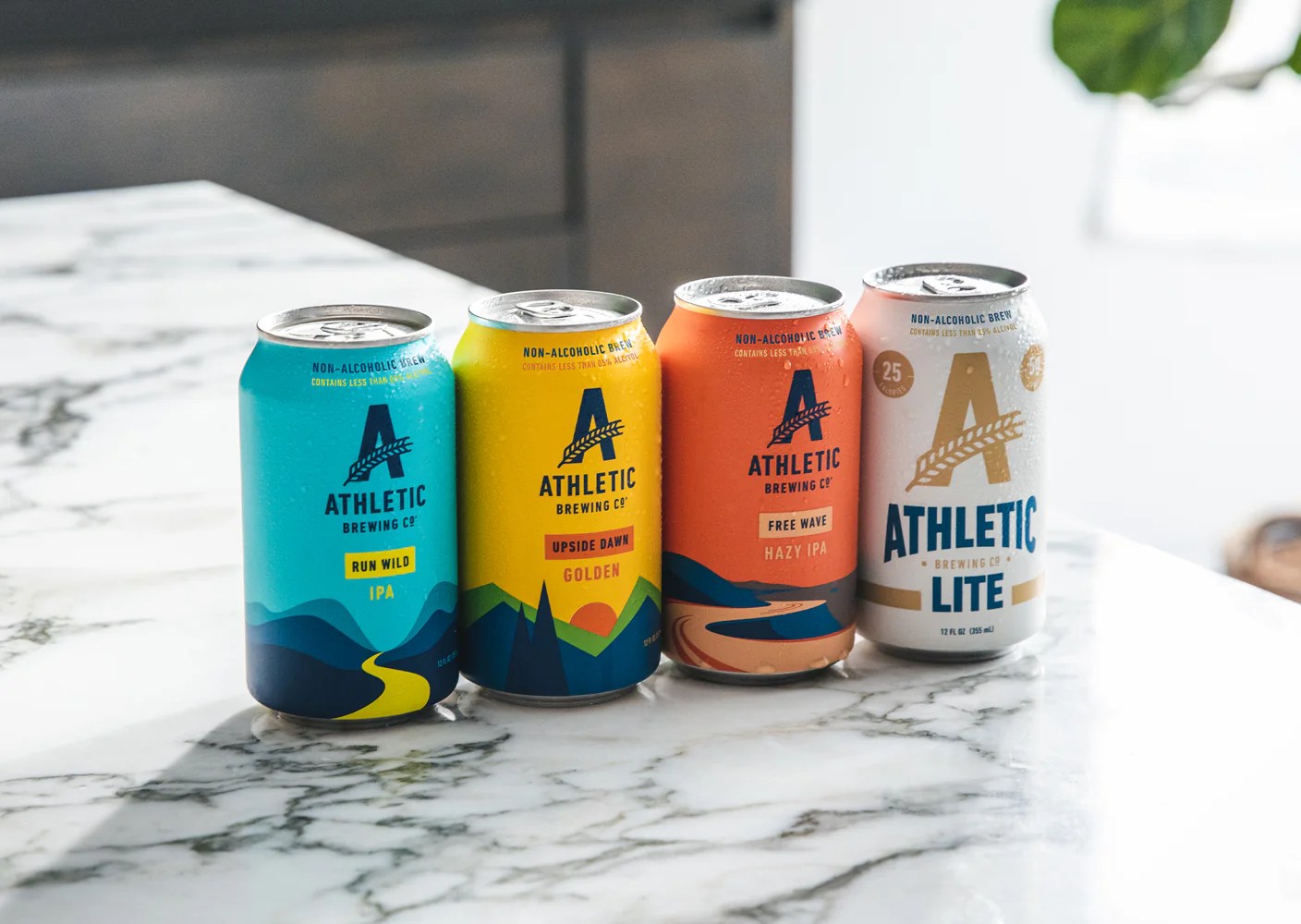
Then Athletic Brewing cracked the code of how to make something that tastes much more like real beer.
Their new process and the higher demand that came with it have led to an explosion in variety, with many new and established breweries offering their own new NA beers.
I tried many of these recently when my wife was pregnant, and was pleased enough that I plan to keep drinking them. Partly as an occasional healthier substitute for real beer (less alcohol also means fewer calories), and partly as a nice drink to have with lunch or in the afternoon when I wouldn’t normally drink beer.
My recommendations:
Re-created the category, pretty good taste, easiest to find: Athletic Brewing
Best NA version of a beer you know: Guinness
Best NA beer from a brewery you probably haven’t heard of: Collective Arts Brewing, Emerald Dark
“Spirituous liquors might remain as dear as ever, while at the same time the wholesome and invigorating liquors of beer and alemight be considerably reduced in their price.” -Adam Smith
A native New Zealander, Tim Brown had two separate ambitions: to become a professional soccer player and a designer. On the soccer (“football”, outside North America) front, he succeeded beyond expectations. He played on the New Zealand national team between 2004 and 2012, often as captain or vice-captain. Brown executed a personal pivot in 2012. After retiring from soccer, he enrolled in the London School of Economics to learn the business skills needed to launch an idea he had been mulling for several years. This was a shoe made mainly of wool.
He wanted to give a boost to New Zealand’s declining sheep in industry (battered by competition from polyester textiles), and wanted to promote something more sustainable than the plasticky shoes that he was always being asked to endorse as a professional player. There seemed to be plenty of room in the half-billion dollar per year footwear industry for something more environmentally friendly.
Brown launched his idea on Kickstarter in 2014, raising over $100,000. He and his partner started selling the Allbirds Wool Runner in 2016. Their green vibe was perfect for that era, and their shoes became wildly popular among the Silicon Valley VC set. They were seen on Larry Page, Barack Obama, Leonardo DiCaprio, and a whole gaggle of Hollywood actors and actresses.
Allbirds expanded its product line, and opened brick and mortar stores on several continents. Allbirds went public in 2021, and its market value ran up to $4 billion. But then the novelty of wool shoes wore off, sustainability became less urgent, and it became widely known that these “Wool Runners” are too flimsy to actually run or exercise in. They are more like slippers, and folks outside of Hollywood or Silicon Valley were not eager to pay $150 for a pair of slippers. Also, better-capitalized competitors muscled into the sustainable footwear market. Sales slid down and down, management conflicts erupted, and founder Tim Brown left to pursue other interests. On April 1, Allbirds announced it was selling the remnants of its shoe business for an ignominious $39 million.
So far, the story is unremarkable – – as with so many other startups, idealistic founders have initial success, but eventually go under upon scale-up. But there is an interesting plot twist. Instead of just going chapter 7 BK, paying off creditors, and returning a few pennies to investors, the company is using the shell of its former business to generate capital and transform itself into a new AI venture of renting out computing centers for AI usage. I assume the managers wanted to keep their jobs as managers, and cooked up this scheme to traffic on the current AI hype.
Apparently, these guys know nothing about GPU centers, so they’ll have to hire folks with expertise. Some unknown investor is backing them to the tune of $50 million, but they will have to raise much more than that to compete in the AI server business. That will horribly dilute current stockholders. They are directly competing with much better-capitalized behemoths like CoreWeave and Oracle, that can raise money on better terms. No moat, no expertise, almost no capital. But, hey, it’s AI, and so the company stock BIRD soared 600% on the news of the computing pivot.
I give them modest odds of succeeding bigly, but sometimes a mission pivot like this does come off. I’m thinking of the 1960’s when Berkshire Hathaway, facing declining earnings from its core textile business, under the leadership of Warren Buffett shifted into insurance. That generated the “float” that then enabled the purchase of other profitable businesses. We shall see if Allbirds (soon to be “NewBird”) management can likewise preside over such a seismic business shift.
Americans like their food. Holidays are often known by the dishes that we serve. Thanksgiving is a bit unique in that most of us converge on turkey, though diversity obviously exists. What about Easter? There’s not really the same focus on a single food like there is for Thanksgiving. My impression is that people eat daytime or lunch foods that include ham, lamb, or just about anything. My family tends to make tacos.
What am I saying?! We eat candy! Solid or hollow chocolate bunnies, jellybeans, peeps, and on and on. We fill Easter eggs and keep candy around the office. We literally have baskets full of candy.
A Chocolate Bunny? In this economy?
Have you seen the price of chocolate? Yeesh! The latest figures are from February and the prices for chocolate and cocoa bean products are down 11.7% year-over-year. That’s nice, you may think, our budgets can fit a bit more chocolate into our consumer – I mean Easter – baskets. Great news. The news seems a little less great when you realize that February’s price of chocolate was 90% higher than it was four years earlier in 2022. 90% higher is a lot like 100%, and 100% is double! In fact, the price had peaked at 142% higher by September of 2025, and now prices are quickly falling. See the chocolate-colored line in the graph below.
Now that we have your attention (if you just got buried in a blizzard yesterday), let’s talk about shoveling snow. Everyone knows how a standard snow shovel works. You bend down, with one hand on the end of the handle and the other hand halfway along the handle, you shove forward, load up the shovel blade, then (Ooof!) lift it up and throw the snow where it needs to go. For many of us, this action uses muscles and joints that are not conditioned for it. Fun facts: every year some 100 Americans die from shoveling snow, and another 11,000 or so end up in the emergency room.
Is there a better way? Well, a powered snowblower can work. But that doesn’t fit everyone’s situation. It turns out there is a better way to manually shovel snow, that fits many (not all) situations.
As I was reading about “electric snow shovels” (more on that another time), I ran across mention of “sleigh shovels” or “sled shovels” or “snow scoops.” Apparently, they are very widely used by Canadians and Alaskans, who ought to know something about snow. A genius aspect of these shovels is that you never have to lift them.
Here is a picture of a 24” Garant brand sled shovel:
Here’s how they work: Start with the position shown, shove it forward (you get to use both hands out in front of you, in an ergonomically good position), till the scoop is largely filled with snow. Then, tilt it back a little, and push this load forward, sledding along until you get to the edge of the driveway. Keep pushing it another several feet, out onto the lawn. Then dump the snow off the shovel by a quick shove forward and a sudden jerk back, to pull the shovel out from under the snow. Plan your dumping points so as to get a gradual ridge beside the driveway, not a narrow, high ridge right at the edge.
Take a quick look at 1:40 – 3:40 (two minutes) of this video to see a more challenging situation (deep snow, big existing ridge on edge). This shows that one scoop shovel-full is equivalent to more than three regular shovel-fulls, and this snow is expelled from the driveway with NO LIFTING. It’s beautiful! Here are two screen shots from this video:
Garant seems to be the most well-established brand here. ACE hardware (see photo above) is selling them for $70. On Amazon, I see a Garand model being sold for an eye-watering $266, maybe scalping prices for the latest blizzard. That is a lot of money for a plastic scoop with a metal handle. You can probably do better by shopping elsewhere or at a different time.
I am tempted to get one, but I don’t have a wide driveway with grassy dumping areas on the sides. I have to shovel mainly steps and narrow sidewalks, often with wet, slushy, not super deep snow. Sleigh shovels can work in these situations, but their advantages are muted, compared to the deep powdery snow found in colder regions.
But if I were living in Boston or Providence or New York, a sleigh shovel would be mighty handy right now.
There was a seismic shift in the AI world recently. In case you didn’t know, a Claude Code update was released just before the Christmas break. It could code awesomely and had a bigger context window, which is sort of like memory and attention span. Scott Cunningham wrote a series of posts demonstrating the power of Claude Code in ways that made economists take notice. Then, ChatGPT Codex was updated and released in January as if to say ‘we are still on the frontier’. The battle between Claude Code and Codex is active as we speak.
The differentiation is becoming clearer, depending on who you talk to. Claude Code feels architectural. It designs a project or system and thrives when you hand it the blueprint and say “Design this properly.” It’s your amazingly productive partner. Codex feels like it’s for the specialist. You tell it exactly what you want. No fluff. No ornamental abstraction unless you request it.
Codex flourishes with prompts like “Refactor this function to eliminate recursion”, or “Take this response data and apply the Bayesian Dawid-Skene method”. It does exactly that. It assumes competence on your part and does not attempt to decorate the output. It assumes that you know what you’re doing. It’s like your RA that can do amazing things if you tell it what task you want completed. Having said all of this, I’ve heard the inverse evaluations too. It probably matters a lot what the programmer brings to the table.
Both Claude Code and Codex are remarkably adept at catching code and syntax errors. That is not mysterious. Code is valid or invalid. The AI writes something, and the environment immediately reveals whether it conforms to the rules. Truth is embedded in the logical structure. When a single error appears, correction is often trivial.
When multiple errors appear, the problem becomes combinatorial. Fix A? Fix B? Change the type? Modify the loop? There are potentially infinite branching possibilities. Even then, the space is constrained. The code must run, or time out. That constraint disciplines the search. The reason these models code so well is that the code itself is the truth. So long as the logic isn’t violated, the axioms lead to the result. The AI anchors on the code to be internally consistent. The model can triangulate because the target is stable and verifiable.
Last year about this time, as the outside world got darker and colder, and the greenery in my outdoor planters shriveled to brown – – I resolved to fight back against seasonal affect disorder, by growing some lettuce and herbs indoors under a sun lamp.
After doing some reading and thinking, I settled on getting a countertop hydroponics unit, instead of rigging a lamp over pots filled with dirt indoors. With a compact hydroponics unit there is no dirt, no bugs, it has built-in well-designed sun lamp on a timer, and is more or less self-watering.
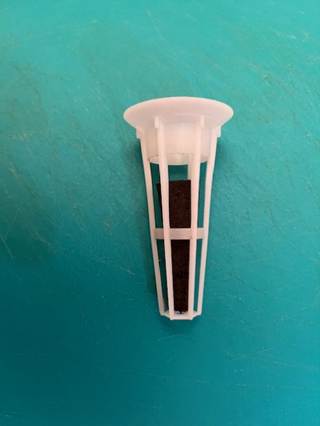
These systems have a water tank that you fill with water and some soluble nutrients. There is a pump in the tank that circulates the water. There is a deck over the tank with typically 8 to 12 holes that are around 1 inch diameter. Into each hole you put a conical plug or sponge made of compressed peat moss, supported by a plastic basket. On the top of each sponge is a little hole, into which you place the seeds you want to grow.
A support basket with a dry (unwetted, unswollen) peat moss grow sponge/plug in it.
As long as you keep the unit plugged in, so the lights go on when they should, and you keep the nutrients solution topped up, you have a tidy automatic garden on a table or countertop or shelf.
The premier countertop hydroponics brand, which has defined this genre over the past twenty years, is Aerogarden. This brand is expensive. Historically its larger models were $200-$300, though with competition its larger models are now just under $200. Aerogarden tries to justify the high cost by sleek styling and customizable automation of the lighting cycles, linked into your cell phone.
I decided to go with a cheaper brand, for two reasons. First, why spend $200 when I could get similar function for $50 (especially if I wasn’t sure I would like hydroponics)? Second, I don’t want the bother and possible malfunction associated with having to link an app on my cell phone to the growing device and program it. I wanted something simple and stupid that just turns on and goes.
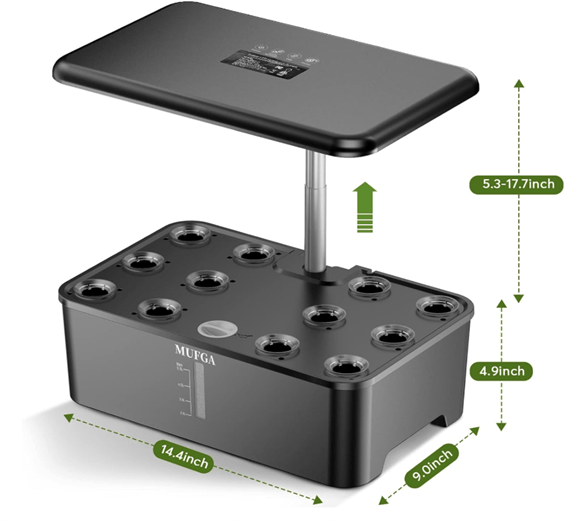
So I went with a MUGFA brand 18-hole hydroponics unit last winter. It is simple and robust. The LED growing lights are distributed along the underside of a wide top lamp piece. The lamp has a lot of vertical travel (14“), so you could accommodate relatively tall plants. The lights have a simple cycle of 16 hours on, 8 hours off. You can reset by turning the power off and on again; I do this once, early on some morning, so from then on the lights are on during the day and the evening, and off at night. The water pump pumps the nutrient solution through channels on the underside of the deck, so each grow sponge has a little dribble of solution dribbling onto it when the pump cycle is on. I snagged a second MUGFA unit, a 12 hole model, when it was on sale last spring. The MUGFA units come complete with grow sponges/plugs, support baskets/baskets for the sponges, nutrients (that you add to the water), clear plastic domes you put over the deck holes while the seeds are germinating, and little support sticks for taller plants. You have to buy seeds separately.
I have made a couple small modifications to my MUGFA units. The pump is not really sized for reaching 18 holes, and with plants of any size you’re likely not going be stuffing 18 plants on that grow deck. Also, the power of the lamp for the 18-hole unit (24 W) is the same as the 12-hole unit; the LEDs are just spread over a wider lamp area. That 24W is OK for greens that don’t need so much light, but may only be enough to grow a few (mini) tomato plants. For all these reasons, I don’t use the four corner holes on the 18-hole unit. Those corner holes get the least light and the least water flow. To increase the water flow to the other 14 holes, I plugged up the outlets of the channels on the underside of the deck leading to those four holes. I cut little pieces of rubber sheeting, and stuffed them in channel outlets for those holes.
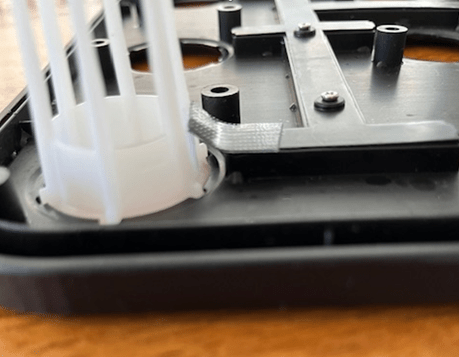
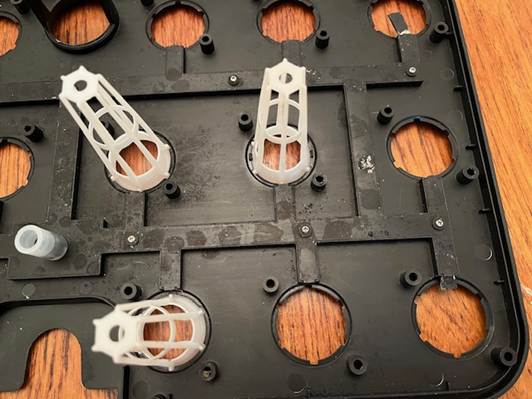
The 12-hole unit has a slightly more pleasing compact form factor, but it has a minor design defect [1]. The flow out of the outlet of each of the 12 channels under the deck is regular, but not very strong. Consequently, the water that comes out of each outlet drops almost straight down and splashes directly into the water tank, without contacting the grow sponge at that hole. The waterfall noise was annoying. The fix was easy, but a little tedious to implement. I cut little pieces of black strong duct tape and stuck them under the outlet of each hole, to make the water travel another quarter inch further horizontally. Those little tabs got the water in contact with the grow sponge basket. The picture below shows the deck upside down, showing the water channels under the deck going to each hole. There is a white sponge basket sticking through the nearest hole, and my custom piece of black duct tape is on the end of the water channel there, touching the basket. (In order to cover the exposed sticky side of the duct tape tab that would be left exposed and touching the basket, I cut another, smaller piece of duct tape to cover that portion of the tab, sticky side to sticky side.). This sounds complicated, but it is straightforward if you ever do it. Also, many cheap knock-off hydroponics units don’t have these under-deck flow channels at all. With MUGFA you are getting nearly Aerogarden type hardware for a third the price, so it is worth a bit of duct tape to bring it up to optimal performance.
12-hole MUGFA deck, upside down with one basket; showing my bit of black duct tape to convey water from the channer over to the basket.
Some light escapes out sideways from under the horizontal lamps on these units. As an efficiency freak, I taped little aluminum foil reflectors hanging down from the back and sides of the lamp piece, but that is not necessary.
To keep this post short, I have just talked about the hardware here. I will describe actual plant growing in my next post. But here is one picture of my kitchen garden last winter, with the plants about 2/3 of their final sizes:
The bottom line is, I’ve been quite satisfied with both of these MUGFA units, and would recommend them to others. They provided good cheer in the dark of winter, as well as good conversations with visitors and good fresh lettuce and herbs. An alternate use of these types of hydroponics units is to start seedlings for an outside garden.
ENDNOTE
[1] For the hopelessly detail-obsessed technical nerds among us – – the specific design mistake in the 12-hole model is subtle. I’ll explain a little more here. Here is a picture of the deck for the 18-hole model upside down, with three empty baskets inserted. The network of flow channels for the water circulation is visible on the underside. When the deck is in place on the tank, water is pumped into the short whitish tube at the left of this picture, flows into the channels, then out the ends of all the channels. (Note on the corner holes here, upper and lower right, I stuck little pieces of rubber into the ends of the flow channels to block them off since I don’t use the corner holes on this model; that blocking was not really necessary, it was just an engineering optimization by a technical nerd).
Anyway, the key point is this: the way the baskets are oriented in the 18-hole model here, a rib of the basket faces the outlet of each flow channel. The result is that as soon as the water exits the flow channel, it immediately contacts a rib of the basket and flows down the basket and wets the grow sponge/plug within the basket. All good.
The design mistake with the 12-hole model is that the baskets are oriented such that the flow channels terminate between the ribs. The water does not squirt far enough horizontally to contact the non-rib part of basket or the sponge, so the water just drips down and splashes into the tank without wetting the sponge. This is not catastrophic, since the sponges are normally wetted just by sitting in the water in the tank, but it is not optimal. All because of a 15-degree error in radial orientation of the little rib notches in the deck. Who knows, maybe Mugfa will send me a free beta test improved 12-hole model if I point this out to them.
LinkedIn has its problems, but so does every other social network.
I joined LinkedIn out of college because it seemed like something you were supposed to do if you want a job someday, but I never checked it because the academic job market makes little use of LinkedIn. In 2013 LinkedIn added social media features like a newsfeed, but I still never spent time there. Facebook and Twitter seemed more interesting, and like many people I’ve always been allergic to “networking” or other social settings where one person is just trying to get something from another. It seemed like a recipe for posts that are cringe, soulless, or desperate.
But over the past couple years, I’ve found myself spending more time there- and not because I’m looking for a job or looking to hire. Some of the posts are genuinely interesting, and it is a nice way to keep up with what people I know are up to. Either LinkedIn got better or I got worse.
I find that LinkedIn is particularly good for staying in touch with my old students. I always told my students they could still e-mail me or stop by my office after the semester is over, but they almost never do; that takes a lot of thought and energy. Social networks are the ideal way to keep in touch with “weak ties“, but you have to find the right one. Facebook was the best for this when it was ubiquitous, but now it is becoming more common for Americans not to have or not to check Facebook, especially young ones (plus it was always a bit too personal for former students). Twitter has never been something that most people have, and the more popular networks are either too personal (Instragram, Snap et c) or too impersonal where almost all content users see comes from people they don’t know (TikTok, Youtube, et c).
LinkedIn by contrast is ubiquitous and just the right amount of personal. It also seems to be increasingly a good place to share interesting writing. I like much of what I read there, and my writing gets a good reception; I tend to get more engagement for EWED posts on LinkedIn than on X and Facebook despite having fewer connections there than Facebook friends or Twitter followers. Yes, you’ll still see some cringe posts there, but it beats the angry political posts that are ubiquitous on Facebook and especially X.
My new article, “Prohibition and Percolation: The Roaring Success of Coffee During US Alcohol Prohibition”, is now published in Southern Economic Journal. It’s the first statistical analysis of coffee imports and salience during prohibition. Other authors had speculated that coffee substituted alcohol after the 18th amendment, but I did the work of running the stats, creating indices, and checking for robustness.
My contributions include:
National and state indices for coffee and coffee shops from major and local newspapers.
A textual index of the same from book mentions.
I uncover that prohibition is when modern coffee shops became popular.
The surge in coffee imports was likely not related to trade policy or the end of World War I
Both demand for coffee and supply increased as part of an intentional industry effort to replace alcohol and saloons.
An easy to follow application of time series structural break tests.
An easy to follow application of a modern differences in differences method for state dry laws and coffee newspaper mentions.
Evidence from a variety of sources including patents, newspapers, trade data, Ngrams, naval conflicts, & Wholesale prices.
Generally, the empirical evidence and the main theory is straightforward. I learned several new empirical methods for this paper and the economic logic in the robustness section was a blast to puzzle-out. Finally, it was an easy article to be excited about since people are generally passionate about their coffee.
Bartsch, Zachary. 2025. “Prohibition and Percolation: The Roaring Success of Coffee During US Alcohol Prohibition.” Southern Economic Journal, ahead of print, September 22. https://doi.org/10.1002/soej.12794.