ABSTRACT: Despite significant advances since 2023 in large language model (LLM) capabilities and the introduction of web-enabled search functionality, citation hallucination remains a persistent problem in AI-generated academic content. We test GPT-4o, DeepSeek V3, web-enabled GPT-4o, and web-enabled GPT-5.1 across prompts derived from Journal of Economic Literature categories. Using a hierarchical citation validation framework, we find that even an advanced web-enabled model produces non-existent citations. While web-enabled models show improvement over their predecessors, the error rates remain high for scholarly applications. Our findings suggest that the fundamental challenge of citation hallucination persists despite technological advances, with implications for academic integrity and the reliable use of AI in research contexts. We provide an online tool for researchers to run LLMs through the benchmark test using our prompts.
Suggested citation:
Buchanan, J., Hill, S. and Shapoval, O. (2026), LLM Hallucination of Citations in Economics Persists With Web-Enabled Models. Southern Economic J. https://doi.org/10.1002/soej.70069
After some time went by since we published our 2024 paper on this topic and GPT became web-enabled, we thought that this silly problem with hallucinating up fake citations might have gone away. So, we went back to do our count again. We found that a significant number of references are still made up.
I believe that this particular problem of fake citations will go away soon. However, I think the starkness of fake references illustrates something more general about the LLM technology and highlights the importance of verification. Feel free to cite our 2026 paper as evidence that hallucinations are still happening, despite improvements along many margins. Since we started down this track, OpenAI released a paper titled “Why language models hallucinate” at https://openai.com/index/why-language-models-hallucinate/ Excerpt:
Hallucinations persist partly because current evaluation methods set the wrong incentives. While evaluations themselves do not directly cause hallucinations, most evaluations measure model performance in a way that encourages guessing rather than honesty about uncertainty.
We are not in the slow-lane “LLMs are stochastic parrots” group. Stephen Hill does even more with AI in his personal workflow than I do. AI will probably soon qualify for all of the academic prizes we used to award to human writers and scientists. However, as we hand more responsibility over to AI, keep the issue of hallucinations in mind.
The striking possibility is that increasingly intelligent AI may not make Hayek obsolete. It may give us a new reason to appreciate him. Intelligence does not abolish the economic problem created by dispersed knowledge. A world filled with capable artificial minds may actually contain more decision-makers, more specialization, more private information, and more discoveries that no central intelligence anticipated.
For those minds, as for ours, prices would be a map of a world too complicated for any one mind to know.
Trillions of dollars are being plowed into building U.S. data centers to handle future AI compute demand. These are being paid for by rich people and organizations, anticipating juicy returns on their investments. Those juicy returns depend on consumers (individuals or businesses) being willing to pay enormous amounts for access to AI. Commentators are so enamored with the glorious prospects of how AI will end poverty and maybe even death, that it is hard to find a clear statement of who exactly will pay how much for all this. Lots of folks are happy to pay $20/month for AI. $200/month? Not so much.
I predict that those earnings will fall far short of expectations. We observe that AI consumption is bifurcating into two main markets, a commodity tier and a premium tier (with, of course, sub-tiers within each of those broad categories). Chinese models are readily available over the internet, and they have proven capable of performing well enough to handle most AI tasks. The Chinese models are priced far lower (on the order of 10X lower) than the big U.S. “frontier” models (ChatGPT from Open AI, and Claude suite from Anthropic). By far the most U.S. compute usage depends on these two labs. Western users are starting to use the Chinese models more and more. This keeps prices so low that the frontier labs are losing money on their AI sales. Sophisticated users automatically route their AI workload to the cheapest feasible provider.
Their will always be a subset of AI usage in the West that requires the highest level of performance, or freedom from Chinese government spying or manipulation, that will be directed to a premium tier. But if that premium tier ends up being only, say, 20% of AI usage in 2028, there is a real question as to whether the financial bases of the data centers being built now can be sustained. There are huge bear and bull arguments on both sides here, which are tough to balance. I got only equivocal “it depends” answers from AI on this.
If the data centers don’t make expected profits, what then? It all depends on how they were financed. Most of the build-out to date has been the big 4 hyperscalers, Google, Amazon, Microsoft, and Meta spending their free cash flow from their other business lines. If it turns out they simply flushed that money down the toilet, no big deal. Just a trillion-dollar whoopsie. The CEOs will still get their bonuses, don’t worry.
But now as more debt financing enters in, the stakes get higher. Analysis seems to show that the debt loads that the big 4 hyperscalers have incurred is manageable – -their base cash flows are so huge that they can manage their own debt. But in the past year we have seen the emergence of monstrous “Special Purpose Vehicles” (SPVs) with a mixture of equity, debt, and guarantees, to finance practically all the upcoming trillion dollars of data centers. This pushes the financing of the balance sheets of the hyperscalers.
If those newer data centers flop, their equity investors will take a hit, leaving their creditors in the hole and in control. One really needs to analyze exactly who those equity and debt holders are for the SPVs. If the creditors decide to recoup some of their investment by selling the data center for say 60 cents on the dollar, the most likely buyers would be…Google and Amazon. There is a school of thought that this (let the SPVs fail, scoop up their assets at discount) has been their plan all along. World domination in AI compute! Just like they have achieved world domination in online search and video and shopping. Maybe.
The resulting slowdown in data center investing would likely throw the U.S. economy into slowdown or recession, considering that it’s estimated that fully half of our recent GDP growth has been from circularly-financed AI buildout. Chipmakers’ (Nvidia, Micron, AMD, etc.) profits depend on continued acceleration in AI build-out. If that build-out stalls, or even slows down, chipmaker profits will crater. Whether this risk is already priced into their share prices is debated.
Boilerplate disclaimer: Nothing here should be considered advice to buy or sell any security.
UPDATE: I stupidly didn’t realize my co-blogger Mike wrote about this too. My bad! I skimmed last week’s posts, but it didn’t click in my head. Be sure to read his thoughts.
ALSO: lots of the papers by Polson seem to have vanished from SSRN since I wrote this blog post… yesterday. Everything after August 14th has been taken down. That brings his count of papers in 2026 down to a mere 168 papers. Still essentially several lifetimes of output from a typical academic.
CODA: As Andrew Gelman documented in real time, all of the papers appear to have been removed from SSRN for now. No explanation as of yet, but you can still see many of the papers listed (for now) on Polson’s Google Scholar page.
For most academics, writing papers that may be eventually published in peer-reviewed journals is an important part of what we do. For some academics, it is the main thing they do (others have more emphasis on teaching courses at their university). Most academics always have a few projects they are working on, with perhaps a goal of finishing 2 or 3 a year, and thus having a regular pipeline of a few publications every few years. But some academics are much more prolific.
Take Daron Acemoglu for example. He has long been considered extremely prolific. So far in 2026, according to his Google Scholar page, he has had 15 papers that have either been published this year or come out as new working papers (that’s the bulk of them). In the past year (2025 and 2026), he has had publications in the Quarterly Journal of Economics, the American Economic Review, and the Journal of Economic Literature, among others (the AER paper was his Nobel lecture). For lower tier academics, that’s almost a lifetime of publications in 12 months or so. Acemoglu is extremely productive.
But I just discovered an economist that is, apparently, even more productive than Acemoglu, at least as measured by working papers. Nicholas Polson has, by my count using his SSRN page, already written 258 working papers in 2026 alone. He’s already written (or at least published to SSRN), six papers today, August 26, 2026. In the month of August 2026, he has written and posted to SSRN a total of 104 papers — and counting, since the month isn’t quite over.
These aren’t just short notes. Most of the papers are of normal academic length: 32 pages, 27 pages, 58 pages. The papers are both theoretical — involving complex math in some cases — or empirical, with regressions. Read any single paper, and it feels like just a normal academic paper, the kind of thing that an academic might work on for a few months. He even has a frequent co-author, which is common for economics papers (and helps to be more productive), a systems engineering professor named Vadim Sokolov, who is a co-author on a little over 100 of the papers this year.
What is going on here? Obviously the research productivity of Polson and his co-author Sokolov is aided by AI. Who isn’t using AI to increase their writing and research productivity these days? But I don’t think I have seen any academic, at least not in economics, that has really pushed it to the limit.
Presumably, many of these papers will get submitted to academic journals. I can imagine the editors of journals have a very hard job these days, as the number of papers submitted has likely increased significantly, while the time that referees have available has not increased much (of course, AI is likely making referees more productive too, though many journals ask you not to upload the paper into an AI program as a referee, since it is unpublished work when you are reviewing it).
I really don’t know where academic publishing goes from here. AI has made us all more productive in terms of output, but are we better at answering important questions in our science than pre-AI? Probably, though it is hard to know. Journals and the peer review process has traditionally been the filter to sort real contributions from gibberish. I don’t know how the peer review process continues in its current form given the massive increase in output (much of it good!) that we are seeing from academics. Dr. Polson is just a leading example of a growing challenge for academia.
Lebron James is obsessed with golf. His new YouTube channel is what is getting the most attention, but this has been a publicly known fact for a while. There’s even a (largely unevidenced) theory that he chose to play his potentially final season in Philadelphia for it’s proximity to elite golf courses.
I just want to take this time to deconstruct why Lebron’s golf obsession is interesting. It’s a reminder that first derivatives often matter more than both absolute values and higher order derivatives. Let me explain.
Lebron at 41 years of age, in the face of history, experience, and logic, is still one of the 20 very best human beings at basketball in the world. So, in terms of absolutes, playing basketball should still give him immense satistfaction. The problem, of course, is his personal reference point (how good he used to be) and the rate of decay he is experiencing from that reference point. This is a person who spent more than two decades getting better and better at something, who arrived at a point where they were literally the very best in the world at it, only to then at some point in time arrive at the awareness that they were in fact getting worse at it. To be clear, that rate of decay is far slower than anyone could have predicted, but it remains decay nonetheless. And it’s not just “getting worse”. It’s getting worse at something that you are orienting your every day around. Your meals, your sleep, your family life, everything, all in dedication to something you are getting worse at.
I’m now going to generalize from my own lived experience, but I think the emotional returns to dedication are always stronger when the first derivative is positive, but no amount of work can guarantee it. You can work harder and increase the positive gains or, failing that, slow down the decay, but at some point the decay is inevitable (i.e. the work shows up in the second derivative). And no matter how much you slow it down, decay just isn’t as satisfying as the day-to-day lived experience as improvement or even plateauing.
And this is where golf comes in. Golf is a sport that has much lower athletic barriers to entry and, for Lebron or anyone who is starting out, a vastly lower reference point for quality. It is entirely likely that every time Lebron has ever picked up a golf club he is better at golf than he was the previous month. It is the 100% inverse to what Lebron has experienced playing basketball for at least 7 or 8 years now, likely longer. The relief he must feel, directly experiencing and observing the returns to his efforts.
Coming to terms with being past your prime is a standard trope in narrative fiction of all formats, but from an actual mental health point of view, I don’t think it is given enough attention, particularly for those at the tops of their field. There are vanishingly few purely natural elites in any profession, vocation, or craft. Most have had to sacrfice whole avenues of life experiences to achieve such levels, and when they do begin to decay they either have to endure public scrutiny bordering on censure, or the quiet tragedy of being alone in their ability to discern just how much they have lost. The latter is almost worse. Almost.
As a final tidbit, let me make a loose connection to technological innovation and AI specifically. Obsolescence hurts. A negative first derivative hurts. But what hurts even more is an unexpected shock that accelerates that decay. Injuries are mentally hard for athletes, in part, because of their often discontinuous nature. They were still improving, the rate at which they were improving was accelerating, until they weren’t. There are professions that are wrestling with this right now. There are professionals who reasonably expected to have another half decade before the decay began. That timeline is now in question. And most of us don’t have the luxury of being a generationally great athlete who can immediately become great at something completely new.
I don’t think it’s a coincidence that movements like expressionism, impressionism, and abstract art took off after the invention of the camera. Photorealistic paintings are impressive, but once they are duplicating what a camera does, they’re less interesting.
We’re due for similar movements in other fields to emerge as reactions to AI. Like writing in a way totally different from how an AI would write- ideally better than an AI would write, but even writing worse than an AI can be interesting if it is at least different.
It’s still early days for both AI and our reactions to it. But since the release of ChatGPT in 2022, what is the good new essay or book that you’re most confident was not written by AI, one that was written in an almost deliberately extra-human manner?
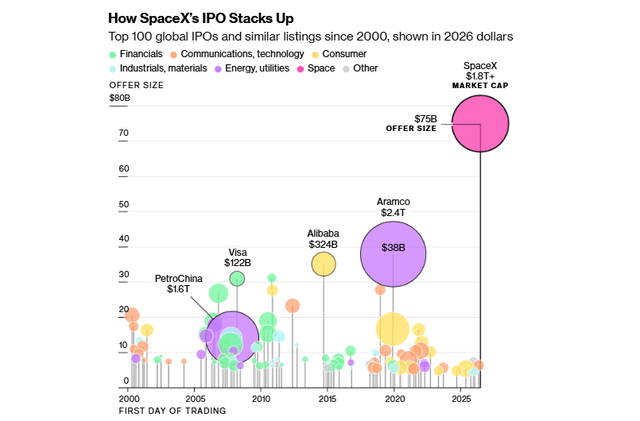
Here is a graphic that compares the size of the initial public offering (vertical axis) and the total company market cap (size of circle) of SpaceX to everything that has come before:
Elon Musk’s space launch/AI conglomerate spin-off SpaceX went public on Friday. Retail investors were all over it like a pack of starving dogs, driving up prices of SPCX from its opening $162 to $192 as of the close Monday. This has been grand theater, with Musk serving up signature visions of gargantuan total addressable markets, while investors are in fact getting crumbs of a money-loser. In the restaurant biz, this is known as selling the sizzle instead of the steak.
Let us pause for a reverent moment to savor the grand vision used to sell SpaceX: making humanity multiplanetary by dramatically lowering the cost of access to space. It extends beyond launch services into global communications (via Starlink), space infrastructure, in-space manufacturing, resource extraction, transportation, and ultimately a potential Mars economy—expanding from billions to trillions of dollars in theoretically addressable markets. Ooh, ahh, who would not want a piece of that?
Well, there are some problems here. It is hard not to splutter when trying to explain it, it is so bad for investors. I will just call out three issues I see:
( 1 ) Governance: You Own It But Can’t Influence It The IPO float represents roughly 4-5% of total shares, so we the people only get a sliver of the company. But it gets worse. Public shareholders receive Class A shares with one vote each, while Musk holds Class B shares carrying ten votes each, giving him approximately 85% voting control. More unusually, the company bylaws explicitly prohibit shareholder proposals — meaning investors cannot even put advisory resolutions to a vote. This is governance subordination beyond what even Zuckerberg imposed on his investors.
( 2 ) Valuation: Priced for Perfection Without Profits There is no price/earnings ratio because there are no earnings. At $2 trillion, SpaceX trades at approximately 20 times REVENUE. That price/sales is not unheard of for a small, fast-growing software company with almost no capital requirements (think: early-stage Amazon, Google, Palantir, etc.). But it makes no sense to apply it to a capital-intensive hardware and infrastructure business with negative GAAP earnings. Starlink is growing rapidly but requires continuous heavy capital expenditure to maintain and expand its satellite constellation. And SpaceX faces meaningful competition for orbital launches from Blue Origin, ULA (for military missions), maybe Rocket Labs, and the Chinese (for non-West payloads). And, if you dig into it, over 90% of their proposed addressable market is not space at all, but enterprise AI (!!). SpaceX pitches a total addressable market of $28.5 trillion, with AI opportunities alone accounting for $26.5 trillion. This is essentially the entire global GDP of the planet for a single year, and I guess they assume their pitiful Grok will claw back lots of market share from Claude, ChatGPT, and Gemini. As we said, priced for perfection.
( 3 ) Unbuilt Revenue Streams SpaceX has announced contracts to provide AI compute services to other companies — potentially a significant revenue source — but the data centers required don’t yet exist. Investors are therefore paying partially for infrastructure that is neither built nor generating revenue, on a timeline that remains speculative.
OK, but we have seen shares of Musk’s other baby, Tesla (TSLA), remain at uniquely high price/sales and price/earnings, seemingly indefinitely. So, investing in SpaceX is much like investing in that shiny yellow metal called gold: there will never be conventional earnings payback, but there might well be some greater fool out there who will pay more for my shares than I did. This really comes down to a psychological head game, not fundamentals. Gold has in fact done very well over the years, and the pros learned the hard way not to short TSLA, not matter how unsupportable its price is.
Final comments on index fund buying to drive up the share price – one of the bull drivers for SpaceX has been the prospect that the huge company market cap (around $2 Trillion) would force index funds like NASDAQ and S&P500 to buy boatloads of SPCX stock, driving up the price. But it turns out this will not be such a big factor. These indices only take into account the publicly traded shares, not locked-up, non-traded founder shares. So, we are looking at around $100 billion in traded SPCX shares, not the full $2 billion, which is mainly shares controlled by Musk and venture capital. $100 billion is only about 0.15% of the total S&P500 market cap of about $70 trillion. This means fund purchases of SPCX should not by itself drive down prices of other companies.
It is true that inclusion in Nasdaq-100 and Russell indexes will force automatic buying of around $25 billion in SPCX shares from funds tracking those indices. That seems like a significant driver, but (a) everyone knows this, so it is already factored into today’s prices, and (b) index fund purchases will be offset by billions in sales from VC’s as they sell shares when their lock-up periods expire in a few months.
Side comment: Historically, the major indices have had a little gravitas about what companies to include. The Nasdaq-100 typically requires at least a 3 month “seasoning” period for an IPO to trade, and then waiting till the next regularly-scheduled reconstitution. Thus, it might take around six months for an IPO to make it into the Nasdaq-100 index. For SpaceX (and presumably for Anthropic and OpenAI IPOs), NASDAQ changed the rules to allow REALLY big IPOs to be included within 15 days. (This means that some other company will get booted from the Nasdaq-100). Russell caved even further than NASDAQ, with almost immediate inclusion in the Russell 3000.
Staid Standard and Poor’s alone has maintained its dignity here, refusing to compromise on its principles. For inclusion in the S&P 500, a company must be publicly listed for at least one full year, must show positive GAAP earnings in the most recent quarter and positive cumulative earnings across the trailing four quarters (this is going to be tough for a cash-burner like SpaceX), and at least 10% (not 5%) of its shares must be publicly traded. So, no S&P listing for SpaceX in the near future.
The SpaceX IPO is set for June 12th, with an anticipated market cap after day one between $1.5 and $2.5 trillion. Most of that valuation is based on the prospect of dominating the market for satellites, putting data centers in space, and the endless demand for computing power from AI. It is essentially an AI-related market power play.
I have no speculative insight into the value of SpaceX stock as an investment, but I am an inveterate, unrepentant consumer of irony. An IPO is a speculative investment, but it’s also the act of becoming a publicly held company. A large part of being a public company is getting the accounting right. Modern accounting has all kinds of informational value, but from the point of view of large companies it’s mostly about minimimizing taxes while maximizing perceived value. Both of those ambitions include strong incentives for malfeasance, which is why we have audits, financial regulation, and the IRS. The IRS and financial regulation have been defanged, however, mostly due to a lack of personnel from aggressive destaffing, at least some of which you can lay at the feet of DOGE. You can’t audit a massive company effectively without accountants.
Or can you?
I can’t think of a technical task that is more perfectly suited to AI than auditing a public company’s accounts and SEC filings. You feed AI a billion previous filings, all of the associated laws and regulations, and then flag all the records previously found in violation. Then you feed it new ones and say “show me the violations and discrepancies in rank order of dollar value.” A hundred good accountants using a dedicated AI, that’s exactly the kind of story that leads to the order of magnitude increase in labor output that the biggest proponents of AI are looking for.
Never forget that the event that initially popped the dotcom bubble was Microstrategy getting caught cooking the books.
I know you can’t write history like a novel, but “IRS, previously destaffed by Musk-headed DOGE, is forced to use AI enabled audits and finds massive revenue discrepancies, leading to panicked sell-off of Musk-headed IPO record holding company and kicking off AI stock sell-off”…that’s too easy, right?
This is a “guest” blog post that I asked Google Gemini Pro to write. Data centers are increasingly becoming a political issue in communities across America. People are asking questions like: “Why do we need these things? How much water will this use?” Because these are sometimes referred to as “AI Data Centers,” people might assume that data centers are primarily about creating cat memes and fake videos. And it’s true that’s a part of AI, and it’s true that much of the new data center construction is for AI.
But… data centers have been around for a while. People are only now taking notice of them, for the most part. To better understand this issue, I asked — what else? — AI to explain how much data centers are used in our daily lives. AI in this case means Google Gemini Pro.
I’ll paste the full guest post below, but I want to point something out first: this blog post makes no mention of AI. Instead, it talks about: GPS and mapping apps; almost everything you do if you work in an office; credit cards and digital banking; news and social media. All of these things rely on data centers and would cease to function without data centers. That’s not because I asked Gemini to leave out AI from the guest post — when I followed up on this omission, Gemini said “It was a calculated omission—partly to keep the focus on the immediate ‘analog’ shock to daily life.” Most people probably wouldn’t care of they lost the ability to create funny images with AI. They would care if they lost all of their photos, access to their Dropbox account, and the ability to send email.
You could interpret all of this as saying we are “too dependent” on data centers and the modern Internet. You could also say we are “too dependent” on electricity. Or modern plumbing. Or modern supply chains. Or agriculture. Modern life is based on modern technology. I don’t know if it really makes sense to say we are “dependent” on these things, other than that we use them and they are beneficial.
Anyway, on to the guest post from Google Gemini Pro:
The Day the Cloud Evaporated: Life After the Data Center Collapse
Imagine waking up tomorrow morning in your suburban home in Ohio, or your apartment in Seattle. You reach for your smartphone to silence the alarm, but the screen is a stubborn, glowing rectangle of error messages. You try to check the weather, but the app’s spinning wheel never stops. You try to text your partner, but the message stays “Sending…” until it eventually fails.
This isn’t just a bad Wi-Fi connection. Every data center on Earth—those massive, humming warehouses filled with silicon and cooling fans—has vanished. In an instant, the “brain” of the modern world has been lobotomized. For the average person in the United States, life wouldn’t just slow down; it would fundamentally reset to 1950, but without the physical infrastructure of 1950 to catch the fall.
A native New Zealander, Tim Brown had two separate ambitions: to become a professional soccer player and a designer. On the soccer (“football”, outside North America) front, he succeeded beyond expectations. He played on the New Zealand national team between 2004 and 2012, often as captain or vice-captain. Brown executed a personal pivot in 2012. After retiring from soccer, he enrolled in the London School of Economics to learn the business skills needed to launch an idea he had been mulling for several years. This was a shoe made mainly of wool.
He wanted to give a boost to New Zealand’s declining sheep in industry (battered by competition from polyester textiles), and wanted to promote something more sustainable than the plasticky shoes that he was always being asked to endorse as a professional player. There seemed to be plenty of room in the half-billion dollar per year footwear industry for something more environmentally friendly.
Brown launched his idea on Kickstarter in 2014, raising over $100,000. He and his partner started selling the Allbirds Wool Runner in 2016. Their green vibe was perfect for that era, and their shoes became wildly popular among the Silicon Valley VC set. They were seen on Larry Page, Barack Obama, Leonardo DiCaprio, and a whole gaggle of Hollywood actors and actresses.
Allbirds expanded its product line, and opened brick and mortar stores on several continents. Allbirds went public in 2021, and its market value ran up to $4 billion. But then the novelty of wool shoes wore off, sustainability became less urgent, and it became widely known that these “Wool Runners” are too flimsy to actually run or exercise in. They are more like slippers, and folks outside of Hollywood or Silicon Valley were not eager to pay $150 for a pair of slippers. Also, better-capitalized competitors muscled into the sustainable footwear market. Sales slid down and down, management conflicts erupted, and founder Tim Brown left to pursue other interests. On April 1, Allbirds announced it was selling the remnants of its shoe business for an ignominious $39 million.
So far, the story is unremarkable – – as with so many other startups, idealistic founders have initial success, but eventually go under upon scale-up. But there is an interesting plot twist. Instead of just going chapter 7 BK, paying off creditors, and returning a few pennies to investors, the company is using the shell of its former business to generate capital and transform itself into a new AI venture of renting out computing centers for AI usage. I assume the managers wanted to keep their jobs as managers, and cooked up this scheme to traffic on the current AI hype.
Apparently, these guys know nothing about GPU centers, so they’ll have to hire folks with expertise. Some unknown investor is backing them to the tune of $50 million, but they will have to raise much more than that to compete in the AI server business. That will horribly dilute current stockholders. They are directly competing with much better-capitalized behemoths like CoreWeave and Oracle, that can raise money on better terms. No moat, no expertise, almost no capital. But, hey, it’s AI, and so the company stock BIRD soared 600% on the news of the computing pivot.
I give them modest odds of succeeding bigly, but sometimes a mission pivot like this does come off. I’m thinking of the 1960’s when Berkshire Hathaway, facing declining earnings from its core textile business, under the leadership of Warren Buffett shifted into insurance. That generated the “float” that then enabled the purchase of other profitable businesses. We shall see if Allbirds (soon to be “NewBird”) management can likewise preside over such a seismic business shift.