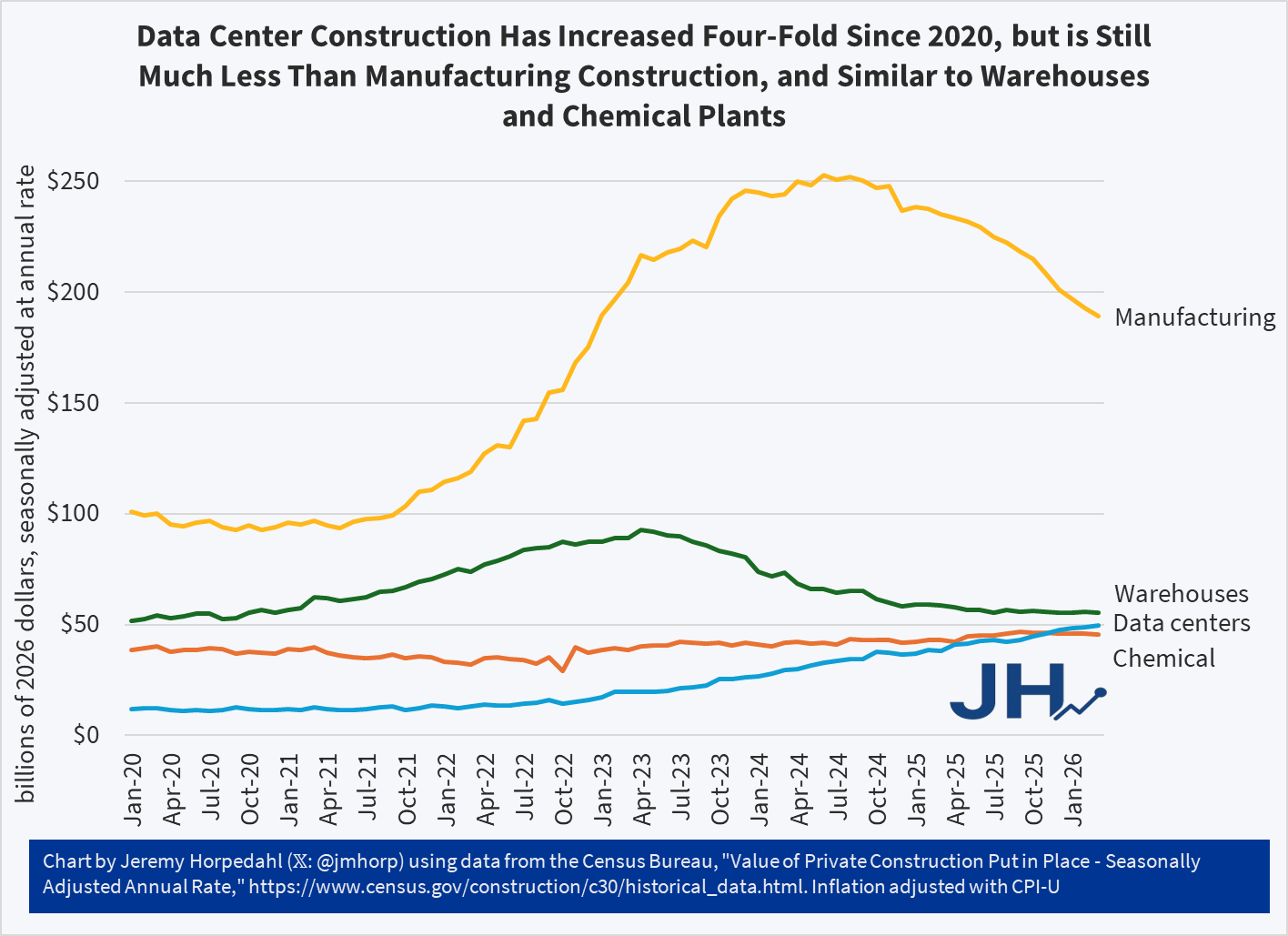
Data centers seem to be popping up everywhere. And based on the value of current construction, the US is indeed building a lot more data centers than we were in 2020 or 2021, about four times as much data center construction (inflation adjusted).
But… did you know that we build a lot more good-old manufacturing than data centers? Almost four times as much in recent months. And that’s even after a decline in manufacturing construction over the past year and a half.
The US also builds about the same amount of warehouses and chemical plants as we do data centers. Data centers may exceed those two categories in a few years, but for now they are pretty similar.
Keep in mind that manufacturing and chemical facilities also use a lot of electricity and water, and have plenty of local negative externalities! Warehouses probably have a lot less resource consumption and external effects, but it’s not zero either.
Are data centers popping up everywhere? Well, people are certainly noticing them. But so are lots of other types of buildings, which rarely register more than a peep from concerned citizens and local media, unless there is some clear and obvious external effect.


Interesting data (as usual). Got me curious. I asked Claude why all the warehouses — is it for more foreign-sourced goods? Not really:
Why the U.S. Has Been Building Enormous Warehouses
1. E-Commerce Is the Biggest Driver This is the dominant force. When you order something online and expect it in 1–2 days, it requires a completely different fulfillment infrastructure than traditional retail. .. A traditional store essentially outsources its inventory storage to the customer’s home — e-commerce reverses that, requiring the retailer to hold enormous volumes of inventory close to population centers. WJLA
2. The Shift from “Just-in-Time” to “Just-in-Case” Inventory …For decades, companies ran lean supply chains — keeping minimal inventory and relying on fast replenishment from suppliers, often overseas. The pandemic exposed how catastrophically fragile that model is. The trend away from just-in-time inventory management toward just-in-case supply chains became a major driver of warehouse construction, as companies chose to hold larger buffer stocks to protect against future disruptions. .. Justia
3. Reshoring and Domestic Manufacturing …. Manufacturing construction spending grew by 23% in 2024, and the manufacturing category made up more than 27% of all non-residential construction spending — more than warehouses themselves. New domestic factories need raw material storage, component staging, and finished goods distribution facilities nearby. ABC15 Arizona
4. Tariff-Driven Stockpiling ….When companies anticipate tariff increases on imports — particularly from China — they rush to import and stockpile goods before tariffs take effect. The announcement of tariffs and increased cost of imports has created volatile swings in container volume from China, directly affecting how much warehouse space retailers and distributors need at any given moment. nih
5. Cold Chain and Specialized Storage Growth in grocery delivery, pharmaceuticals, and temperature-sensitive goods has created demand for specialized cold storage warehouses, which are substantially larger and more complex than standard facilities.
LikeLike