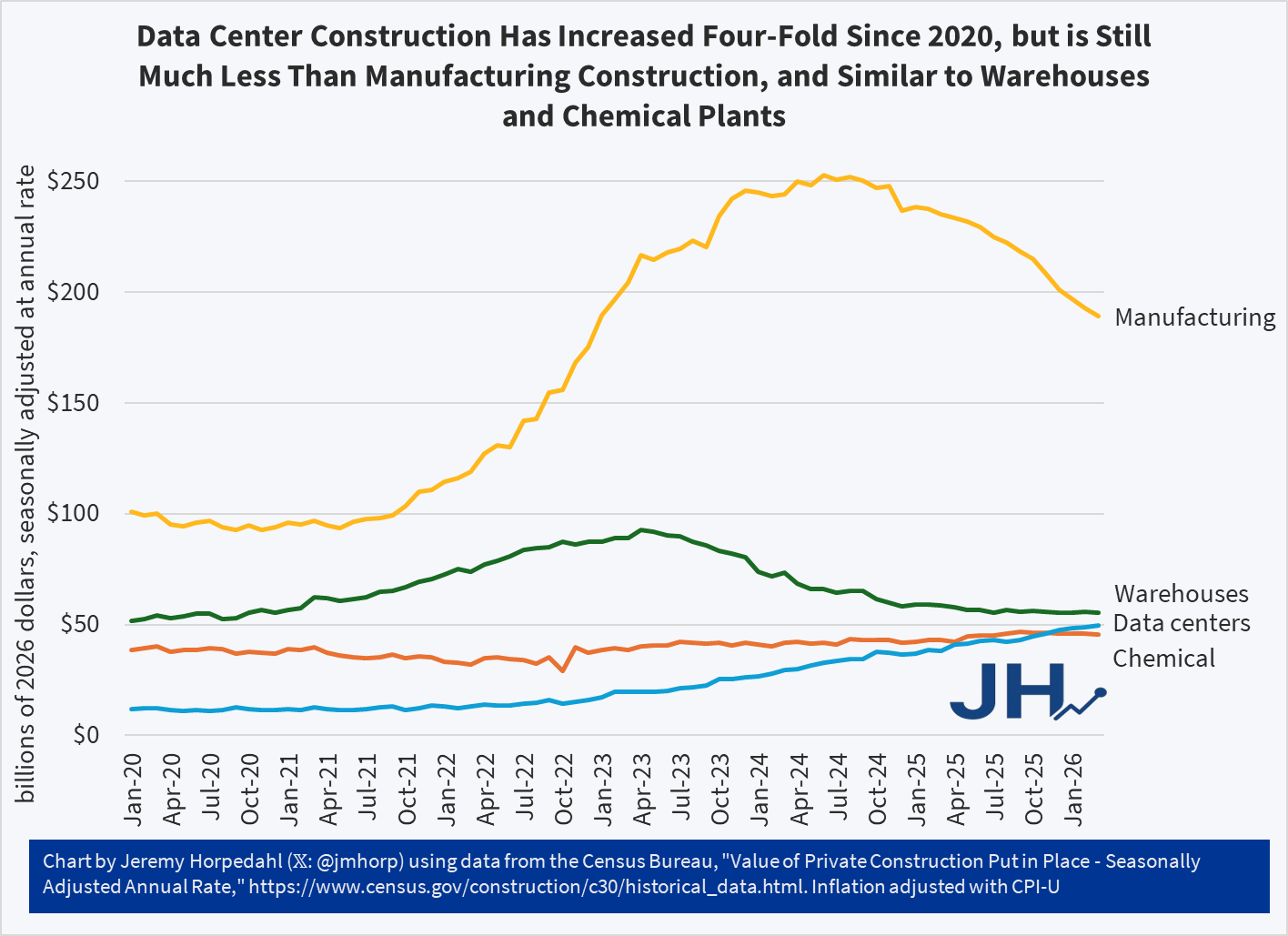
Data centers seem to be popping up everywhere. And based on the value of current construction, the US is indeed building a lot more data centers than we were in 2020 or 2021, about four times as much data center construction (inflation adjusted).
But… did you know that we build a lot more good-old manufacturing than data centers? Almost four times as much in recent months. And that’s even after a decline in manufacturing construction over the past year and a half.
The US also builds about the same amount of warehouses and chemical plants as we do data centers. Data centers may exceed those two categories in a few years, but for now they are pretty similar.
Keep in mind that manufacturing and chemical facilities also use a lot of electricity and water, and have plenty of local negative externalities! Warehouses probably have a lot less resource consumption and external effects, but it’s not zero either.
Are data centers popping up everywhere? Well, people are certainly noticing them. But so are lots of other types of buildings, which rarely register more than a peep from concerned citizens and local media, unless there is some clear and obvious external effect.
Last week I drove an hour south to help an acquaintance with constructing his retirement home. I answered a group email request, looking for help in putting up a wall in this house. I assumed this was a conventional stick-built construction, so I envisioned constructing a studded wall out of two by fours and two by sixes whilst lying flat on the ground, and then needing four or five guys to swing this wall up to a vertical position, like an old-fashioned barn raising.
But that wasn’t it at all. This house was being built from Structure Integrated Panels (SIP). These panels have a styrofoam core, around 5 inches thick, with a facing on each side of thin oriented strandboard (OSB). (OSB is a kind of cheapo plywood).
The edges have a sort of tongue and groove configuration, so they mesh together. Each of the SIP panels was about 9 feet high and between 2 feet and 8 feet long. Two strong guys could manhandle a panel into position. Along the edge of the floor, 2×6’s had been mounted to guide the positioning of the bottom of each wall panel.
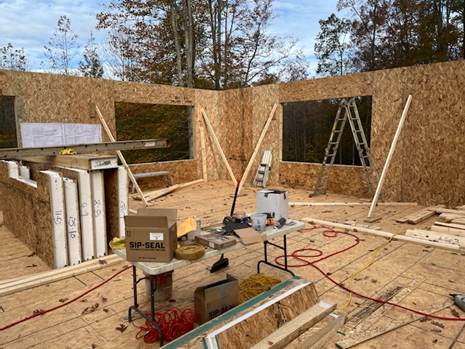
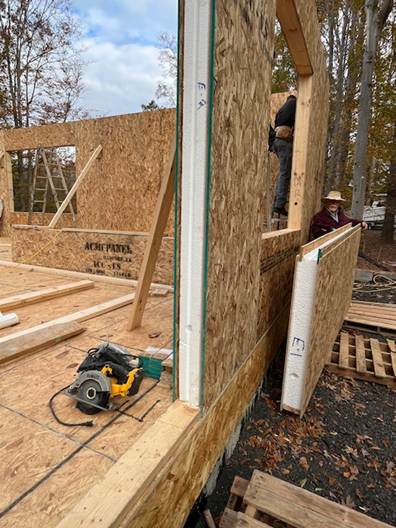
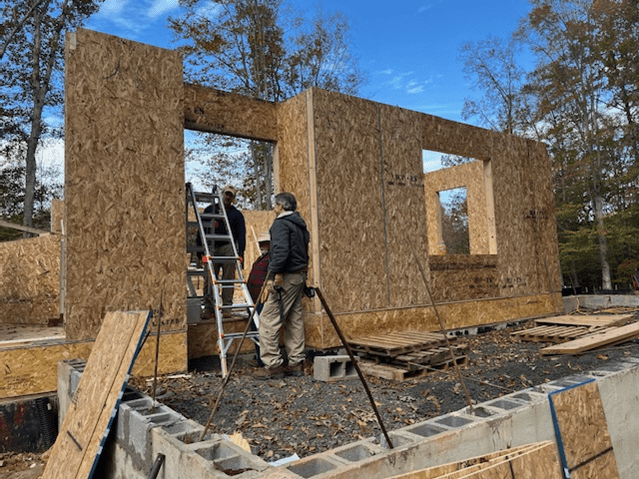
We put glue and sealing caulk on the edges to stick them together, and drove 7-inch-long screws through the edges after they were in place, and also a series of nails through the OSB edges into the 2×6’s at the bottom. Pneumatic nail guns give such a satisfying “thunk” with each trigger pull, you feel quite empowered. Here are a couple photos from that day:
The homeowner told me that he learned about SIP construction from an exhibit in Washington, DC that he attended with his grandson. The exhibit was on building techniques through the ages, starting with mud huts, and ending with SIP as the latest technique. That inspired him.
(As an old guy, I was not of much use lifting the panels. I did drive in some nails and screws. I was not initially aware of the glue/caulk along the edges, so I spent my first 20 minutes on the job wiping off the sticky goo I got all over my gloves and coat when I grabbed my first panel. My chief contribution that day was to keep a guy from toppling backwards off a stepladder who was lifting a heavy panel beam overhead).
We amateurs were pretty slow, but I could see that a practiced crew could go slap slap slap and erect all the exterior walls of a medium sized single-story house in a day or two, without needing advanced carpentry skills. Those walls would come complete with insulation. They would still need weatherproof exterior siding (e.g. vinyl or faux stone) on the outside, and sheetrock on the inside. Holes were pre-drilled in the Styrofoam for running the electrical wiring up through the SIPs.
From my limited reading, it seems that the biggest single advantage of SIP construction is quick on-site assembly. It is ideal for situations where you only have a limited time window for construction, or in an isolated or affluent area where site labor is very expensive and hard to obtain (e.g., a ski resort town). Reportedly, SIP buildings are mechanically stronger than stick-built, handy in case of earthquakes or hurricanes. Also, an SIP wall has very high insulation value, and the construction method is practically airtight.
SIP construction is not cheaper than stick built. It’s around 10% more expensive. You need perfect communication with the manufacturer of the SIP panels; if the delivered panels don’t fit properly on-site, you are hosed. Also, it is tough to modify an SIP house once it is built.
Because it is so airtight, it requires some finesse in designing the HVAC system. You need to be very careful protecting it from the walls from moisture, both inside and out, since the SIP panels can lose strength if they get wet. For that reason, some folks prefer to not use SIP for roofs, but only for walls and first-story flooring. For more on SIP pros and cons, see here and here.