Fiscal Trends: USA’s 250th (And the Government’s 237th)

We celebrate 250 years since the Declaration of Independence was signed on July 4th, 1776. That’s the day that we celebrate our country’s birth. So, it’s very American of us to celebrate the day that we merely declared independence (not the day that the revolutionary war ended). We simply said we were independent from the crown. Regardless, we celebrate 250 years as a people. BUT, our government is only 237 years old.  The current constitution replaced the articles of confederation in 1789.  So there are some caveats to the whole semiquincentennial thing.

An important distinction that is baked into the American pie is that we are not our government. Our government is younger than we are. Our government has a piggy bank called ‘US Treasury’. It can spend and borrow for the US national government. It can also impose tax liabilities on the population in order to service those outlays. Now that it’s the government’s 237th birthday, what’s its basic financial track record?

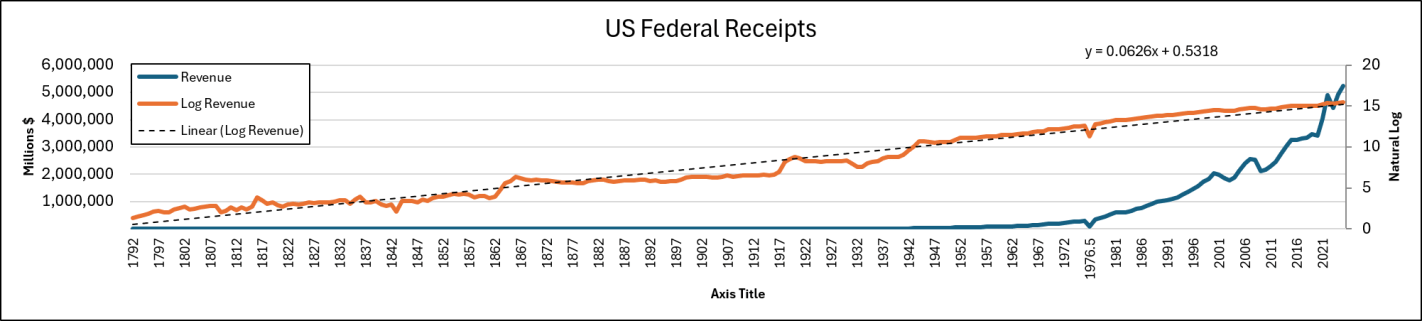
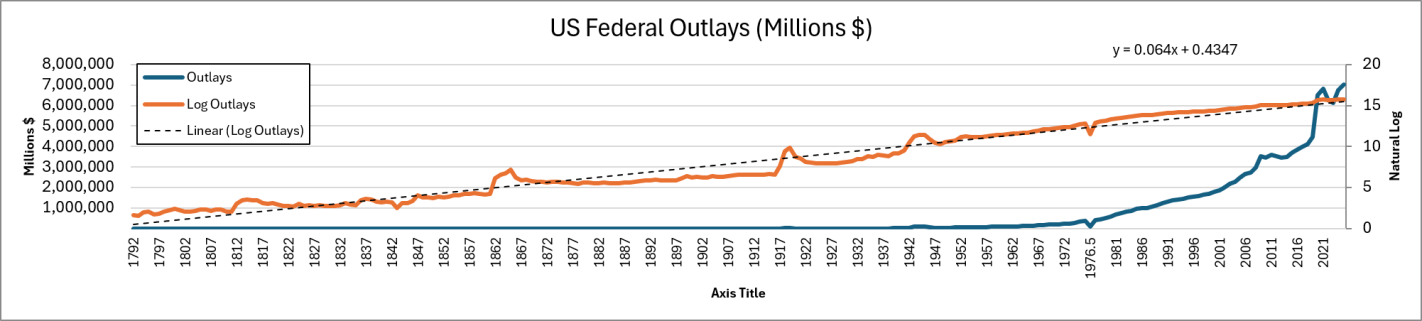
I like to think in the long run, for better or for worse, and I don’t like to get hysterical. So, let’s look at the full span of the 237 years – well – 235 years. The oldest annual data that we have is from Bicentennial Historical Statistics, which goes back to 1792. Below are the series for Federal Receipts and Outlays (revenue and spending).

The blue line is in nominal dollars and the orange line is the natural log so that we can see the changes in growth rates more easily. These aren’t inflation adjusted numbers, so we should expect to see some inflationary patterns. Long-run inflation was pretty stable prior to the 1913 Federal Reserve act and wee can see that reflected in both series. There was some drift upward in terms of revenue and expenditures. But the primary pattern was one of punctuated rises followed by plateaus. That’s a pretty standard ratcheting leviathan pattern. There’s a bump up for the big events in the first half of our history: the War of 1812, Civil War in 1861, and World War I in 1917.

Then, after the great depression and leaving the gold standard (mostly), in about 1933 a new and positive trend in cash flows began. In fact, it’s amazing how consistent the raw nominal series is.  We can see where World War II is in the series, but after that we appear to have traded punctuated increases for steady increases. Even the higher inflation rates of the 1970s look pretty muted and on trend (Btw, the blip in 1976 is a record-keeping artifact. There was a 3 month gap-period when the US government changed its fiscal year start/end). Even the new growth in total cashflows seems to be slightly bending downward and growing a little more slowly.

But rest assured, spending has exceeded revenues. Below is the long run deficit. I don’t take the log for this one since there are negative numbers. It’s hard to tell from the line graph, but the first big and persist swing in the deficit arrived after the Fed was established and the onset of WWI. The deficit hit $9 billion in 1918, which was 10x the prior peak of $0.9 billion at the end of the civil war in 1865. Notice that the above government revenues stayed flat or fell after 1920, but the outlays began trending upward before the revenues. The deficit doesn’t really start its long, steady march until 1932. Of course, for the past quarter century, the national government has been in a deficit mess (even if you measure the proportion of GDP).

Continue reading

What the Fed Knew, and When

I’ve recently gone back and started listening to the archived episodes of the ‘Macro Musings’ podcast hosted by David Beckworth. The show started in 2016. At that time, there was still a sense of malaise after the 2007-2008 Great Financial Crisis (GFC) and the slow recovery that followed it. We were also in a prolonged low-interest rate environment.

A recurring theme is whether the Fed should have engaged in expansionary policy earlier than they did in response to the GFC. There are multiple ways to answer. It’s not helpful to say ‘knowing what we know now’. The Fed didn’t have that opportunity. It’s a little bit more helpful to say ‘if the Fed had a different target or different tools’.  The target and tools are higher-order policy decisions and changing them can be helpful in the future. But they typically can’t be changed with the flip of a switch. After all, the 2% inflation target itself rolled out over the course of decades.

The most awkward/damning question is “Given the target, tools, and data that the fed actually had, did they make the right decision?”. If the answer is ‘no’, then that warrants a serious investigation of individuals, groups, processes, etc. I don’t mean a legal investigation. I mean the decentralized kind in which public and expert trust can be affected.

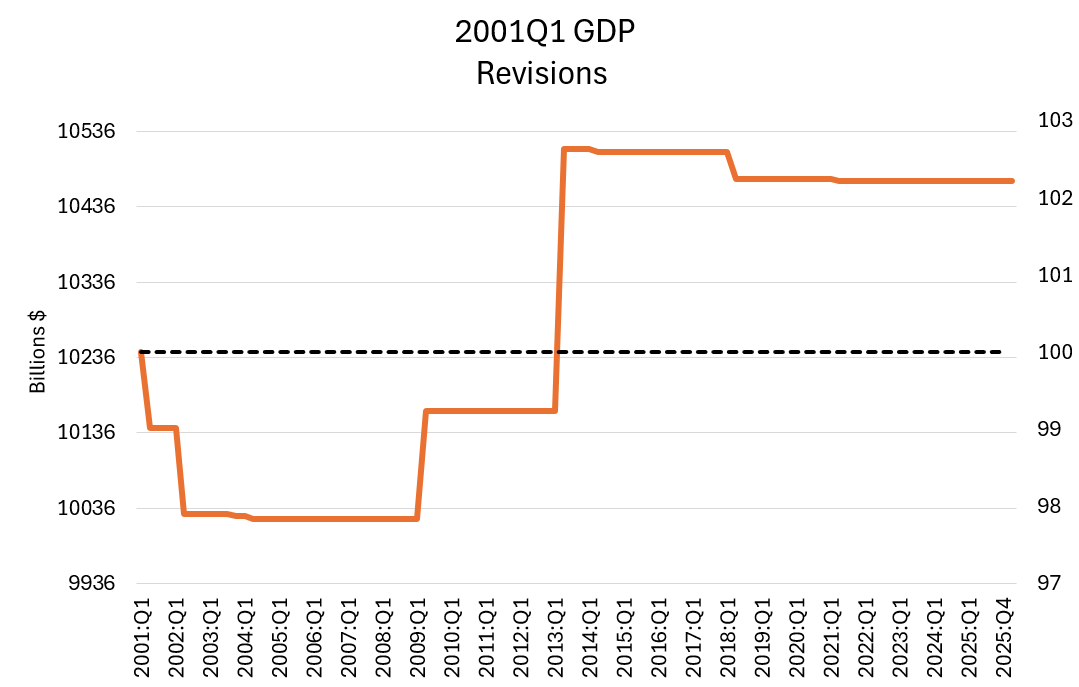
A concept that Beckworth often mentions concerning Fed culpability/performance during the GFC is the problem of data revisions. Currently, we know what the revised data says about NGDP, inflation, employment, etc. But the Fed only had the contemporary numbers and immediate revisions. In a world where economic growth is lousy or stellar in a range of 1-3%, small revisions can matter a lot. For example, below are the 2001q1 NGDP revision values over time.

Revisions occurred twice by 2002q2, revising NGDP down by more than 2%. Subsequent revisions raised the value on record to nearly +3% of the initial estimate, before settling at a less elevated value. Sheesh! In a world where a 1% swing is a big deal, how can we possibly expect the Fed to succeed at managing aggregate demand?

Things are not so scary as they might seem. The Fed doesn’t much care about revisions to an individual quarter. Rather, they care about the direction of change over time. Whether future revisions increase GDP by 2% is unimportant. What’s important is whether one period’s value is lower relative to the earlier value. That’s the relevant difference that tells us how the economy is changing.

Now, in 2026, our current understanding of NGDP during the GFC follows the below pattern starting in 2005q1 (lest I omit important pre-trends). NGDP growth had weakened in 2007q4, turning negative in 2008q1. Weak growth resumed in 2008q2. Then we had near-zero or negative growth for the next five quarters. Of course, we’re now approaching twenty years later, so we have the huge benefit of hindsight and revisions. Keep in mind that the contemporary numbers aren’t available until the subsequent quarter. By the yard stick of NGPD, the Fed should have been loosening by Q3 or certainly Q4 of 2008 if they cared about supporting total spending. Maybe as early as Q2 is they were especially sensitive.  

Continue reading

Greenspan’s Unknown Ideal

Alan Greenspan died this week at age 100. He was the Federal Reserve chair during my entire childhood.

But since I wasn’t really following markets and macro at the time, I don’t think of him in terms of monthly announcements about interest rates. What I find most interesting now is the winding personal and intellectual path he took to become a long-serving Fed chair.

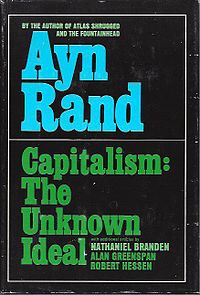
He studied clarinet at Julliard before later getting economics degrees at NYU. He supposedly attended the famous 1944 Bretton Woods conference that organized the post-war international monetary system- but as part of an orchestra, not as a monetary economist. In 1966 he coauthored “Capitalism: The Unknown Ideal” with Ayn Rand, where he argued against antitrust and consumer protection laws and for the gold standard. This may be why my intro macro professor Bobbie Horn always referred to Greenspan as “Ayn Rand’s boy toy”.

His advocacy for the gold standard is striking given that just two years later he would join the campaign of Richard Nixon, who took the US off the gold standard in 1971. Then Greenspan would go on to chair the Fed in the now-standard discretionary manner while making, as far as I can tell, no attempts to move it back in the direction of a gold standard.

While it’s unclear whether Greenspan’s unusual path improved his ability as a Chair, it was at least possible then to reach the office by his somewhat unusual path. Since his 1987 appointment the path to the highest appointed offices narrowed to include only more conventional candidates. Randy Barnett and Josh Blackman noted this in a 2015 article on the Supreme Court:

earnest, platinum-résumé’d law geeks have their eyes set on “the Big Bench,” so they keep tidy lives because they think they might someday face a confirmation hearing. It is an unfortunate reality today that to be a judge, you cannot hold vehement opinions prior to the nomination and confirmation process.

I see similar forces at work in economics, where the 50 economists who have a shot at being Fed Chair and the 500 who think they do all hold their tongues. But what does that mean for the kind of Fed Chairs we get?

the truth about SCOTUS-wannabes who “trim their sails” and limit their potential based on a fear of a future confirmation hearing: Such persons lack the character a justice needs…. “Courage is a muscle. You develop courage by exercising it. Sitting on the fence is not practice for standing up.” Imagine what it takes to live your whole professional and personal life as a “justice-in waiting.” These SCOTUS-wannabes spend their careers seeking the approval of others, in the hopes that one day they will be nominated because of their friendships across the political spectrum. 

Barnett and Blackman argued that this should change, and I think this is now in the process of changing again:

Such willfully “stealth candidates” should be disqualified from consideration for the Supreme Court…. We need jurists who are fearlessly committed to the rule of law, reputation be damned…. Paper trails are an asset, not a disqualification.

Raise Rates- But Not Because Of Oil

Next week the Fed will almost certainly hold interest rates steady. Stephen Miran will probably dissent saying the Fed should be cutting rates. Kevin Warsh, Trump’s nominee for Fed Chair, would also like to see cuts. But other prominent voices think that rising oil and gas prices mean we should be raising rates.

I still think that rate hikes make more sense than cuts- but not because of oil. The high oil and gas prices we’re seeing are obviously driven by supply shocks from the Iran war- not increasing demand. Raising rates to fight an oil shock would mean repeating a classic mistake.

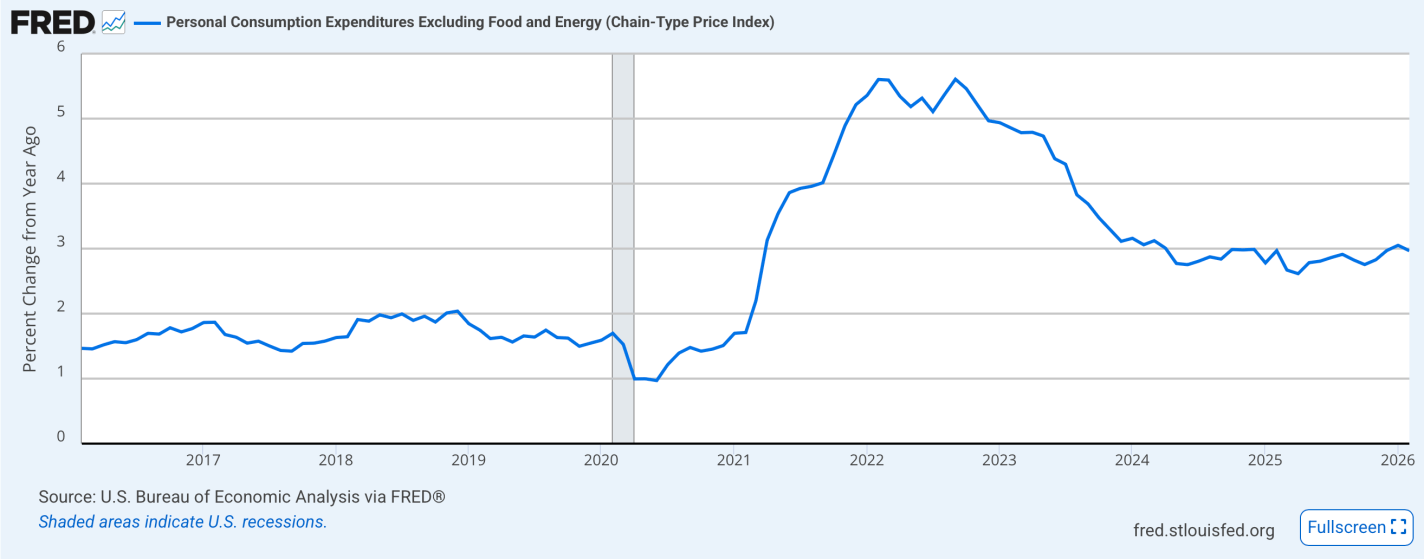
But raising rates to fight core inflation that is at 3% makes perfect sense. Especially when inflation (overall or core) hasn’t been at or below the Fed’s supposed 2.0% target in over 5 years, and market forecasts predict it will stay well above 2.0% for the next 5 years.

Especially when real GDP is growing, and NGDP is still above trend, and the unemployment rate is 4.3%. Financial conditions are so loose that stock markets are hitting all time highs in the middle of a war.

Various Taylor Rules suggest that the Fed Funds rate should be between 4.25% and 6.25%, but the Fed currently has us at 3.75%.

I see so many good arguments to raise rates- there is no reason to bring up a bad one like oil prices. If we must latch on to a headline to find the argument to raise rates, let’s focus on a shoe company’s stock going up 600% because they announced they were pivoting AI.