I’ve recently gone back and started listening to the archived episodes of the ‘Macro Musings’ podcast hosted by David Beckworth. The show started in 2016. At that time, there was still a sense of malaise after the 2007-2008 Great Financial Crisis (GFC) and the slow recovery that followed it. We were also in a prolonged low-interest rate environment.
A recurring theme is whether the Fed should have engaged in expansionary policy earlier than they did in response to the GFC. There are multiple ways to answer. It’s not helpful to say ‘knowing what we know now’. The Fed didn’t have that opportunity. It’s a little bit more helpful to say ‘if the Fed had a different target or different tools’. The target and tools are higher-order policy decisions and changing them can be helpful in the future. But they typically can’t be changed with the flip of a switch. After all, the 2% inflation target itself rolled out over the course of decades.
The most awkward/damning question is “Given the target, tools, and data that the fed actually had, did they make the right decision?”. If the answer is ‘no’, then that warrants a serious investigation of individuals, groups, processes, etc. I don’t mean a legal investigation. I mean the decentralized kind in which public and expert trust can be affected.
A concept that Beckworth often mentions concerning Fed culpability/performance during the GFC is the problem of data revisions. Currently, we know what the revised data says about NGDP, inflation, employment, etc. But the Fed only had the contemporary numbers and immediate revisions. In a world where economic growth is lousy or stellar in a range of 1-3%, small revisions can matter a lot. For example, below are the 2001q1 NGDP revision values over time.
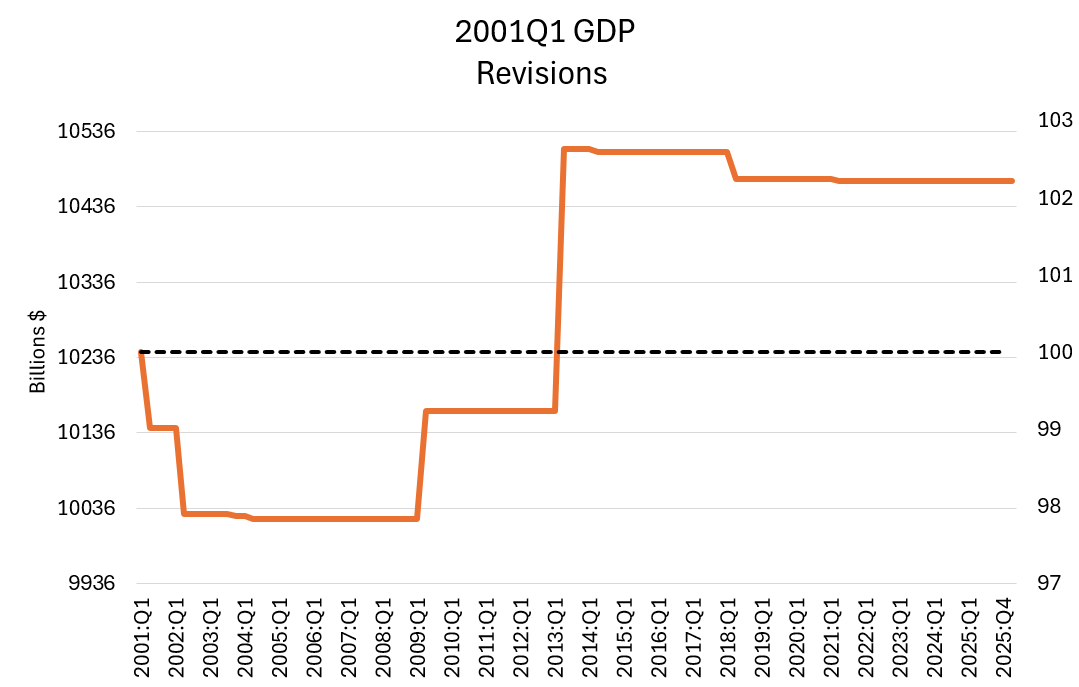
Revisions occurred twice by 2002q2, revising NGDP down by more than 2%. Subsequent revisions raised the value on record to nearly +3% of the initial estimate, before settling at a less elevated value. Sheesh! In a world where a 1% swing is a big deal, how can we possibly expect the Fed to succeed at managing aggregate demand?
Things are not so scary as they might seem. The Fed doesn’t much care about revisions to an individual quarter. Rather, they care about the direction of change over time. Whether future revisions increase GDP by 2% is unimportant. What’s important is whether one period’s value is lower relative to the earlier value. That’s the relevant difference that tells us how the economy is changing.
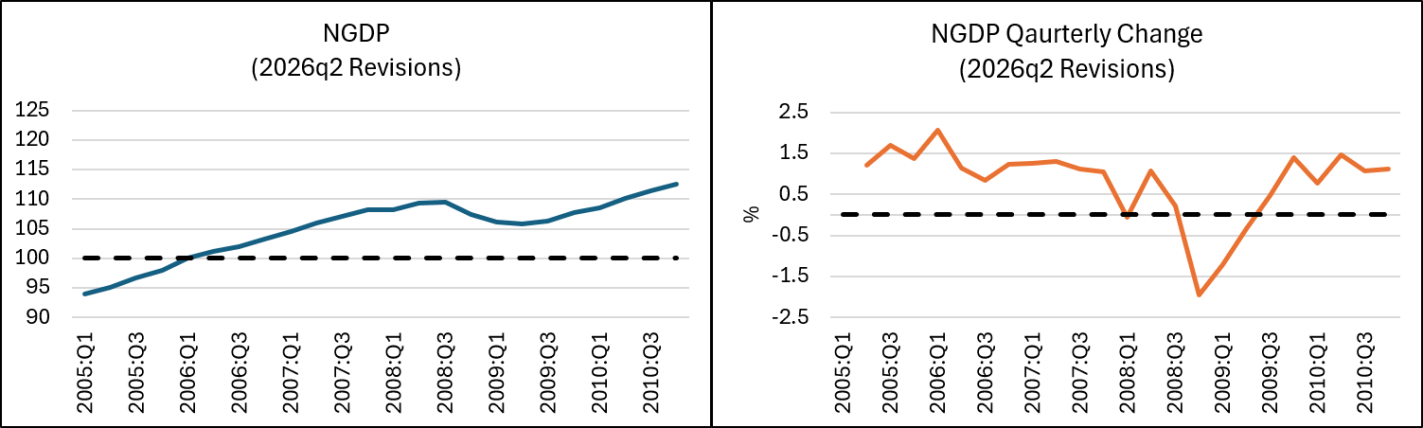
Now, in 2026, our current understanding of NGDP during the GFC follows the below pattern starting in 2005q1 (lest I omit important pre-trends). NGDP growth had weakened in 2007q4, turning negative in 2008q1. Weak growth resumed in 2008q2. Then we had near-zero or negative growth for the next five quarters. Of course, we’re now approaching twenty years later, so we have the huge benefit of hindsight and revisions. Keep in mind that the contemporary numbers aren’t available until the subsequent quarter. By the yard stick of NGPD, the Fed should have been loosening by Q3 or certainly Q4 of 2008 if they cared about supporting total spending. Maybe as early as Q2 is they were especially sensitive.
What should the Fed have done?
What did the Fed know at the time? Let’s examine the numbers at contemporary revisions in 2006-2009 (indexed to 2006q1=100). Each chart shows the quarterly revisions for each year. So, I only graph the 3rd and 4th quarter releases of the 2nd and 3rd quarter data in 2006.
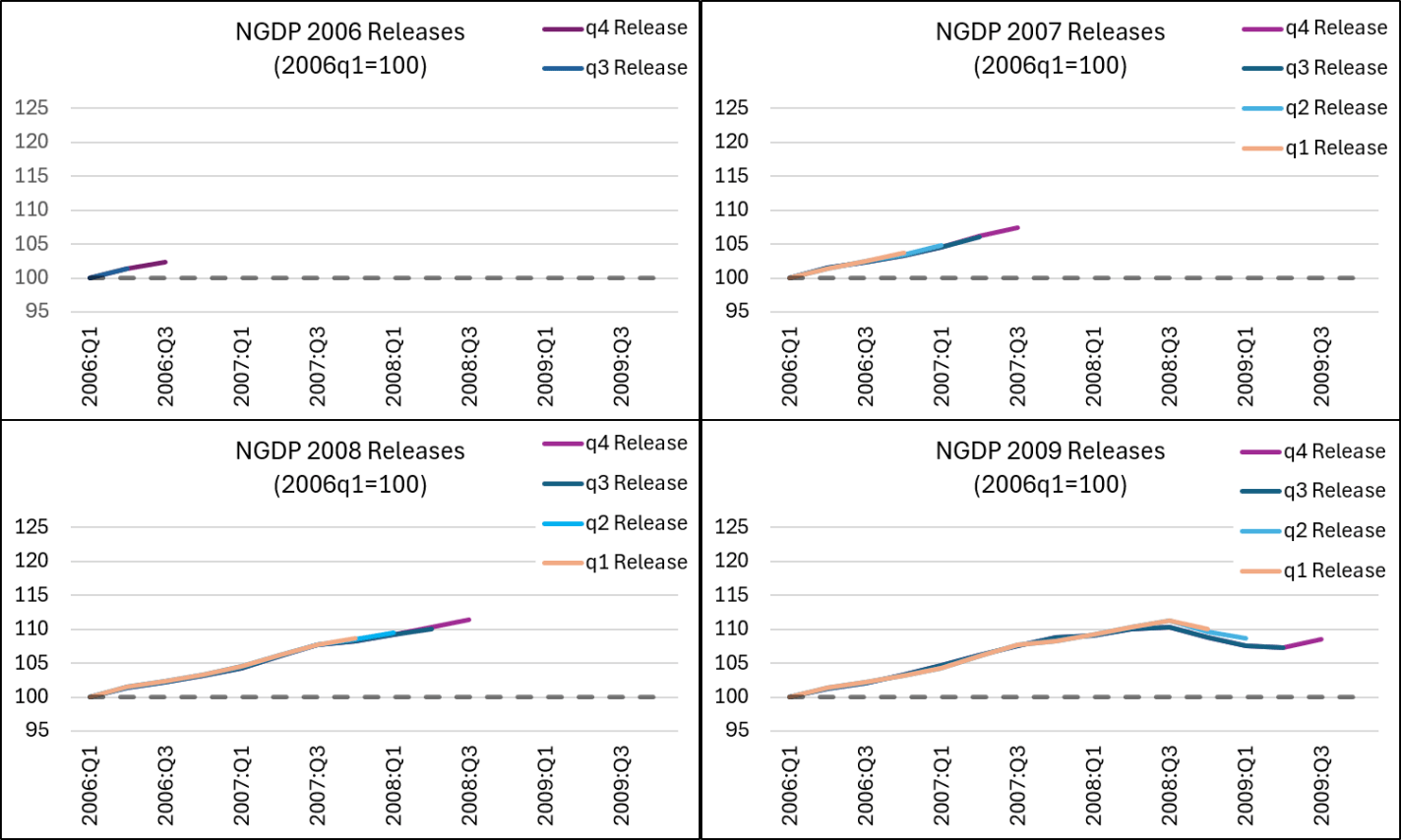
The NGDP data that the Fed had in their hands from 2006-2008 said that there was no reason for drastic rate cuts. However, by the 3rd quarter release of 2008q2 data, it was clear that NGDP growth was half of what it should have been for two straight quarters. By the 2009q1 release, it was obvious that 2008q4 had negative growth. That negative growth persisted for the 3 following quarters through 2009q2. According to the NGDP numbers, the Fed should have been cutting rates by the 3rd quarter of 2008 and then cutting aggressively by 2009q1. That’s according to the data that they had in hand, flaws and all.
What did they actually do?
They pretty much did what the data told them to do. In fact, they were ahead of the GDP numbers. The graph below shows that the Fed had already begun to cut the federal funds rate by 125 basis points down to 4% by the end of 2007. The Fed then cut even more aggressively down to 2% by May of 2008. In other words, based on the quarterly NGDP releases, the Fed was doing what it was supposed to do with interest rate policy.
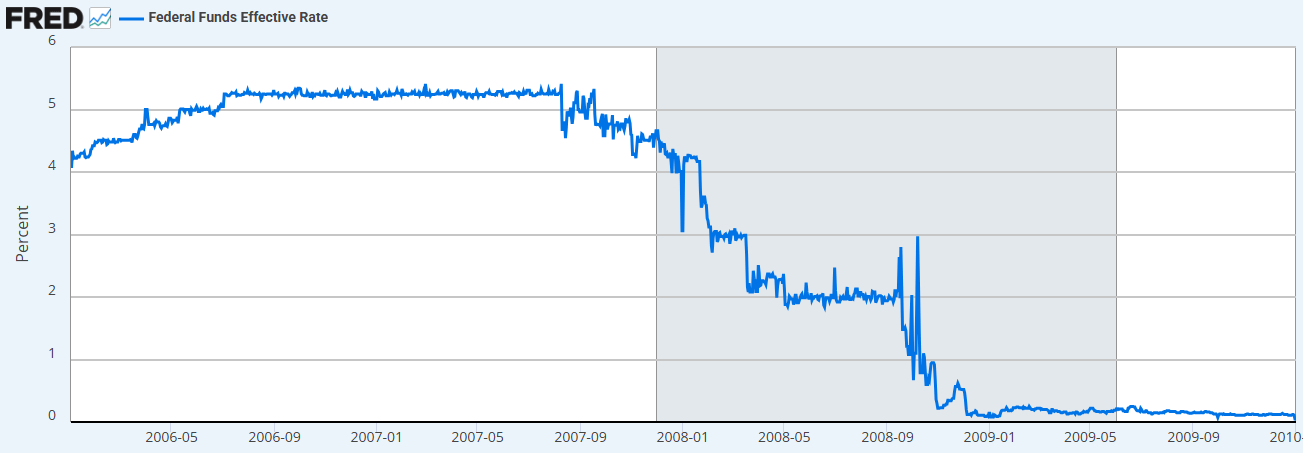
Some people, including myself, have criticized the Fed for being too slow as the GFC unfurled. And many of those critics happen to be market monetarists who favor targeting NGDP. Leaving aside their prescriptions for new tools, they often argue that the Fed should have cut rates as soon as NGDP growth started to falter. But that’s exactly what the Fed did! They cut in 2007 as growth slowed, then started slashing as growth turned negative. The negative NGDP growth of 2007Q4 was released in late January 2008 and that’s exactly when we see fed funds rate get sliced from 4.25% to 3%. Reasonable minds can argue over whether when rates should have hit zero instead.
I can’t sum up all of Fed macro policy in a blog post. But I hope that this post gives us pause. The Fed acted quickly to adjust interest rates when it had information about weak NGDP.
There are some caveats. Here, I’ve used quarterly NGDP. But consumption expenditures are available monthly and NGDP revisions are also released monthly. Since consumption is the largest component of GDP, one could argue that I should be using those numbers instead or use the monthly GDP revisions. My use of quarterly revisions stacks the deck and makes the Fed look better than monthly data may permit. Second, the Fed had expressed worries that inflation would exceed their internal target of 2%. So, maybe I should be referring to the inflation numbers instead of NGDP growth. Finally, the focus on cutting the federal funds rate ceases to mean as much when a new monetary policy tool is also introduced. Specifically, the Fed announced and started paying banks interest on their reserve balances in October of 2008, coinciding with federal funds rate cut to zero. That had a sterilizing effect on total spending, because banks retained reserves rather than lend to private borrowers.
 Economist Writing Every Day