Did you know that we have access to digital copies of the historical US census rolls? You can also find the digitized data at IPUMS. However, the data for people with disabilities is not great. It depends on the year, but those data have error rates on the order of 20% or higher. We have the digital census rolls, the data just doesn’t match them.
So, I created a non-install windows computer application that lets people identify disabled people on those digital census rolls. Complemented with machine learning, my goal is to improve the accuracy of historical records about people with disabilities. Historical and quantitative research about disabled populations is relatively thin. We can do better. If you have students who would benefit from this research experience, then do please let me know! I can approve your institution’s email domain and we can get started.
The application is really straightforward with basically two user-facing features.
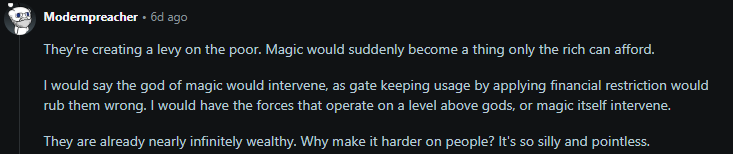
Economics is everywhere, but I find endless enjoyment in watching others learn about economics in unexpected places. In this case, it’s in the largest Dungeons and Dragons subreddit, where a particularly long-playing and supremely powerful group of adventurers get the bright idea to institute a tax…on magic. What could possibly go wrong?
Well, that is precisely the discussion that emerges. All the things that will and should go wrong if you decide to place a tax on what is essentially the wellspring of all technology and welfare in their world. All healthcare, production, sanitation, agriculture, public safety, etc etc. It all comes back to magic. And these hearty and hale adventurers think it would nice to rake in a few extra million gold pieces by placing, and presumably enforcing, a tax on it.
What’s fascinating is to walk through the comments and watch the crowd collectively puzzle out all the ways this is going to backfire, only to then march through ways the world is going to collectively respond and eventually rebel. There’s a reason why most tax discussions eventually become, at the very least, targeted and, at their very best, highly nuanced. Because it is no small decision how a society should best leverage taxation as a means to solve a problem. Do we want to tax the rich? Ok, what’s the line at rich? Do we want to eliminate regressive taxes targeting the poor? Ok, but is this only a tax or is it doing something else as well?
In this world of magic and mayhem, we see our heroic players stumble into literally the worst possible thing you could ever tax: the entire body of technology. Not labor, not capital, not income, not capital gains…no, they target the single most important input into all of economic growth and human welfare. From a pedagogical point of view, this is <chef kisses fingers> perfection. Absolutely no notes. I’m not kidding when I say that, if I was still teaching Principles of Economics, I would build a class discussion around this exact thread.
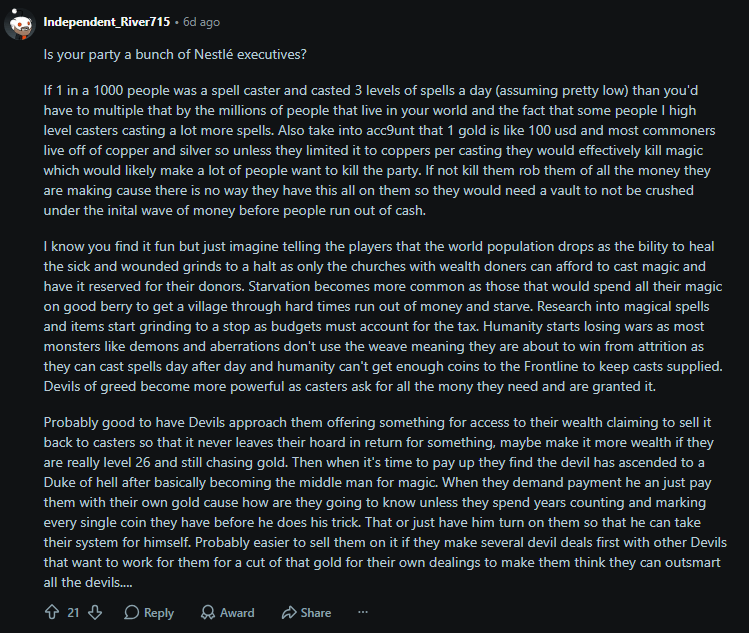
And special shout out the commenter to worked through the economic, political, and ecumenical consequences in real time:
It’s economics all the way down, apparently even into the depths of The Nine Hells.

 Economist Writing Every Day