Political discontinuities

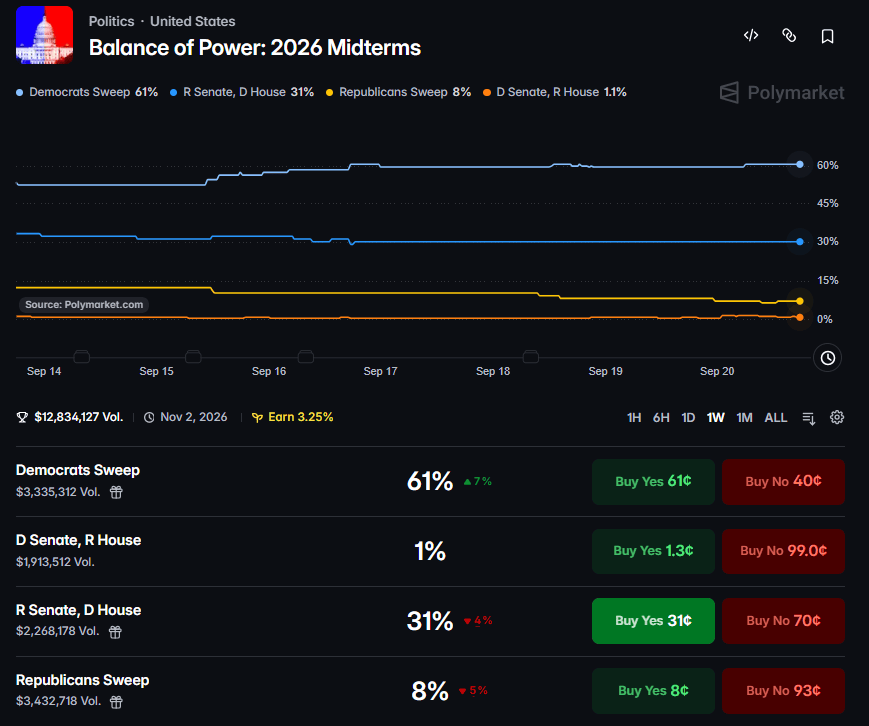
Here’s the Polymarket…market… for bets on the outcome of the US midterms in November over the last 7 days. You’ll notice a 7 percentage point (13% relative to a 54pp baseline) increase in the expected probability of the leading outcome. That’s a very big change, most of which happened over 3 days. In a $12.8 million market where the largest shareholder has $73k on the line, that is a very, very big move.

I don’t have any insight into what is happening here, I would simply note that there was to my knowledge no singular news item or event that appears to have sparked this. It’s just a great example of what makes betting markets so interesting. There is some tacit knowledge held by a relatively small number of inviduals, but within and through this market this information has now become at least partially observable in the form of a price. Now, to be extra, super, you just won’t believe how clear about this, I don’t have any insight to lay on top of this, no personal model to share, and I would strongly advise very nearly everyone against trying to participate in this market for personal profit. But, nonetheless, this is useful information. If you made me choose between a world with sports gambling or everything else gambling, I might very well choose “everything else.” At least the world captures some value from the revealed information that is, at least in part, subsidized by enabling a very real and serious addiction. I don’t know that we can say anything similarly positive about sports gambling.

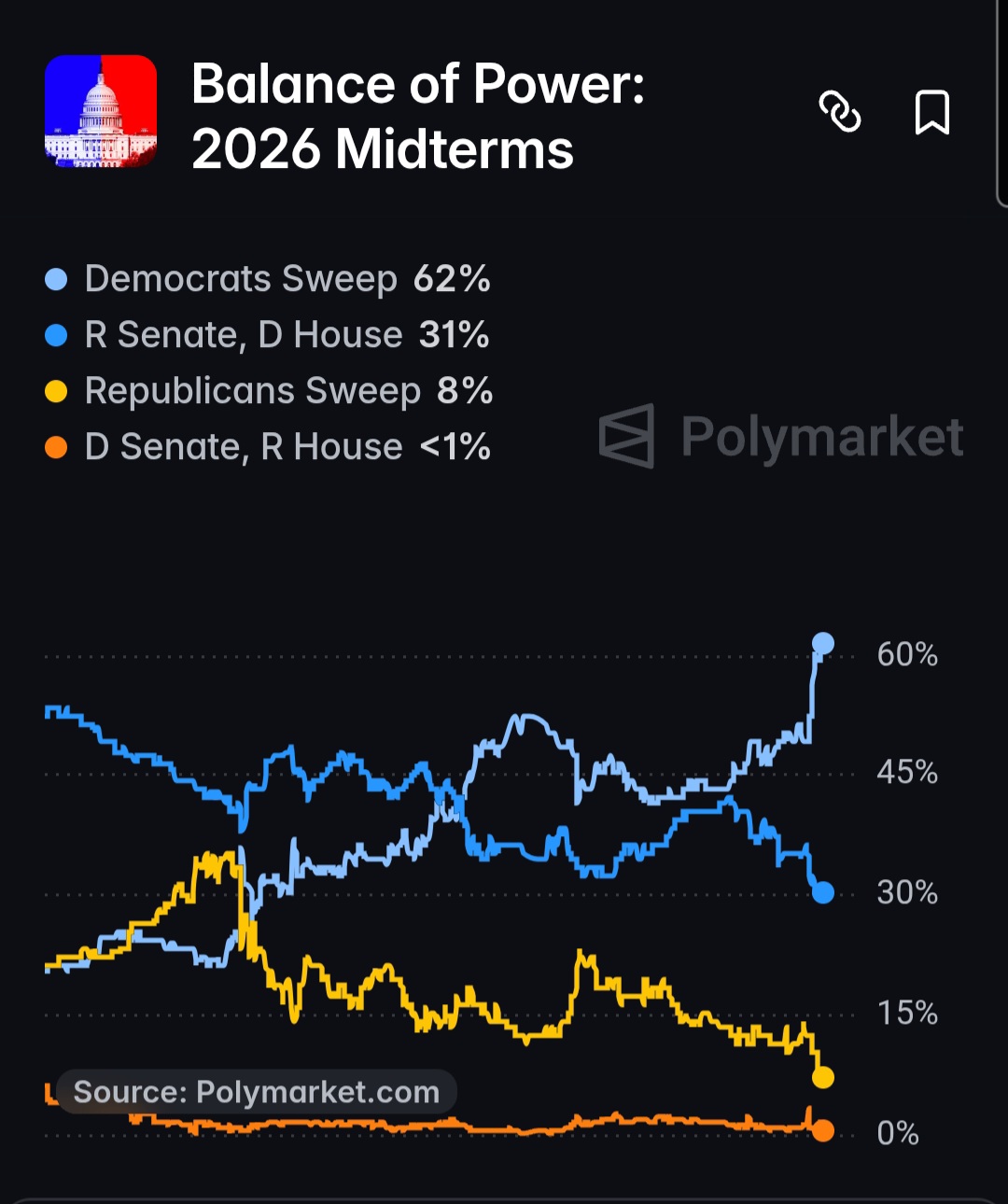
Update: longer timeline as of 10am this morning (7/11 to 9/21)
When do betting markets become endogenous?

I don’t have an article or statistic to point to, just a question: what is the threshold at which a betting market outcome becomes endogenous to the existence of the betting market?

Polymarket recenttly removed its market for a nuclear detonation. The implication is straightforward: if a market exists for an outcome that a singular individual (or small group) can make manifest, then as the market becomes takes on greater volume, the maximal reward for independently producing the wagered upon outcome increases. This generates a testable hypothesis: does the predicted possibility of a positive outcome increase with market volume?

If and when the answer is yes, market volume has a positive causal relationship with market outcomes, then the welfare proposition of the market existing comes into question. I don’t care about more accurately predicting nuclear detonation if the market yielding the prediction is increasing it’s probability of occurring.

Now, do I think betting markets are increasing the probability of a nuclear explosion? Eh….probably not, or at the very least the effect should be quite modest. But there are lots of events on prediction markets that raise this possibility without wading into the waters of apocalypse-adjacent outcomes. As I discussed previously, the endogeneity of sports outcomes to betting markets is threatening the integrity of professional competition. Many of those obscure sports wagers don’t seem like thick markets, but relative to a 20 years where such wagers didn’t even exist, they are positively rippling with volume.

In a world where unscrupulous individuals are betting big on their ability to extract enough rents in public life before the world catches up with them, we would be wise not that add more profit channels for corruptuon than we are capable of credibly monitoring.