The phrase “are you better off than you were 4 years ago?” seemed to have been a winning campaign slogan for Ronald Reagan in 1980. But when I looked at the data, it didn’t really hold up, if we are looking at real income growth to determine “better off.” Real family income growth was actually positive under Carter, but he lost reelection. Then four years later, Reagan won reelection, despite having negative real income growth. This is a pattern we see often in recent presidential reelection years. Interestingly, it does not appear to be 4-year income growth that matters, but 1-year income growth might.
Is there any similar data we can look at for midterm elections? It is well known that Presidents almost always lose seats in a midterm election. But might they lose fewer seats if the economy is performing well? The following scatter plot shows all midterm elections since 1970. On the horizontal axis is the percent change in real wages (AHETPI series, deflated by the PCEPI) from the January a President takes office until November of the midterm election year. The vertical axis shows the net change in Congressional seats for the party of the President, including both the Senate and House (I weight Senate seats at 4.35x House seats, which is somewhat arbitrary).
Figure 1
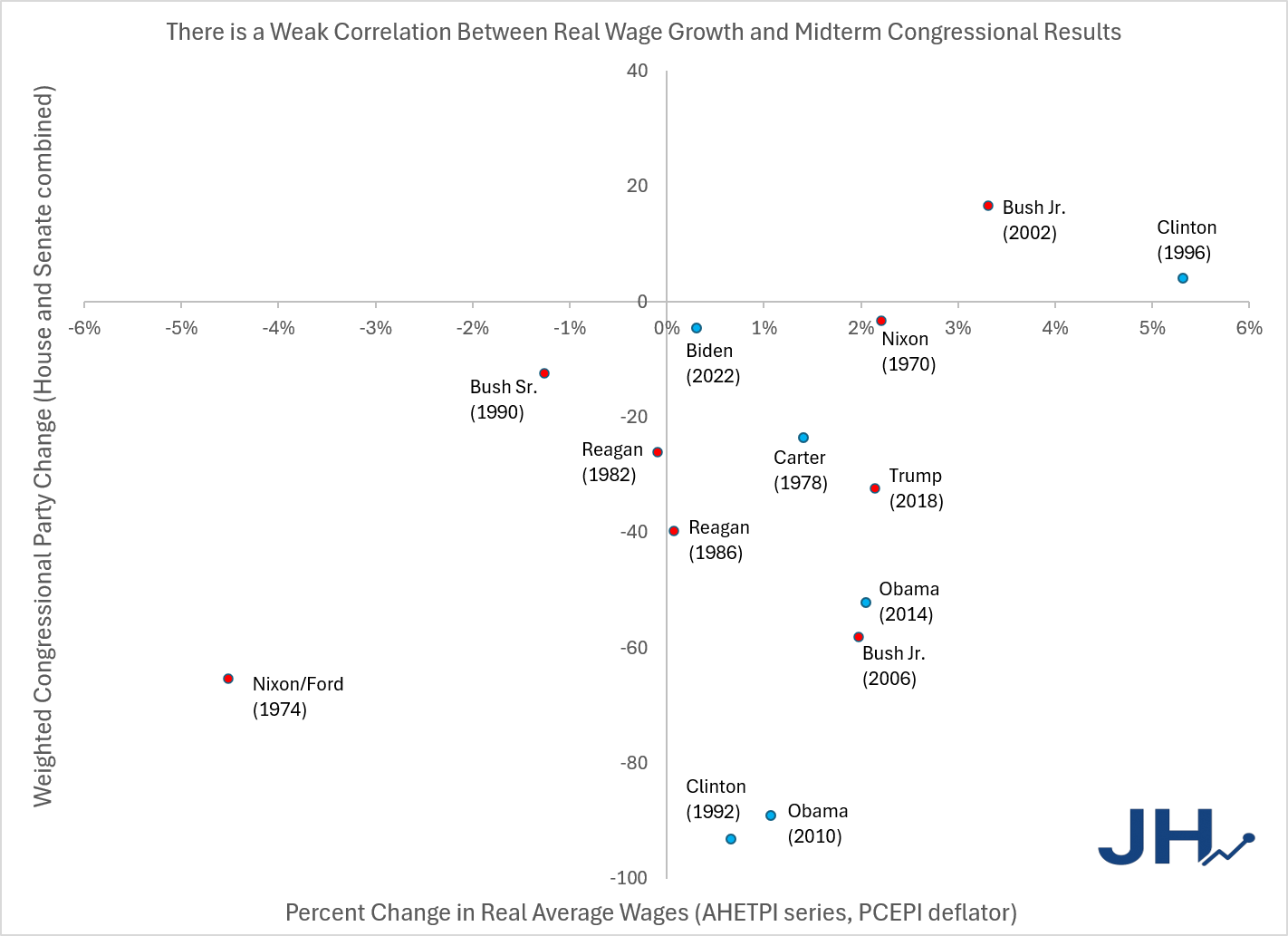
What can we learn from this scatter plot? I would say there is a weak correlation between the variables: better real wage growth means losing few seats. The sample size is small, so I am reluctant to plot a trendline, but it would be positive. The only two midterm elections since 1970 where the President’s party actually gained Congressional seats had very high wage growth: Bush in 2002 (3.3%) and Clinton in 1996 (a very robust 5.3%). Very negative wage growth shows up just once, for the Nixon/Ford midterm in 1974, and here the Congressional losses were pretty massive.
Now you might object that other factors matter. And surely they do. The Republicans probably would have lost a lot of seats in 1974 anyway, due to Nixon’s resignation. But I’m sure the higher rates of inflation and resulting negative real wage growth didn’t help. And Bush probably got a significant post-9/11 hero bounce in 2002, though the real wage growth might have helped too.
However, Clinton and Obama had the worst midterm losses in this era, in 1992 and 2010, much worse than Nixon/Ford in 1974, and despite positive but weak real wage growth. Does this mean the correlation is useless?
Here’s one way to save it: compare Presidents against themselves. While Clinton and Obama had poor showings in their first midterm elections, their second midterms were much better — and had much better wage growth! Ditto for Nixon, though in reverse: his first midterm was pretty good, and so was real wage growth. Reagan had similarly bland real wage growth rates in both midterms, and had similarly mediocre Congressional losses. Bush did worse in his second midterm — again, you could blame a reverse-9/11 effect, with voters now weary of the global War on Terror, but wage growth was also worse.
What does this all mean for Trump? While we don’t have the full wage growth picture yet, through 18 months it has been pretty mediocre: 0.3%, and falling in recent months due to inflation exceeding wage gains for most of 2026. On social media and among pundits, a lot of people are trying to make comparisons to Biden. “But gas prices were even higher under Biden!”
If Figure 1 is at all useful, it is probably most useful to compare Trump to himself, in his first midterm. Wage growth through November 2018 was about 2.1%: not bad, not great. And he suffered middling Congressional losses. Because wage growth will almost certainly be much worse this time around, we can expect Trump to perform much worse than in his first, 2018 midterm. If Democrats pick up 20 seats in the House and 5 seats in the Senate (current prediction markets suggest about this many), this will put Trump pretty close to the Reagan 1986 point in Figure 1. That feels about right, given recent history, though it wouldn’t be surprising if the Republicans lost even more seats, since that would be a Congressional shift not much different from Trump’s first midterm.

