I’ve discussed multiple times now how economics degrees are associated with higher income. One reason may be that it’s not the bachelor’s degree that’s doing the legwork, but rather the graduate degree. I examine that hypothesis here for the 25 most popular degrees in the 2024 American Community Survey.
The data identifies who has a bachelor’s degree and in what field. We also know whether an individual has a master’s or professional degree, or a doctorate. Unfortunately, we don’t know the field for the higher degrees. So, while we can say that 45% of Economics majors have a graduate degree, we can’t say that the graduate degree is in Economics. After all, plenty of people major in one thing and pursue a graduate degree in another thing.
Degree Types by College Major
Below is a chart that ranks the 25 most popular college majors and whether those graduates also hold a graduate degree. There are several patterns. First, the tier near the top of the chart shows more business majors tend to be terminal. Students majoring in communications, business, and marketing tend not to proceed to get higher degrees.
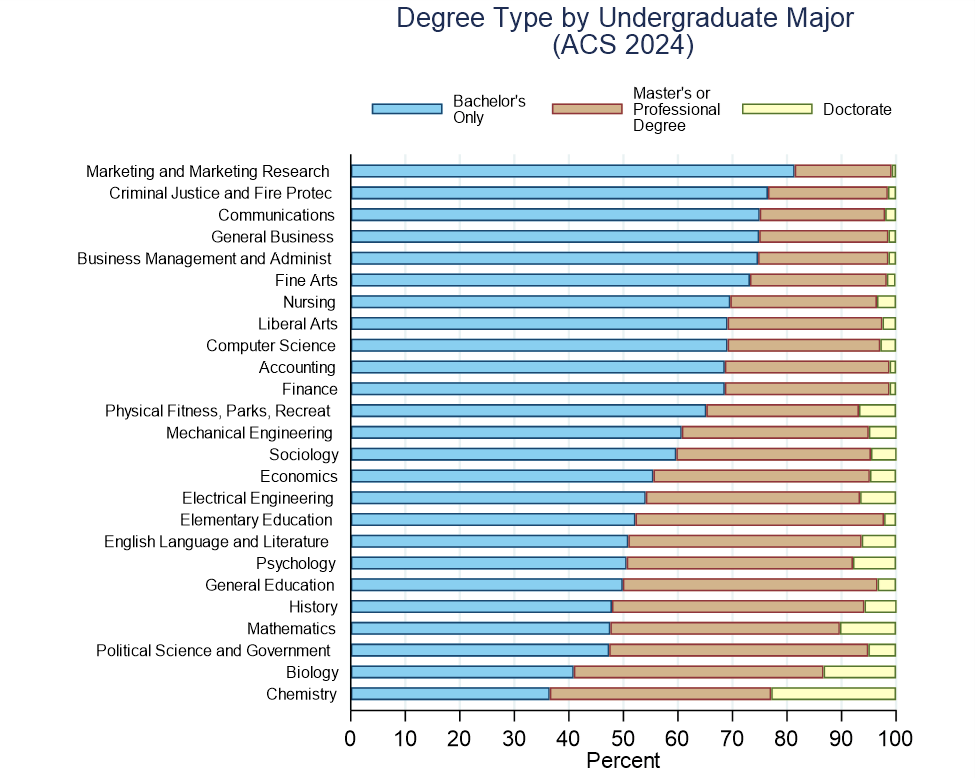
That contrasts starkly with the bottom tier of the graph where majors like Chemistry, Biology, Political Science, Math, and History all tend to have high rates of graduate degrees. I’m not sure why this is. Maybe it’s because the skills are more research-oriented in nature and prepare those students well for graduate school. Other alternatives may be that the bachelor’s degree alone doesn’t provide much income or that a graduate degree results in a large proportional increase in income for those majors.
Economics majors are on the lower end in terms of the proportion with only a bachelor’s degree (55.5%), near the middle of the pack for proportion with a master’s or professional degree (39.7%), and have an average proportion holding doctorates (5.1%).
Because the numbers make it easy, I’ll pick on education majors a little. Given the high proportion of education and elementary education majors who have graduate degrees, there are relatively few of them who have doctorates. Other majors that have a lot of graduate degree holders tend to have more doctorates, but education majors in higher education are overwhelmingly people with master’s degrees. Given that many of them work for governments, I suspect that they often get procedural pay raises merely for holding a higher degree.
Income by Degree Type and College Major
Below is a chart that shows the average income among employed people by college major and higher degree. The highest-paying terminal bachelor’s and master’s degrees are both among Economics majors ($144k & $203k). A previous post showed that Economics majors had the highest overall income and here we can see that it comes primarily from the bachelor’s and master’s degree holders, while economics majors with doctorates earn the 3rd highest income ($208k) behind computer science ($247k) and electrical engineering ($238k).
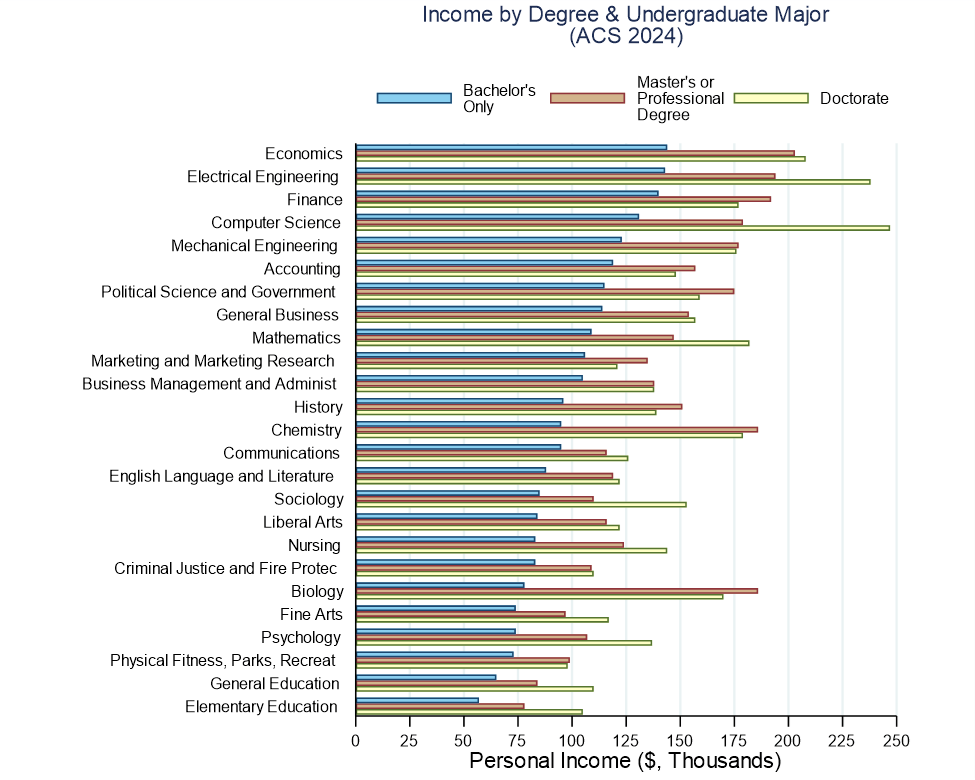
Once you have your bachelor’s degree, obtaining a higher degree uniformly provides more income. But even ignoring opportunity cost, notice that more education is not always associated with more income. Of the 25 majors here, 9 earn more income when they stop at a master’s degree rather than pursue a PhD.
I don’t think that I need to explain why all graduate degrees result in a pay bump. The real question is why doctorates don’t always result in a pay-bump over master’s degrees. I think of it in terms of who is paying. Generally, more doctorate holders are in academia. So, the pay bump from a bachelor’s partially reflects the pay in higher education vs the non-higher education sectors. But some doctorates are more valuable in the private, for-profit market – those are the higher paying ones. When a doctorate pays less than a master’s, it can be interpreted as superfluous for the private market or we can reason that the market pays more than academia.
For example, finance and accounting majors are more valuable with a master’s in the private market than their doctoral counterparts are in academia. But some doctorates tend to be more valuable in the private sector than in academia. I don’t show data here, but that probably includes economics, computer science, and electrical engineering.
Picking on elementary education again, their average earnings with a doctorate is lower than some college majors who hold just a bachelor’s! Every major from ‘Marketing and Marketing Research’ and higher earns more income than elementary education majors with a doctorate (on average). Yeesh!
The above chart also makes greater sense of why so many chemistry and biology majors have higher degrees. Look at the premium that they enjoy over a mere bachelor’s! Biology majors can more than double their annual income with a master’s and chemistry majors almost double theirs too.
The chart below illustrates how the average graduate degree premium correlates with the proportion of degree holders who hold only a bachelor’s degree. Expectedly, the higher the premium that a graduate degree earns, the more college majors who decide to pursue more years of education. The blue line of best fit has a slope of -0.35, meaning that a ~3pp higher graduate degree income premium corresponds with ~1pp fewer people who stop at a bachelor’s degree. The red line omits biology and chemistry and has a slope of -0.85, meaning that every 10% higher graduate degree income premium corresponds with ~8.5pp fewer people who stop at a bachelor’s degree.
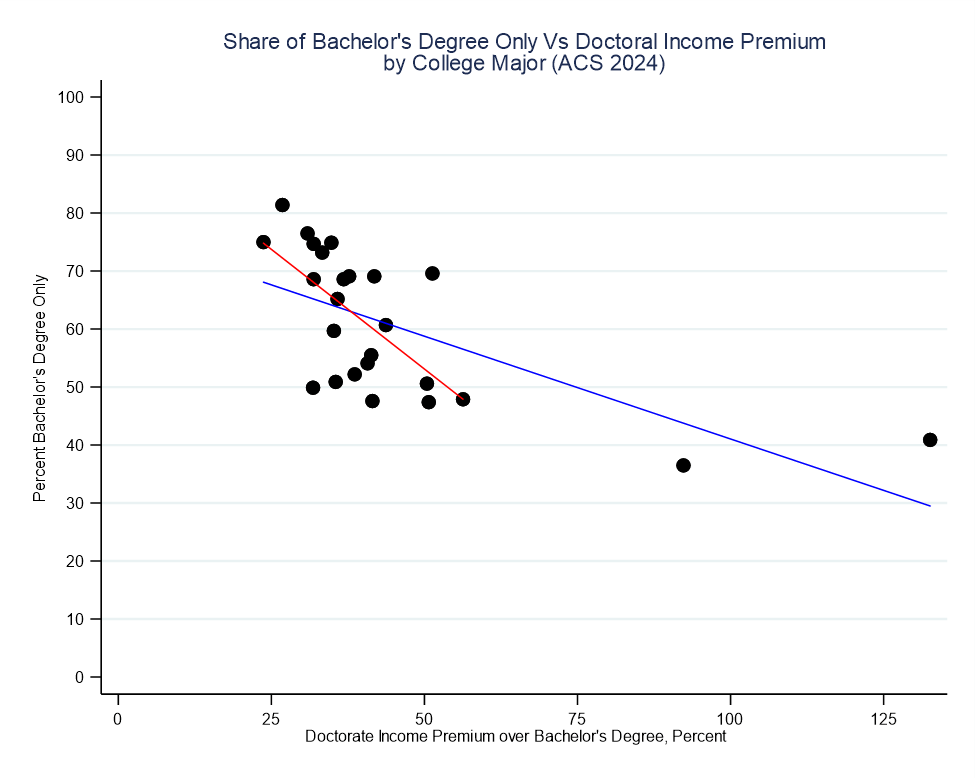
In conclusion, college majors vary in income and the rates at which they complete graduate school. All majors earn more with a graduate degree, though a master’s sometimes pays more than a doctorate. The premium that a graduate degree earns over a bachelor’s degree helps drive the proportion of people who attain a graduate degree. Economics majors have some of the highest average incomes unconditionally, and even conditional on their level of education.

