College Major & Income Sources

We already know that economists earn more income on average. But when and how one earns income matters for how you spend your time both now and in the future. Being more productive affords the option to earn more money by working. For that matter, it also affords the option of staying home or pursuing passion projects at work or elsewhere.  Earning more money earlier in life also has implications for how you spend your time later in life.

Specifically, given the choice, you may choose to work less as a young adult so that you can spend more time with your family. The tradeoff isn’t just whether to work now or spend more quality time with others. After all, money can be saved for the future. Choosing to work less (or for a lower salary) today means that you may choose to work more in the future in order to achieve your desired standard of living. Personally, assuming I make it to old age, I would very much like to afford spending time with my family.

The more that you earn earlier in life, the more that you can save and invest for the future. The more that you save, the more that you can enjoy the fruits of compound interest. It’s not just a matter of earning more now rather than later. If you work and save now, then your future income can be passive. That is, your future earnings won’t require you to spend your time in an office or otherwise employed. You can still do that if you want, but you wouldn’t *need* to.  By having more retirement, investment, and social security income, your future self will earn plenty of income without spending as much time formally working.  You can instead spend time with loved ones or on other pursuits.

Below is the stacked bar graph of average income sources over each decadal age cohort. All data is from the 2024 ACS, so it’s just a snapshot in time rather than following individuals over the course of their life. I singled out people with Economics, Finance, and other 4-year college degrees. Economists make the most lifetime income if we count salary and other compensation alone. But if we look at the older cohorts, economics majors also earn more passive income. You’d think that Finance majors would earn more from investments. But among people in their 70s, economics majors earn more investment and retirement account income. Finance majors do earn more social security in that cohort, however.

Continue reading

Income By Major (ACS 2024)

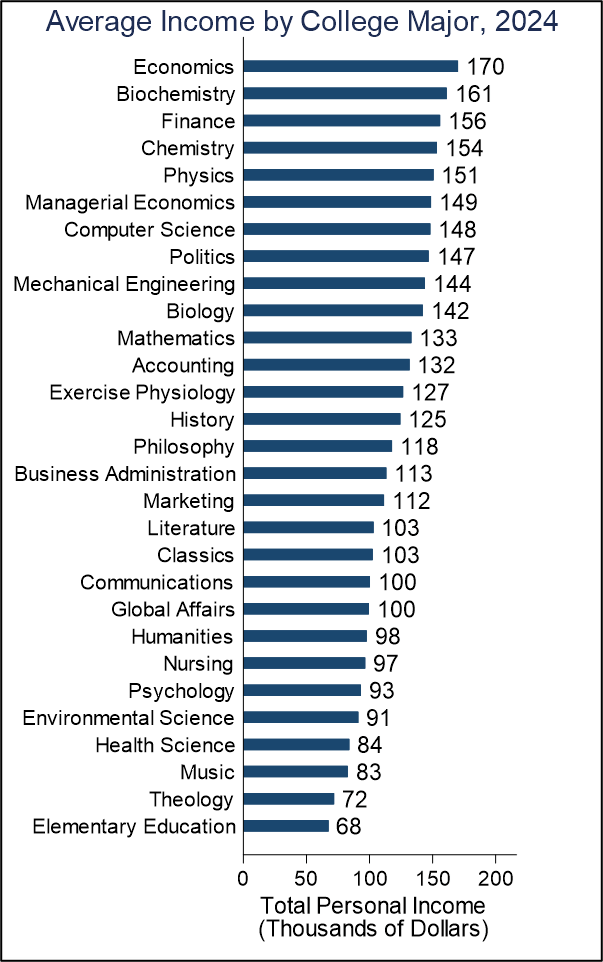
A chart showing the average income by major was recently making the rounds on social media. So, I tried to replicate it. It turned out that some of the college majors were omitted. That part actually makes sense. The 2024 American Community Survey includes 174 degree fields – which is way too many for a clearly labeled bar chart. So, for local advertisement, I used only the majors and their equivalents that are offered at my university.  That chart is below (unweighted).

These are just raw average earnings by college major for employed adults. They all have decent sample sizes. Below is the cumulate distribution of sample size for each major. The smallest sample size is 45 (Military Technologies) and only 3% have sample sizes below 100. Only 34% have sample sizes below 1k.

You better believe that my colleagues and I show this chart to every single one of our classes. Obviously, it’s truncated from the full 174 majors, but it’s the relevant chart for us. If we use the full sample of college majors, Economics ($170k) drops to 3rd highest income, behind “Petroleum Engineering” ($173k) and “Health and Medical Preparatory Programs” ($183k). To be perfectly honest, those latter two sound a lot more difficult and have surprisingly little pay bump in compensation. Being more difficult is also consistent with the smaller sample size Economics=13k, Petroleum Engineering=343, and Health and Medical Preparatory Programs=1,099.  

One challenge that I’ve heard about the chart is that top business schools, such as Wharton, have Economics majors and various business concentrations. So, those top performing financiers are getting categorized as Economics in a way that is a bit misleading to young students elsewhere who are trying to decide on a major. If that’s true, then we should see Economics drop in the rankings if we omit the top-most earners.  After all, the criticism is that they’re pulling up the average.

Continue reading

What’s the Best Major to Prepare for Law School?

  • This is post coauthored with Jack Cavanaugh, Ave Maria University Graduate of 2025.

Say that you want to become a successful lawyer. What does that mean? One possible meaning is that you are well-compensated. Money is not everything, but it does give people more options for how to spend their time and resources. Law degrees are a type of graduate degree. So, what bachelor’s degree major should one choose in preparation for law school? We lack rich administrative data on college majors and LSAT scores.

Luckily, the 2023 American Community Survey (ACS) comes to the rescue. It has all of the typical demographic covariates, income, occupation, and college major. So, if we make the small leap that well-prepared law school students become high-performing lawyers who are ultimately paid more, then what college major puts you on the right path? What should your major be?

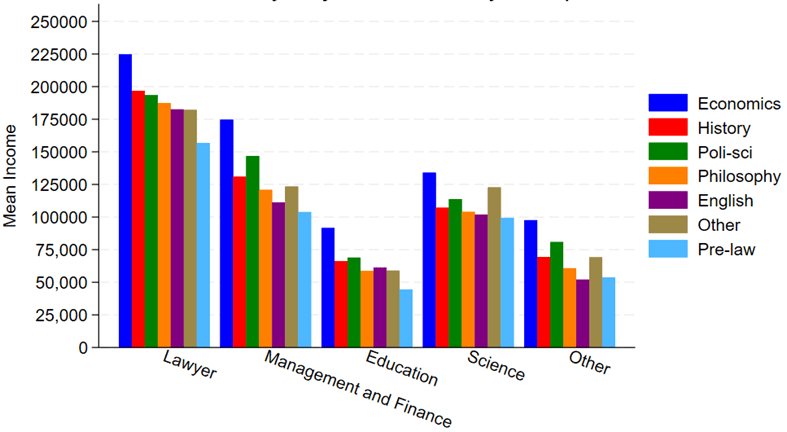
We don’t look at an exhaustive list. We place several occupations into bins and examine only a few alternative majors. Any unlisted major falls under ‘other’. Below are the raw average incomes by occupational category and college major. Note two majors in particular. First, Pre-law literally has the word ‘law’ in the name and is marketed as preparation for law school. However, it is the undergraduate major associated with the lowest paid lawyers. For that matter, Pre-law majors have the lowest pay no matter what their occupation is. Second, Economics majors are the most highly paid in all of the occupations.

Continue reading

College Major, Marriage, and Children Update

In a May post I described a paper my student my student had written on how college majors predict the likelihood of being married and having children later in life.

Since then I joined the paper as a coauthor and rewrote it to send to academic journals. I’m now revising it to resubmit to a journal after referee comments. The best referee suggestion was to move our huge tables to an appendix and replace them with figures. I just figured out how to do this in Stata using coefplot, and wanted to share some of the results:

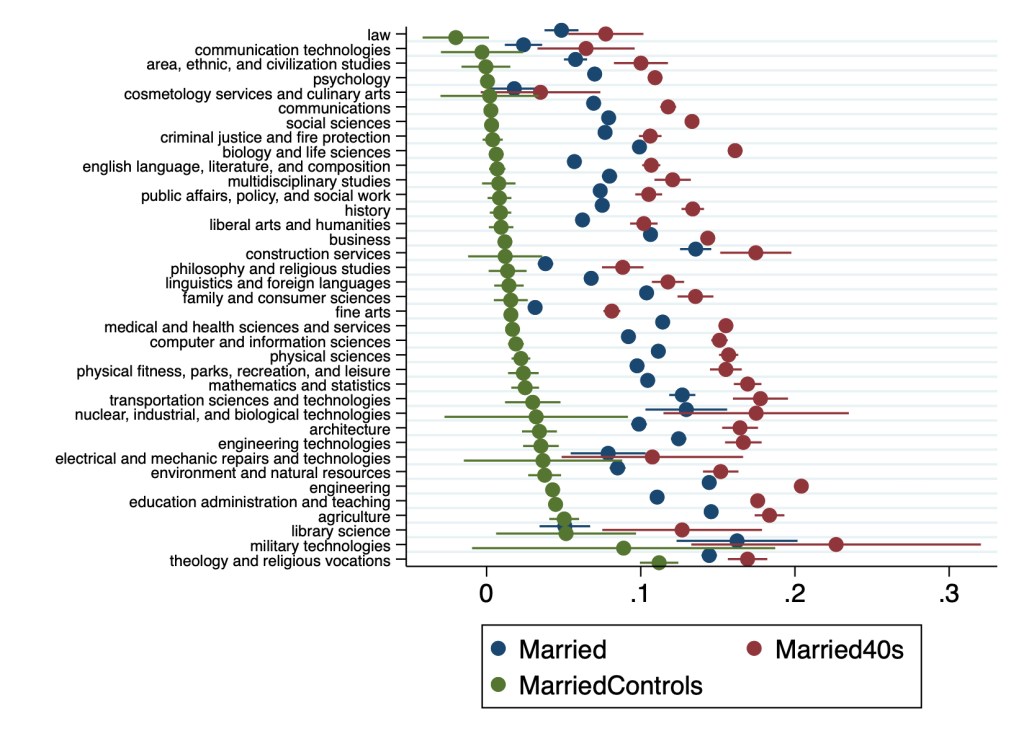
Points represent marginal effects of coefficient estimates from Logit regressions estimating the effect of college major on marriage rates relative to non-college-graduates. All regressions control for sex, race, ethnicity, age, and state of residence. MarriedControls additionally controls for personal income, family income, employment status, and number of children. Married (blue points) includes all adults, others include only 40-49 year-olds. Lines through points represent 95% confidence intervals.
Points represent coefficient estimates from Poisson regressions estimating the effect of college major on the number of children in the household relative to non-college-graduates. All regressions control for sex, race, ethnicity, age, and state of residence. ChildrenControls additionally controls for personal income, family income, employment status, and number of children. Children (blue points) includes all adults, others include only 40-49 year-olds. Lines through points represent 95% confidence intervals.

Many details have changed since Hannah’s original version, and a lot depends on the exact specification used. But 3 big points from the original paper still stand:

  1. Almost all majors are more likely to be married than non-college-graduates
  2. The association of college education with childbearing is more mixed than its almost-uniformly-positive association with marriage
  3. College education is far from uniform; differences between some majors are larger than the average difference between college graduates and non-graduates

College Major, Marriage, and Children

The American Community Survey began in 2000, and started asking about college majors in 2009, surveying over 3 million Americans per year. This has allowed all sorts of excellent research on how majors affect things like career prospects and income, like this chart from my PhD advisor Doug Webber:

See here for the interactive version of this image

But the ACS asks about all sorts of other outcomes, many of which have yet to be connected to college major. As far as I can tell this was true of marriage and children, though I haven’t searched exhaustively. I say “was true” because a student in my Economics Senior Capstone class at Providence College, Hannah Farrell, has now looked into it.

The overall answer is that those who finished college are much more likely to be married, and somewhat more likely to have children, than those with no college degree. But what if we regress the 39 broad major categories from the ACS (along with controls for age, sex, family income, and unemployment status) on marriage and children? Here’s what Hannah found:

Every major except “military technologies” is significantly more likely than non-college-grads to be married. The smallest effects are from pre-law, ethnic studies, and library science, which are about 7pp more likely to be married than non-grads. The largest effects are from agriculture, theology, and nuclear technology majors, each about 18pp more likely to be married.

For children the story is more mixed; library science majors have 0.18 fewer children on average than non-college-graduates, while many majors have no significant effect (communications, education, math, fine arts). Most majors have more significantly more children than non-college graduates, with the biggest effect coming from Theology and Construction (0.3 more children than non-grads).

In this categorization the ACS lumps lots of majors together, so that economics is classified as “Social Sciences”. When using the more detailed variable that separates it out, Hannah finds that economics majors are 9pp more likely than non-grads to be married, but don’t have significantly more children.

I love teaching the Capstone because I get to learn from the original empirical research the students do. In a typical class one or two students write a paper good enough that it could be published in an academic journal with a bit of polishing, and this was one of them. But its also amazing how many insights remain undiscovered even in heavily-used public datasets like the ACS. We’ve also just started to get good data on specific colleges, see this post on which schools’ graduates are the most and least likely to be married.