Uncertainty Increases Profits?

Most people have an intuition that uncertainty can harm economic outcomes. Baker, Bloom, & Davis (2016) and Bloom (2009) demonstrated that industrial production and manufacturing decline in the face of policy uncertainty. The typical mechanism that people suggest is that uncertainty about the future causes people to engage in precautionary saving, resulting in fewer sales.

The theory continues that firms consequently decrease production as demand for their output declines. Firms aren’t interested in causing the quantities supplied and demanded to be equal. Rather, they don’t want to produce too many goods that don’t get sold or don’t get sold at an adequate markup. Production is costly.  A related theory is that more persistent or longer-run uncertainty can also depress investment, since the riskier future increases the tail risk of losses.

Rather than make a risky investment, one could instead just hold off and wait for some of that uncertainty to get resolved. There’s tradeoffs to this, of course. As future costs and benefits become clearer, they also get priced-in to asset values. So, there is an optimization problem. The possible downside outcome is big and uncertain. If the risk of the investment gets resolved and the downside outcome is still too likely or harmful, then a project manager did the ex-post ‘right thing’ by waiting.

But, if the downside risk disappears or is found to be very small, then waiting to invest in the project incurs an economic cost. Either 1) the profitable project and its associated profits will occur later and less valuably, or 2) other firms also resolve their uncertainty and bid up the price of the project’s inputs. Invest too early, and the downside is large and uncertain. Invest too late, and you may lose the potential upside partially or entirely.

But can uncertainty systematically increase profits?

Walter Oi said yes.

Continue reading

By the Numbers: Florida’s Property Tax Amendment (2026)

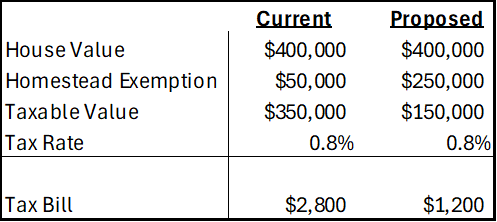
Voters this November will face a proposed amendment to the Florida state constitution on property tax reform. Currently, Florida has what’s called a ‘homestead’ exemption of $50,000. If a residential property is your primary residence, then your home’s assessed value is $50k less before taxes are calculated. There is no exemption for rental property or 2nd homes or vacation homes. The proposed amendment increases the exemption to $250k by 2028 and then indexes it to inflation.

First, let’s get an idea of the magnitudes. The median home in Florida is priced at about $400k and the average property tax rate is around 0.8%. Below compares the current consolidated tax bill against that of the proposed amendment. Given current home prices and local tax rates, the new exemption would have a huge impact on municipal governments who get the bulk of their revenue from property tax. In fact, there is no Florida state property tax, so the proposed amendment would adopt a new rule for municipalities and not the state government.

What Motivates the Amendment?

The current homestead exemption of $50k was established in 2008. A subsequent amendment in 2024 allowed half of that to be indexed to CPI-U. The average home price in Florida has risen 114% since 2008 and 84% since 2020. That’s a lot faster than inflation, but the tax burden is partially offset by a maximum of 3% annual increase in assessed value. Regardless, many individuals face a larger tax bill over time even independent of whether their income or use of public services has changed. Plenty people are feeling the squeeze.

What’s the Purpose of the Homestead Exemption?

The exemption is available for primary residences only. That means that rentals and vacation homes do not qualify. It’s important to keep in mind that, given some total revenue, every tax break for one group or activity implies a higher tax rate for others. So, clearly, the effect is to tax residents less and tax seasonal residents and visitors more. Florida doesn’t have an income tax, but it does have a sales tax, gasoline tax, and others that are disproportionately borne by non-residents. Given that higher income individuals tend to have higher home values, the homestead exemption is a way to lower the tax burden of lower income households. Obviously, the lowest income individuals are renters, but so are non-residents who Florida prefers to tax.

The Economics

Homeowners

The exemption is enjoyed by all primary residences, but helps low income owners the most. And, given a stable amount of municipal tax revenue, a higher homestead exemption requires that municipalities replace that revenue. This might take the form of higher local fees and taxes, making life harder for lower income people to, say, own a car or make purchase if taxes on those activities rise. Revenue stability might also be helped by higher property tax rates. The higher the property value is above $250k, the greater the average tax burden that is borne. So, someone with a very high property value may find themselves with an even higher property tax bill after municipalities adjust to the proposed statewide rule. In this sense, the new amendment would be a step in the direction of tax progressivity (a higher proportion taxed from those with higher income/wealth).

Indexing

Normally, I am in favor of indexing nominal values to CPI. In this case, we need to think about what the goal is. Let’s assume that the goals is to provide relief to lower income homeowners specifically and all primary residence homeowners generally. Does indexing to the CPI help? It depends!

Continue reading

Which Business Programs Require Economics?

Disclaimer: This post might throw shade.

The vast majority of business majors across the US are required to take two or more Economics courses. You can look across the spectrum. All of the top 20 business schools require two or more econ classes. In fact, Wharton is the top-ranked business school and their business program is actually an *economics* program. They don’t have finance/accounting/business degrees. Instead, they have an Economics degree with the various business concentrations. Again – the top business school in the country is an Economics program.

What about at the other end of the spectrum? I live in Florida. Every single Florida state school requires both Micro and Macroeconomics for business majors. These schools include everything from Florida State University to the local Florida state college down the road. I didn’t look at other state-run higher education systems in other states. There are a lot of states…

I teach at a private Catholic university. We’re listed in something called ‘The Newman Guide’ which recommends 17 Catholic schools. Many of these are liberal arts schools, but the list also includes Catholic University of America, which is an R1. Most of these schools also require two or more Economics classes in their Business major programs. The only exception is University of Dallas, which has Economics in the core curriculum.*

So, overwhelmingly undergraduate business programs across the country require two economics courses. But, why? The students are often not happy to be there, and I’ve even heard business professors demean the math as performatively rigorous and superfluous. They argue that plenty of people get rich or are otherwise successful without all of the quantitative skills that economics leverages.

I think that the fear of math is both a red herring and a scapegoat. Rather, Economics confronts students with the liberal arts – whether they like it or not. Be careful. Liberal Arts are not the same as Humanities. They include argumentation, the ability to write and communicate, clear and consistent logic, and, yes, even math. Accounting can tell you how to keep track of the money, but it doesn’t include a theory for when you should produce more or less in contrast to your competitors. Finance does better since it has the time value of money and ‘with vs without’ analysis. That’s closer to marginal thinking. But finance lacks a theory of markets outside of portfolio theory and arbitrage.**

Continue reading

Against Eugenics, on its Own Terms

Once upon a time, eugenics was all the rage. It was nascent during the reconstruction era and persisted into the 20th century. It grew out of biological evolutionary theory and emphasized reproductive fitness. In brief, the theory asserted that there are differences in individual fitness and that the more fit living things will survive better and reproduce, eventually becoming a greater part of the population. The ability to compile and evaluate statistics about various human measurements made inferences hard to resist. Of course, researchers were plagued by small sample size, omitted variable bias, and social biases of the day (for example, phrenology inferred fitness characteristics from skull shape).

People employing eugenic thinking, overwhelmingly, supported theories that their own type of person was among the more fit. Eugenicists didn’t promote theories of their own un-fitness. In the progressive era of the early 20th century, eugenics met the prevailing attitude that government could be employed to resolve social and economic ills. This era is when the income tax emerged, prohibition was enacted, the Federal Reserve was formed, and various labor regulations were enacted.

The result was that policy sometimes pursued greater ‘fitness’ among its populations. Rather than systematically encouraging the supposedly more fit with economic incentives, most policy was geared toward reducing the reproductive success of supposedly less fit people. These included forced sterilization, institutionalization, and economic exclusion. Besides rejecting basics individual human dignity, the harm was all the more tragic given that fitness was often poorly specified. That is, policy criteria weren’t dependably related to fitness. Fatal conceit, indeed!

One of my favorite ways to argue is to grant premises and then change details on the margin to see whether the conclusion changes. Let’s do that. Let’s grant that there are innate differences between people that are related to biological success. Since survivability is related to resource acquisition, let’s grant also that economic success overlaps at least somewhat.  Taking that as granted, does pursuit of the historical eugenic policy still follow?

It does not.

There are two mistakes that eugenicists and various sorts of racists and xenophobes made. They assert or imply 1) that fitness characteristics are stable and systematically identifiable, and 2) that policy needed to intentionally select for the fitness characteristics.

Continue reading

What’s the Best Major to Prepare for Law School?

  • This is post coauthored with Jack Cavanaugh, Ave Maria University Graduate of 2025.

Say that you want to become a successful lawyer. What does that mean? One possible meaning is that you are well-compensated. Money is not everything, but it does give people more options for how to spend their time and resources. Law degrees are a type of graduate degree. So, what bachelor’s degree major should one choose in preparation for law school? We lack rich administrative data on college majors and LSAT scores.

Luckily, the 2023 American Community Survey (ACS) comes to the rescue. It has all of the typical demographic covariates, income, occupation, and college major. So, if we make the small leap that well-prepared law school students become high-performing lawyers who are ultimately paid more, then what college major puts you on the right path? What should your major be?

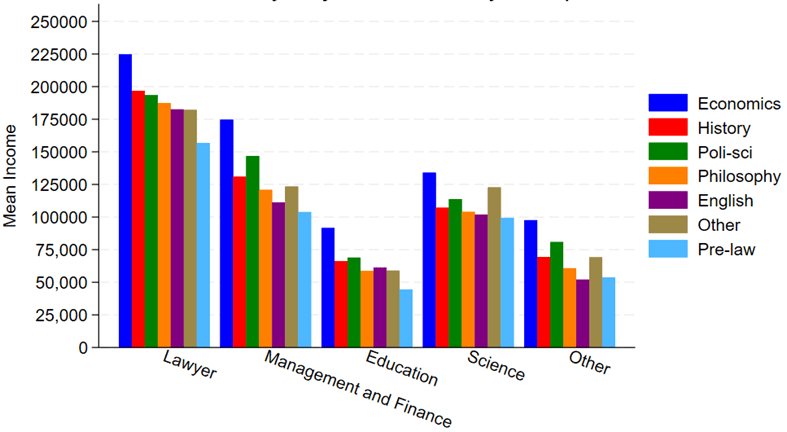
We don’t look at an exhaustive list. We place several occupations into bins and examine only a few alternative majors. Any unlisted major falls under ‘other’. Below are the raw average incomes by occupational category and college major. Note two majors in particular. First, Pre-law literally has the word ‘law’ in the name and is marketed as preparation for law school. However, it is the undergraduate major associated with the lowest paid lawyers. For that matter, Pre-law majors have the lowest pay no matter what their occupation is. Second, Economics majors are the most highly paid in all of the occupations.

Continue reading

I’m Chair! 😬

As of July 1st of this year, I am the Chairman of the Department of Economics at my university. It’s one of those positions that includes more work and not much compensation. Depending on who I tell, I’m given both congratulations and condolences. Generally, at my university there is an expectation that department faculty ‘take turns’ being chair. So, we’re expected to serve whether the pay is good or not. There’s a lot of informal practice around this process.

In addition, Economics Majors have been less popular at liberal arts institutions over the past several years. No one knows why and there are probably multiple reasons. At my institution, our department has healthy enrollment among the peripheral majors. So, the Economics BA and BS have lower enrollment, but the Business Economics and the Global Affairs majors are more popular than ever.

All the same, I’d like to increase the number of students who have declared majors in our department and the number of Economics graduates. How do I do that?

Continue reading

Tariffs: Bad for Revenue

Economists are pretty united against tariffs. There are lots of complicated arguments. Keeping things simple, one reason is that they are bad for welfare. President-elect Trump seems to imply that tariffs can raise a lot of government revenue. But in lieu of what? The Tax Foundation estimates that there is absolutely no way that tariffs can replace all revenue from income taxes. The primary reason that they cite is that imports compose a tiny portion of the potential tax base. There are plenty of goods and services produced domestically that wouldn’t be subject to the tariffs. Any time we add a tax exemption, we’re adding complication, higher compliance costs, and distorting consumption patterns, etc.

For this post I singularly focus on the tax revenue.  In fact, let’s demonstrate what *maximizing* tax revenue looks like under three cases: 1) Closed economy with a tax, 2) Open economy with a tax, & 3) Open economy with a tariff. I’ll use some simple math to demonstrate my point. None of the particulars affect the logic. You’ll reach the same general results with different intercepts, slopes, etc. Let’s start with a domestic demand and domestic supply.

Closed Economy with a Tax

Whenever tax revenue is raised, there is a difference between the price paid by demanders and the price received by suppliers. In a closed economy a tax might be imposed on all goods. In these examples, I treat the tax as some dollar per-unit of output tax. But it’s a short jump to percent of spending taxes, and then another short jump to percent of income taxes. With this in mind, demanders pay more than the suppliers receive by the amount of the tax. Tax revenue is the tax rate times the number of units of output that are subject to the tax. That’s the thing we want to maximize.

Continue reading

Florida Ballot Initiatives 2024

The November election in Florida will include 6 proposed amendments to the Florida State Constitution. They only pass if at least 60% of voters vote YES. Here are some brief takes from an economic perspective.

Amendment 1: Partisan Election of Members of District School Boards

Currently, school district boards are locally elected and they do not have a party affiliation listed on the ballot. If passed, the amendment would permit party affiliation to be on the ballot. Partisan primaries would also be introduced, reducing the number of candidates in the general elections. The argument in favor is that party affiliation itself communicates information to voters. Removing that information forces voters to abstain, vote randomly, or to vote based on other information.

An argument against is that, in Florida, only registered party members may vote in primaries. If passed, parties will endorse particular candidates according to the primary results, winnowing the field. I happen to live in a county with an overwhelming republican majority, so the party-endorsed candidate will probably win. The outcome will be that the median republican primary-voter will choose the winning candidate in the primary rather than the median voter during the election. Voting “YES” aggregates information from a smaller set of voters.

I’ll vote NO.

Continue reading

Cleaning Data and Muddying Water

I’ve praised IPUMS before. It’s great.

The census data in particular is vast and relatively comprehensive. But, it’s not all perfect.

Consider three variables:

  • Labforce, which categorizes whether someone is employed
  • Occ1950, which categorizes occupation types
  • Edscor50, which imputes a relative education score based on occupation

These all seem like appropriate variables that a labor economist might want to control for when explaining any number of phenomena. There is a problem. Edscor50, and the several measures like it, are occupation based. Specifically, the scores use details about 1950 occupations to impute educational details. There are similar indices used for earnings, income, status, socioeconomic status, and prestige.

Cool.

Continue reading

Inflation, Information, & Logic

Most economists know that the CPI is overestimated and therefore prefer the PCE price index. However, monthly CPI data is consistently released before PCE data for a given month. One would think that they move in the same direction and be highly correlated. Indeed, in the past five years, the correlation is 0.96. Therefore, it stands to reason that the there is less new relevant information on the PCE release dates than on the CPI release dates. Yes, CPI is biased, but it still contains some information about prices and it is known well prior to the more accurate PCE numbers.

Supply and Demand react to new information. Sometimes the new information changes our expectations about the future, and other times we learn that our beliefs about goods and assets were previously not quite right. So, with new relevant information comes new prices as people update their beliefs and expectations.

Let’s get financial.

Continue reading