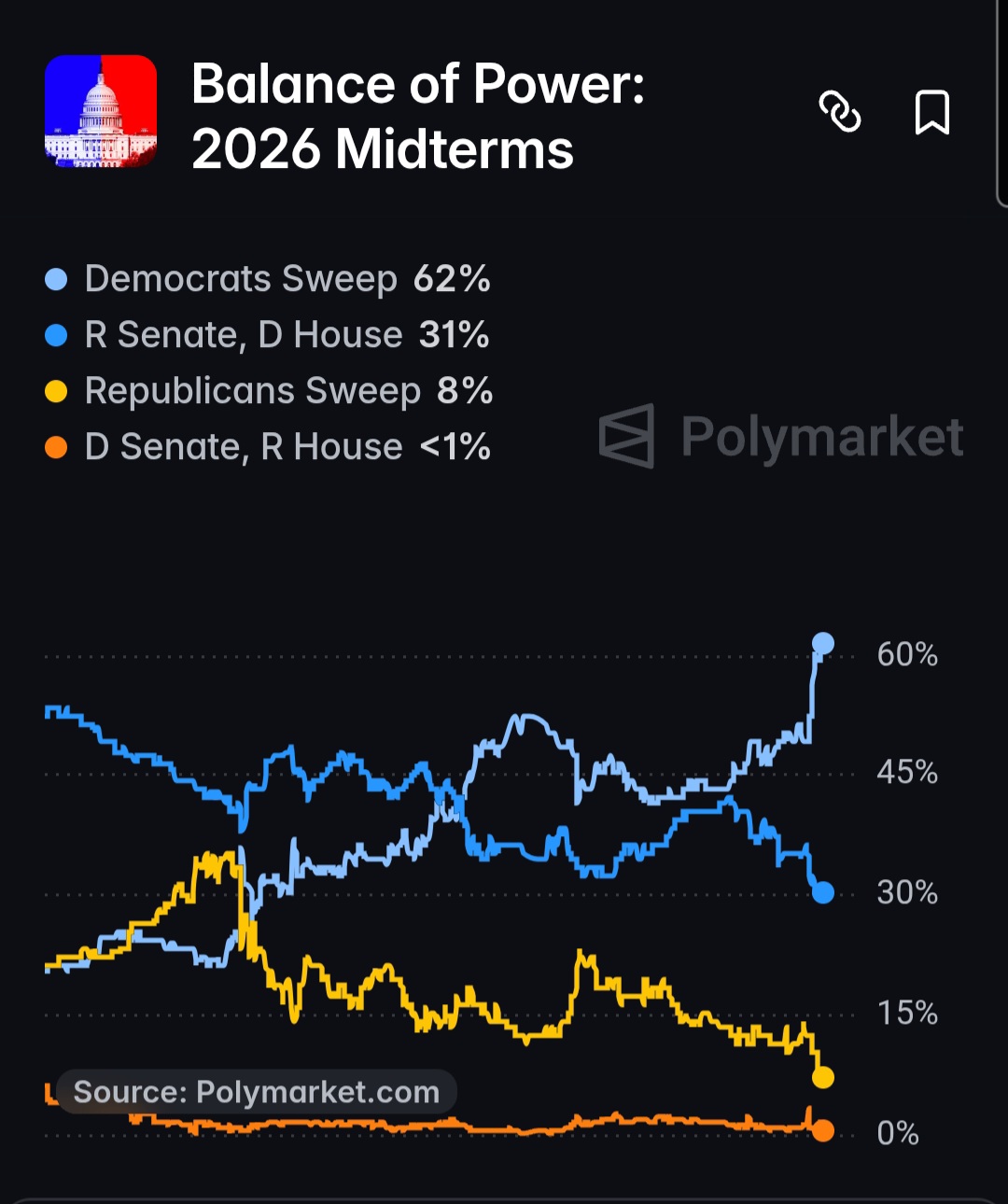
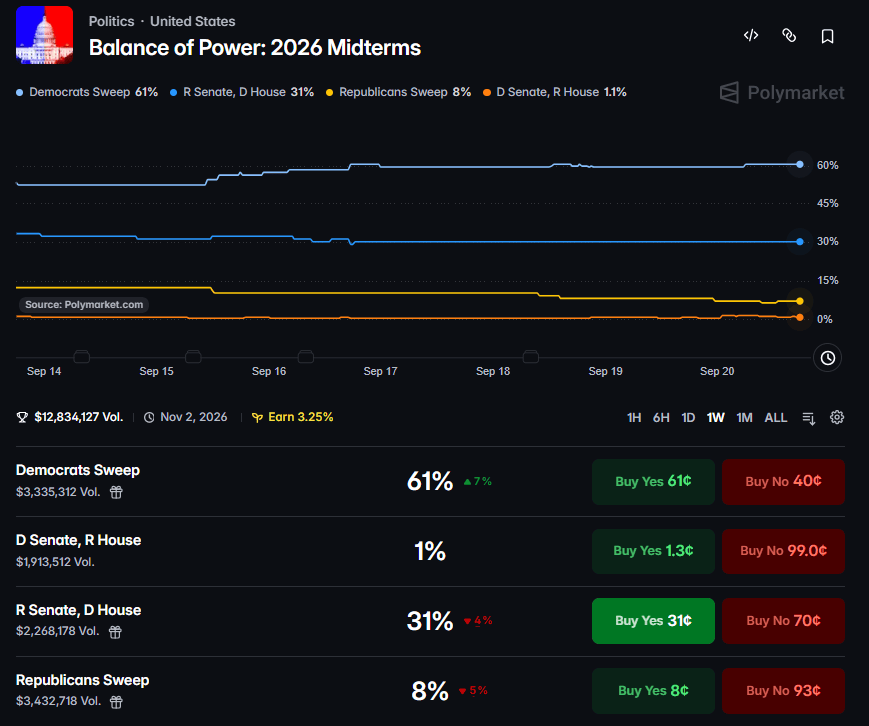
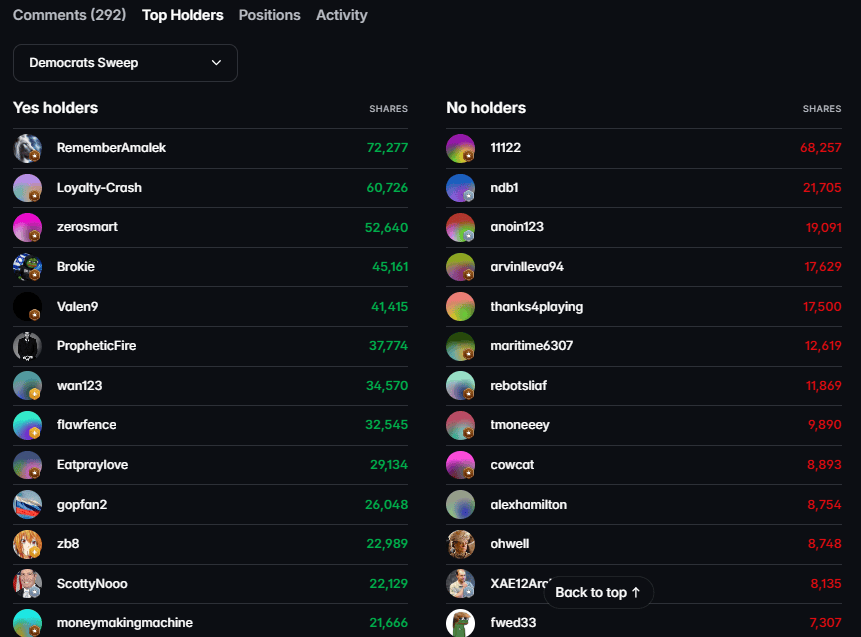
Here’s the Polymarket…market… for bets on the outcome of the US midterms in November over the last 7 days. You’ll notice a 7 percentage point (13% relative to a 54pp baseline) increase in the expected probability of the leading outcome. That’s a very big change, most of which happened over 3 days. In a $12.8 million market where the largest shareholder has $73k on the line, that is a very, very big move.
I don’t have any insight into what is happening here, I would simply note that there was to my knowledge no singular news item or event that appears to have sparked this. It’s just a great example of what makes betting markets so interesting. There is some tacit knowledge held by a relatively small number of inviduals, but within and through this market this information has now become at least partially observable in the form of a price. Now, to be extra, super, you just won’t believe how clear about this, I don’t have any insight to lay on top of this, no personal model to share, and I would strongly advise very nearly everyone against trying to participate in this market for personal profit. But, nonetheless, this is useful information. If you made me choose between a world with sports gambling or everything else gambling, I might very well choose “everything else.” At least the world captures some value from the revealed information that is, at least in part, subsidized by enabling a very real and serious addiction. I don’t know that we can say anything similarly positive about sports gambling.
Update: longer timeline as of 10am this morning (7/11 to 9/21)