The value of reading great literature

I am pleased to have guest posted for Henry Oliver:

An economist asks: What is the value of reading great literature like Eliot and Tolstoy?

In 2025, after mostly feeling too busy for great literature for a few years, I picked up two books that come highly recommended by people with good taste: Middlemarch and Anna Karenina. They are excellent, and they are long. I propose two reasons why they need to be long.

My second reason for long novels:

The second powerful thing about a long novel, if they are written by geniuses like Eliot or Tolstoy, is that you have enough time to see how choices play out over years. You have space to even see the consequences of the consequences. You will experience moral formation from these novels in a way that you just cannot from a 2-hour movie or social media post. 

Quick bio of Henry: Henry Oliver writes the popular literary Substack The Common Reader, which has been quoted in the Atlantic and elsewhere. His book Second Act, a study of late-blooming talent, was released in 2024.

Lastly, I must thank my sister for engaging me in literature discussion over the Christmas break. She is reading Proust.

Rising Chinese Zombie Firms

Have you ever looked up and wondered where the time went? One moment you’re living your life, and the next moment you realize that you’ve just lost time that you’ll never get back? That’s what happened to Japan’s economy at the turn of the century in an episode that’s known as ‘the lost decades’. It was a period of slow or null economic growth. Economists differ with their explanations. One cause was the prevalence of ‘zombie firms’.

Japan’s Economy

Japan had a current account surplus from 1980-2020, which means that they had more savings than they effectively utilized domestically. Metaphorically, they were so full of savings that they exhausted productive domestic investment opportunities and their savings spilled out into other counties in the form of foreign investments. This was driven by high household savings and slow growth in domestic investment demand. The result was the Japanese firms had easy access to credit. Maybe a little too easy…

Private corporate debt ballooned throughout the 1980s. That’s not intrinsically a problem. In the 1990s, households began saving somewhat less, and most firms began to drastically deleverage… But not all firms. The net effect of the mass deleveraging was that interest rates fell.  The firms that remained in debt were the ones that risked insolvency. Less productive firms had slim profits and their Earnings Before Interest, Taxes, Depreciation, and amortization (EBITDA) was slim. So slim, that they couldn’t pay their debts. Faced with the prospect of insolvency, firms did what was sensible. They refinanced at the lower interest rates. Firms went to their banks and to bond markets and rolled over their debt, which they couldn’t afford, and replaced it with debt that had a lower interest rate. This occurred across industries, but especially in non-tradable goods and services that were insulated from international competition. Crisis averted.

Except this process of refinancing, while avoiding acute defaults and a potential financial crises, ensured that the less productive firms would survive. Not exactly failing and not exactly thriving, they could sort of just hold on to something that looks like life. Well, high debt and low profits aren’t much of a life for a firm. It’s more like being undead – like a zombie. Between 1991 and 1996, the share of non-finance firm assets held by zombie firms ballooned from 3% to 16%. The run-up differed by industry: Manufacturing zombie assets rose from 2% to 12%, from 5% to 33% in real estate, and from 11% to 39% in services.  These zombie firms linger on, tying up valuable resources with low-productivity activities and drag on the economy.

China’s Economy

I’m not prone to China hysteria generally. However, I do have uncertainty about the plans and actions of the Chinese government because I don’t know that domestic economic welfare is its priority. That makes forecasting more political and less economic and outside my expertise. Regardless, the Chinese economy is a constraint on the government, whether they like it or not.  And there are some echoes of the Japanese economy’s lost decades.

Continue reading

Is This the End of the Largest Refugee Crisis in the Americas?

Our 2024 post on the Venezuelan election provides context for this week’s dramatic events:

Venezuela held an election this week; President Maduro says he won, while the opposition and independent observers say he lost. Disputed elections like this are fairly common across the world, but where Venezuela really stands out is not how people vote at the ballot box- it is how they vote with their feet.

Reuters notes that “A Maduro win could spur more migration from Venezuela, once the continent’s wealthiest country, which in recent years has seen a third of its population leave.”

This makes Venezuela the largest refugee crisis in the history of the Americas, and depending on how you count the partition of India, perhaps the largest refugee crisis in human history that was not triggered by an invasion or civil war.

Instead, it has been triggered by the Maduro regime choosing terrible policies that have needlessly and dramatically impoverished the country

Plus some foreshadowing:

I hope that the Venezuelan government will soon come to represent the will of its people. I’m not sure how that is likely to happen, though I guess positive change is mostly likely to come from Venezuelans themselves (perhaps with help from Colombia and Brazil); when the US tries to play a bigger role we often make things worse. But what has happened in Venezuela for the past 10 years is clearly much worse than the “normal” bad economic policies and even democratic backsliding that we see elsewhere. 

Here’s an update on the chart I shared then, showing that the diaspora has continued to swell:

I hope that Venezuela will soon become the sort of country people don’t want to flee. I don’t necessarily expect that it will, but it’s not now a crazy hope:

Liberal Democratic Institutions Generally Improve After US Military Intervention (Post-Cold War)

With the arrest of Venezuelan President Maduro, the US is potentially attempting to remake the institutions of yet another country. I say potentially because, as of now, all that has happened is that Maduro was removed. His VP stepped in to replace him, and it appears that, for now, the rest of the structure of government is in place.

Nonetheless, any time the US intervenes in the affairs of another country, it brings back the old debates about regime change, nation building, exporting democracy, etc. Many want to discuss the legal and moral implications of these actions — and these are certainly worth discussing! — but as social scientists we should also ask “does it work?”

For example, one excellent paper on regime change via CIA covert intervention is from Absher, Grier, and Grier. They look at five cases during the Cold War in Latin America of CIA-sponsored regime change, and find moderate declines in income and large declines in democratic institutions. Not a good case for regime change and exporting democracy!

But what if we look at more recent interventions — post-Cold War — and look at direct military interventions by the US, rather than covert CIA operations or indirect funding of factions within a country. This is more in line with what might be happening in Venezuela right now (if regime change is ultimately what the US military pushes for). Using a list from Chris Coyne’s book After War (table 1.1) as a starting point for the relevant cases, and then using data from the V-Dem Liberal Democracy Index, we have seven cases since 1990 to examine (note: I have added Libya to Coyne’s list, which I believe is the only new addition of explicit military intervention since he created the list):

The first thing you might notice is that relevant to their starting position (pre-US military intervention), all except one of these countries saw improvements in their V-Dem Liberal Democracy Score after 25 years (or whatever the end point is for those more recent than 25 years). Some of the improvements — such as Libya, Somalia, and Iraq — are quite small, around 0.1 points on the 1-point scale. But other improvements — especially Kosovo and Bosnia — are quite large, around 0.3 points on the 1-point scale.

The one decline is Afghanistan, though you will note that during the occupation (which lasted a very, very long time, until 2021) their liberal democracy score did improve slightly, about as much as Iraq. I should also note that if we didn’t use my 25-year cut-off, Haiti would also have slipped back to roughly where they were in 1993, with a large decline happening since 2020.

For reference on this scale: the US scores 0.75 in 2024, the best scoring country is Denmark with 0.88, the World average is 0.37 (or 0.29 weighted by population), and the European average is 0.62 (or 0.56 weighted by population).

So while the improvements in Kosovo and Bosnia are impressive, they still fall below the average score in Europe. And those examples point to another problem with my simple analysis: we don’t have the counterfactual of what their score would be without US intervention. That kind of sophisticated analysis is what the above-mentioned Absher paper does (using synthetic control), but it’s more than I can do in a short blog post. Nonetheless, we should note that while we can’t say that US intervention caused these improvements, things didn’t get worse in most countries (as many critics of intervention assume always happens) — Afghanistan being the notable exception after the US ended the occupation.

Now that I’ve got the causation caveat out of the way, we should note a few more limitations of my analysis. First, perhaps the V-Dem Liberal Democracy Index isn’t the best one to use. Our World in Data has seven democratic measurement sets to choose from, and even from V-Dem there are others we could have used. I think Liberal Democracy best captures what we are usually talking about in terms of “does it work?” but you could use another measure. However, glancing through the other available measures, such as Polity, I don’t think the picture would be radically different with another measure of liberal democracy. 25 years is also somewhat arbitrary of a cut-off, though in Coyne’s book he uses 20 years, so I’m going beyond that.

Finally, I want to stress even more than on the causation point: none of these improvements mean the intervention passes a cost-benefit test. There was much destruction of lives and property in all of these cases, the use of US tax dollars, and some other harms to the US and international law (e.g., restrictions of civil liberties in the US from the War on Terror). I do not want to suggest that this means the interventions were worth the cost, merely that they did not fail on this one measure of improving democracy. It is also not a prediction that future interventions, such as in Venezuela, will succeed. Instead, I wrote this post because it goes against my priors (I would not have guessed improvements in 6/7 cases).

Is the Silver Bubble Bursting?

This is a five-year chart of the silver ETF SLV:

By most standards, this pattern looks like we entered a bubble a few months ago: speculative froth, unjustified by fundamentals. Economic history is replete with such madness of crowds. It is accepted wisdom on The Street that these parabolic price rises seldom end well. I lost a few pesos buying into the great gold bubble of 2011. All sorts of justifications were given at the time by the gold bugs on why gold prices ought to just keep on rising, or at least reach a “permanently high plateau” (in the famous words of Irving Fisher, just before the 1929 crash). Well, gold then proceeded to go down and down and down, losing some 60% of its value, until the price in 2015 matched the price in 2009, before the great bubble of 2010-2011.

Today, similar justifications are proffered as to why silver is going to the moon. There is a long-standing deficit in supply vs. demand; it takes ten years for a new silver mine to get productive; China has started restricting exports; Samsung announced a breakthrough lithium battery that can charge in six minutes, but requires a kilogram of silver; AI infrastructure is eating all the silver. These narratives seem to feed on each other. As the silver price moved higher in the past month, out came yet wilder stories that ricochet around the internet at high speeds: the commodities exchanges have run out of physical silver to back the paper trades; and the persistent claim that “they” (shadowy paper traders, central banks, commodity exchanges, the deep state, etc.) are “suppressing” silver and gold prices by means of shorting (which makes no sense). Given this popular shorting myth, it was with great glee that the blogosphere breathlessly spread the bogus story that some “systematically important bank” was in the process of being liquidated because it got squeezed on its silver short position.

The extreme price action at the very end of December (discussed below) was like rocket fuel for these rumors. Having bought a little SLV myself so as to not feel like a fool if the silver rally did have legs, I spent a number of hours as 2025 turned to 2026 trying to sort all this out. Here are some findings.

First, as to  the medium term supply/demand issues, I refer the reader to a recent article on Seeking Alpha by James Foord. He shows a chart showing that silver demand is increasing, but slowly:

He also notes that as silver price increases, there is motivation for more recycling and substitution, to compensate. He concludes that the current price surge is not driven by fundamentals, but by paper speculation.

The last ten days or so have been a wild ride, which merits some explanation. Here is the last 30 days of SLV price action:

Silver prices were rising rapidly throughout the month, but then really popped during Christmas week, reaching a crescendo on Friday, Dec 26 (blue arrow), amid rumors of physical shortages on the Shanghai exchange. To cool the speculative mania, the COMEX abruptly raised the margin requirements on silver contracts by some 30%,  from $25,000 to $32,500, effective Monday, Dec 29. I think the exchange was trying to ensure that speculators could make good on their commitment, and the raise in margin requirement would help do that. (Note, the exchange is liable if some market participant fails to deliver as promised and goes BK).

Anyway, this move forced long speculators to either post more collatoral or to liquidate their positions, on short notice. Blam, the price of silver dropped a near record amount in one day (red arrow). For me, a little minnow caught in the middle of all this shark tank action, the key part is what came after this forced decline. Was the bubble punctured for good? Should I hold or fold?

As shown above, the price has traded in a range for the past week, with violent daily moves. Zooming out to the a one-year view, it looks like the upward momentum has been halted for the moment, but it is unclear to me whether the bubble will deflate or continue for a while:

I sold about a quarter of my (small) SLV holding, hoping to buy back cheaper sometime in the coming year. Time will tell if that was a good move.

Usual disclaimer: Nothing here is advice to buy or sell any security.

P.S. Tuesday, Jan 6, 2025, after market close: I wrote this last night (Monday, Jan. 5) when silver was still rangebound. SLV was about $69, and spot silver about $76/oz. But silver ripped higher overnight, and kept going during the day, up nearly 7% at the close to new all time high. It looks like the bubble is alive and well, for now. Congrats to silver longs…

Where do we find papers to read?

I was going to write a long post this week but time got short, so I went looking for new papers to skim through, put a few in my reading list, and then share one here. But Bluesky is bereft of new papers and Twitter isn’t even 3% of what it used to be. NBER working papers? Of course, but I’d desperately love to not have to resort to sharing the same working paper series that everyone else depends on and I don’t get to be a part of. Which is petty, yes, but it would nonetheless be great to tap other veins. I haven’t really figured out how to properly channel the SSRN digests that can feel at times like an entirely uncurate deluge. At the moment too much of my research diet is based in my personal network.

Are there accounts on bluesky I should be following? Or a particularly good SSRN digest? Or a substack I should be subscribing to? Or a Cuban coffee shop where cool social scientists hang out and share dope new papers?

Hit me up.

Summary of You Wouldn’t Steal a Car

I have a new working paper with Bart Wilson titled: “You Wouldn’t Steal a Car: Moral Intuition for Intellectual Property” 

This quote from the introduction explains the title:

… in the early 2000s… the Motion Picture Association of America (MPAA) released an anti-piracy trailer shown before films that argued: (1) “You wouldn’t steal a car,” (2) pirating movies constitutes “stealing,” and (3) piracy is a crime. The very need for this campaign, and the ridicule it attracted, signals persistent disagreement over whether digital copying constitutes a moral violation.

The main idea:

In contemporary economies, “idea goods” comprise a substantial share of value. Our paper examines how norms evolve when individuals evaluate harm after the taking of nonrivalous resources such as digital files.

We report experimental evidence on moral evaluations of unauthorized appropriation, contingent on whether the good is rivalrous or nonrivalrous. In a virtual environment, participants produce and exchange two types of resources: nonrivalrous “discs,” replicable at zero marginal cost, and rivalrous “seeds,” which entail positive marginal cost and cannot be simultaneously possessed or consumed by multiple individuals. Certain treatments allow unauthorized taking, which permits observation of whether participants classify such actions as moral transgressions.

Participants consistently label the taking of rivalrous goods as “stealing,” whereas they do not apply the same term to the taking of nonrivalrous goods.

To test the moral intuition for taking ideas, we create an environment where people can take from each other and we study their freeform chat. The people in the game each control a round avatar in a virtual environment, as you can see in this screenshot below.

In the experiment, “seeds” represent a rivalrous resource, meaning they operate like most physical goods. If the playerin the picture (Almond) takes a seed from the Blue player, then Blue will be deprived of the seed, functionally the equivalent of one’s car being stolen.

Thus, it is natural for the players to call the taking of seeds “stealing,” Our research question is whether similar claims will emerge after the taking of non-rivalrous goods that we call “discs.”

The following quote from our paper indicates that the subjects do not label or conceptualize the taking of digital goods (discs) as “stealing.”

Participants discuss discs often enough to reveal how they conceptualize the resource. In many instances, they articulate the positive-sum logic of zero-marginal-cost copying. For example, … farmer Almond reasons, “ok so disks cant be stolen so everyone take copies,” explicitly rejecting the application of “stolen” to discs.

Participants never instruct one another to stop taking disc copies, yet they frequently urge others to stop taking seeds. The objection targets the taking away of rivalrous goods, not the act of copying per se. As farmer Almond explains in noSeedPR2, “cuz if u give a disc u still keep it,” emphasizing that artists can replicate discs at zero marginal cost.

We encourage you to read the manuscript if you are interested in the details of how we set up the environment. The conclusion is that it is not intuitive for people to view piracy as a crime.

This has implications for how the modern information economy will be structured. Consider “the subscription economy.” Increasingly, consumers pay recurring fees for ongoing access to products/services (like Netflix, Adobe software) instead of one-time purchases. Gen Z has been complaining on TikTok that they feel trapped with so many recurring payments and lack a sense of ownership.

In a recent interview on a talk show called The Stream, I speculated that part of the reason companies are moving to the subscription model is that they do not trust consumers with “ownership” of digital goods. People will share copies of songs and software, if given the opportunity, to the point where creators cannot monetize their work by selling the full rights to digital goods anymore.

A feature of our experimental design is that creators of discs get credit as the author of their creation even when it is being passed around without their explicit permission. Future work could explore what would happen if that were altered.

Related Reading

An Experiment on Protecting Intellectual Property” (2014) with Bart Wilson. Experimental Economics, 17:4, 691-716.

You Wouldn’t Steal a Car: Moral Intuition for Intellectual Property,” with Bart Wilson (SSRN)

Joy on The Subscription Economy (EWED)

The Anthropic Settlement: A $1.5 Billion Precedent for AI and Copyright (EconLog)

Tariffs Are Not Smart Industrial Policy

Economists overwhelmingly see tariffs as clearly welfare-reducing. Tariffs on imports result in higher prices, fewer imports, less consumption, and more domestic production. In fact, it is the higher prices that solicit and make profitable the greater domestic production. We don’t get the greater domestic output at the pre-tariff price. We can show graphically that domestic welfare is harmed with either export or import tariffs. The basic economics are very clear.

However, the standard model of international trade makes a huge assumption: Peace. That is, the model assumes that there are secure property rights and no threats of violence. All transactions are consensual. This is where the political scientists, who often don’t understand the model in the first place, say ‘Ah ha!. Silly economists…’ They proceed to argue for tariffs on the grounds of national security and the need for emergency manufacturing capacity. But is an intellectual mistake.  

Just as economists have a good idea for how to increase welfare with exchange, we also have good ideas about how to achieve greater or fewer quantities transacted in particular markets. This is not a case of economists knowing the ideal answer that happens to be politically impossible.  Rather, if it pleases politicians, economists can provide a whole menu of methods to increase US manufacturing, vaccine manufacturing, weapons manufacturing… Heck, we can identify multiple ways to achieve more of just about any good or service. Let the politicians choose from the menu of alternatives.

The problem with tariffs is that they reduce consumer welfare a lot, given some amount of increased production in the protected industry. Importantly, this assumes that the tariffs aren’t hitting inputs to those industries and are only being applied to direct foreign competitors. The below argument is even stronger against imperfectly applied tariffs, like the US tariffs of 2025.

What’s the alternative?

The alternative is a more focused tack. If the government wants more missile or ship production, then what should it do? There’s plenty, but here’s a short list of more effective and less harmful alternatives to tariffs:

Continue reading

How Good Were 2025 Forecasts?

Last January I shared a roundup of forecasts for the year from markets and professional economists. Were they any good? Here was their prediction for the US economy:

WSJ’s survey of economists reports that inflation expectations for 2025 were around 2% before the election, but are closer to 3% now. Their economists expect GDP growth slowing to 2%, unemployment ticking up slightly but staying in the low 4% range, with no recession. The basic message that 2025 will be a typical year for the US macroeconomy, but with inflation being slightly elevated, perhaps due to tariffs.

The verdicts (based on current data, which isn’t yet final for all of 2025):

Inflation: Nailed it exactly (2.7%)

GDP: We’re still waiting on Q4, but 2025 as a whole is on track to be a bit above the 2.0% forecast.

Unemployment: 4.6% as of November 2025, a bit above the 4.3% forecast

Recession: Didn’t happen, making the 22% chance forecast look fine

So the professional forecasters were probably a bit low on GDP and unemployment, but overall I’d say they had a good year. What about prediction markets?

For those who hope for DOGE to eliminate trillions in waste, or those who fear brutal austerity, the message from markets is that the huge deficits will continue, with the federal debt likely climbing to over $38 trillion by the end of the year. This is one reason markets see a 40% chance that the US credit rating gets downgraded this year.

While the US has only a 22% chance of a recession, China is currently at 48%, Britain at 80%, and Germany at 91%. The Fed probably cuts rates twice to around 4.0%.

Deficits: Nailed it, the federal debt is currently around $38.4 trillion.

US Credit Downgrade: It’s hard to score a prediction of a 40% chance of a binary event happening, but in any case Moodys downgraded the US’ credit rating in May, so that all three major agencies now rate it as not perfect.

The Fed: Cut rates a bit more than expected.

Foreign Recessions: China and Britain avoided recessions. Germany had a recession by the technical definition of Kalshi’s market, but not really in practice (FRED shows -0.2% Real GDP growth in Q2 followed by 0.00000% growth in Q3). Britain avoiding recession when markets showed an 80% chance was the biggest miss among the forecasts I highlighted.

Overall though, I’d say forecasters did fairly well in predicting how 2025 turned out, in spite of curveballs like the April tariff shock.

If you think the forecasters are no good and you can do better, you have more options than ever. Prediction markets are getting more questions and more liquidity if you’re up for putting your money where your mouth is; if you don’t want to put your own money at risk, there are forecasting contests with prizes for predicting 2026.

2025 in Data

By almost any measure, 2025 was a great year for the United States.

Despite inflation remaining elevated and the damage from new tariffs, the economy did well. Inflation-adjusted median earnings are higher than a year ago, though only by about 1.3%. While most prices are still rising, one bright spot for affordability is that home prices are falling in much of the country (according to Zillow estimates).

The S&P 500 total return is over 18% in 2025. GDP has grown at an annualized rate of about 2.5% for the first three quarters of 2025, and will probably be around 3% in the 4th quarter — not a blockbuster rate of growth, but continuing improvement for our already record high GDP of 2024.

The unemployment rate did tick up slightly, from 4.2% last November to 4.6% currently. This is definitely an indicator to watch over the next few months, but it is still well below average.

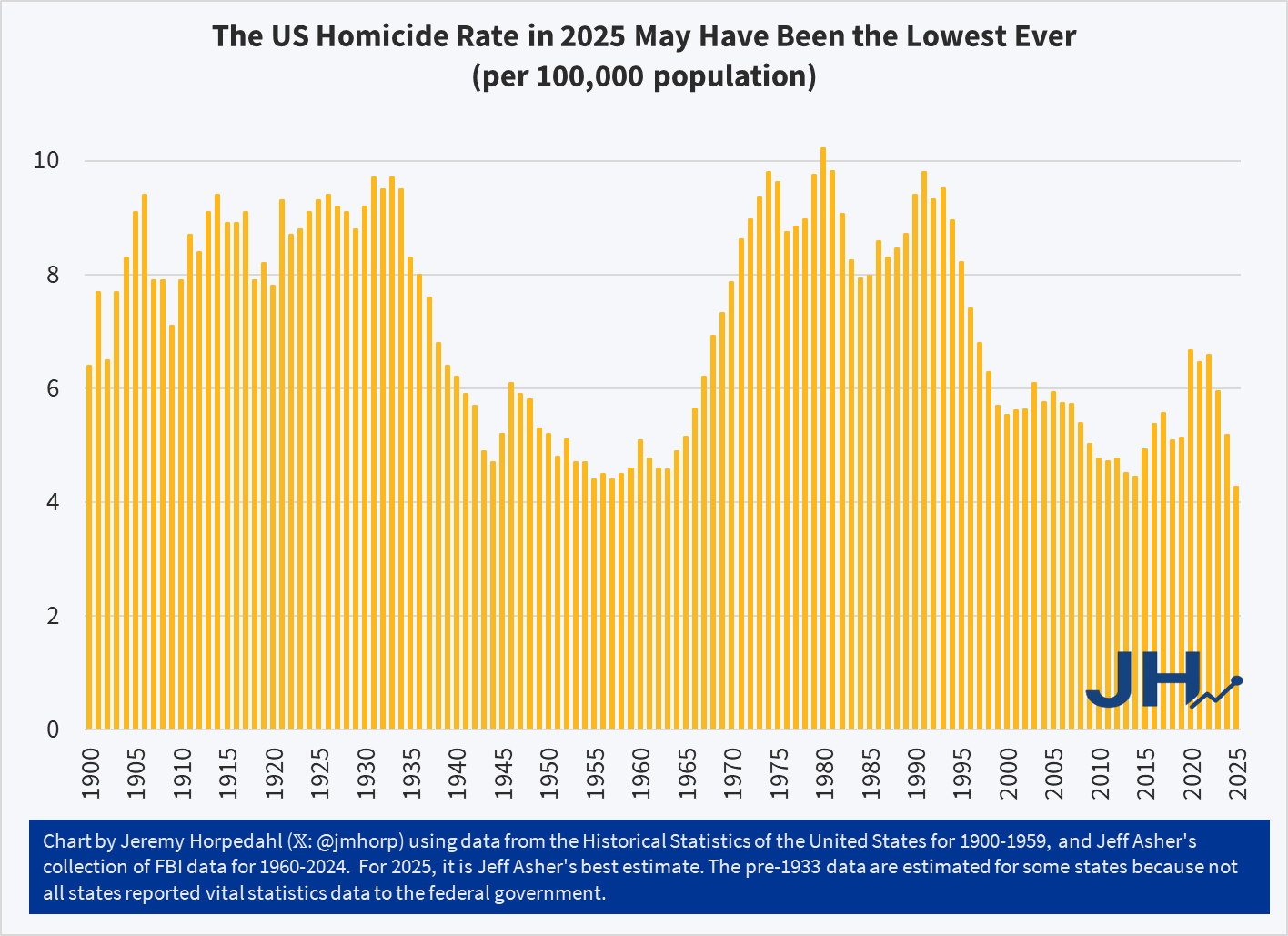
But even outside of the economy, there is plenty of good news in the data. Crime rates are plummeting. The murder rate fell something like 20%, as well as every major category of crime (violent crime overall is down 10%). This are some of the largest one-year drops in crime the US has ever seen.

Homicides aren’t the only category of deaths that are falling in 2025. For most categories of death as tracked by the CDC, there is a long lag (6 months or more) before all of the deaths are categorized. So we can’t look at complete 2025 data yet. For example, drug overdoses have increased massively in recent years, especially during the pandemic. But after plateauing in 2021-23, drug ODs started falling in 2024 and have continued to fall in early 2025. For the 12 months ending in April 2025, drug OD deaths were 26% lower than the prior 12 months. If we look at just the first 5 months of the year, 2024 was 20% lower than 2023, and 2025 was another 20% lower than 2024. For the first five months of 2025, ODs are basically back down to the same level as 2018 and 2019. Motor vehicle deaths also increased during the pandemic, but they are down 8% in the first half of 2025, essentially back down to 2018-19 levels.

Was it all good news? No, you can certainly find some data to be pessimistic about. For example, despite the efforts of DOGE and other attempts to cut federal government spending, over $2 trillion was added to the national debt in 2025, up 6 percent from the end of 2024 and surpassing $38 trillion. And as I mentioned above with the unemployment rate, there is some evidence the labor market may be weakening.

Not all is rosy as we head into 2026, but 2025 was a year filled with many positive trends on the economic front and in society more generally. May your new year be prosperous and healthy!