For the past two years, we’ve had a unified government in which the Republican party has populated the White House and had majorities in both chambers of congress. Once the new legislators are in office we’ll have a divided government. That means that the political party controling the White House won’t also control the senate and house of representatives. In the spirit of saying something of substance, I want to know what the implications are for our fiscal picture.
One can measure fiscal health in many ways. Does a divided government bode well for shrinking the deficit? Rather than spit-ball about politics, I take the data since 1960 in one hand and a model in the other. See the end notes for model details.
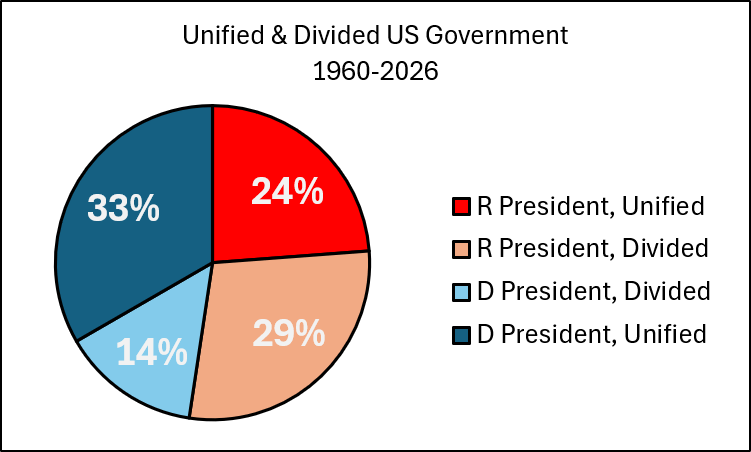
Since 1960, the most popular form of government split has been a Democratic president and unified government, followed by Republican presidents and a divided government. Democrats have controlled at least one chamber of congress for 62% of the years. Do these splits matter for federal outlays, receipts, and the deficit? Since a unified democratic government was most common, I use that as the baseline fiscal case and compare the cases to it.
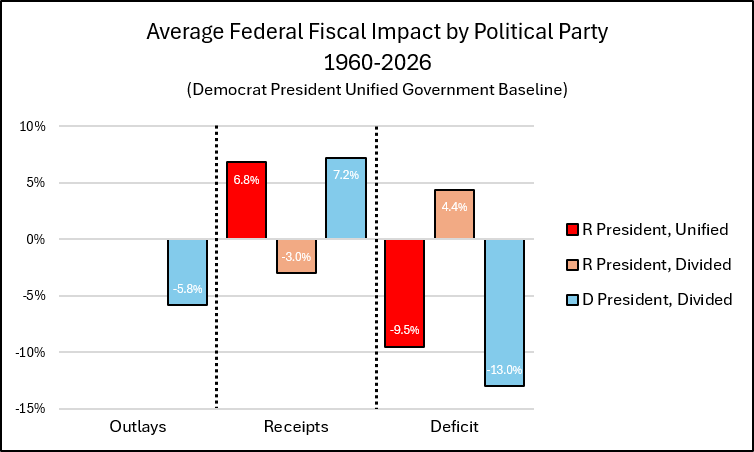
Below are the average impacts of government-party types on federal spending, revenues, and the deficit. The blanks are insignificant differences. On average, the only party split that results in less spending is a Democrat president with divided government. Those and unified Republican governments raise more revenue and reduce the budget deficit from its trend (there was a small decline in in discretionary spending at the start of Trump’s 2nd term with a unified government). The bad news for deficit hawks is that Republican presidents with a divided government – the type that we’ll have for the next two years – perform poorly. On average, they reduce government revenue and increase the deficit. Again, all of this is ‘on average’.
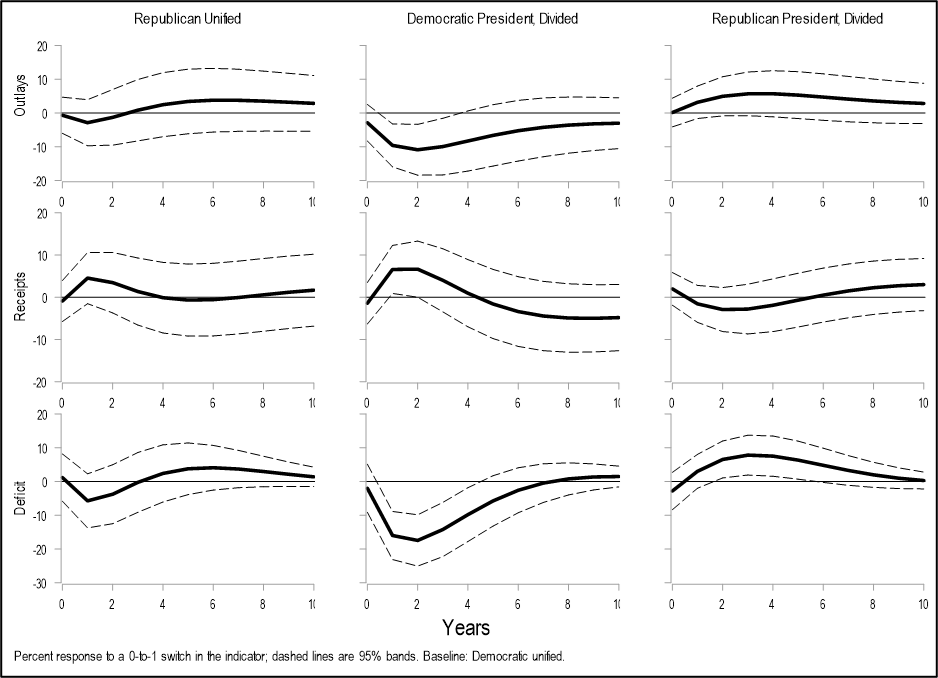
What about the dynamic effects? After all, plenty of legislation takes years to have substantial fiscal impact. Those effects are below. Dynamically, a Republican united government is no different from a Democrat united government. When Democrats hold the White House but not congress, then the fiscal picture lives its best life. Spending falls, receipts rise, and the deficit falls too. Republican divided governments don’t have ‘statistically significant’ dynamic effects on outlays and receipts – but they do both move in the wrong direction. In fact, a Republican president with divided government is the only type of government that precedes transitory increases in the deficit. So, we have that to look forward to.
How will 2027-29 look? The data is too noisy for a formal statistical forecast. But, if the above stats are any indication, then we should expect worsening deficits. Given that the Federal Reserve engages in monetary offset, we should not expect interest rates to decline anytime soon.
I ran a VAR of log outlays and receipts on themselves, indicators of party control, and an exogenous trend. I did the same for log(outlays/receipts) to measure the deficit. Fiscal variables get a Cholesky order that give party control indicators exogeneity. The 4-lag version is similar to the 1-lag results that I illustrate above. The bar graph illustrates the VAR coefficients.

