For the past two years, we’ve had a unified government in which the Republican party has populated the White House and had majorities in both chambers of congress. Once the new legislators are in office we’ll have a divided government. That means that the political party controling the White House won’t also control the senate and house of representatives. In the spirit of saying something of substance, I want to know what the implications are for our fiscal picture.
One can measure fiscal health in many ways. Does a divided government bode well for shrinking the deficit? Rather than spit-ball about politics, I take the data since 1960 in one hand and a model in the other. See the end notes for model details.
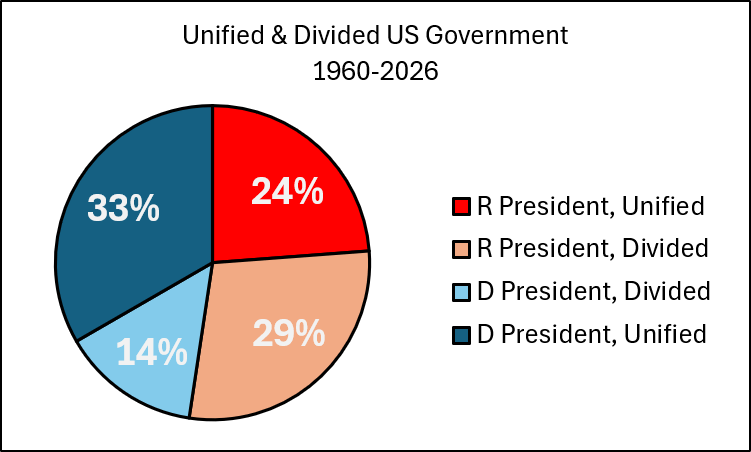
Since 1960, the most popular form of government split has been a Democratic president and unified government, followed by Republican presidents and a divided government. Democrats have controlled at least one chamber of congress for 62% of the years. Do these splits matter for federal outlays, receipts, and the deficit? Since a unified democratic government was most common, I use that as the baseline fiscal case and compare the cases to it.
Below are the average impacts of government-party types on federal spending, revenues, and the deficit. The blanks are insignificant differences. On average, the only party split that results in less spending is a Democrat president with divided government. Those and unified Republican governments raise more revenue and reduce the budget deficit from its trend (there was a small decline in in discretionary spending at the start of Trump’s 2nd term with a unified government). The bad news for deficit hawks is that Republican presidents with a divided government – the type that we’ll have for the next two years – perform poorly. On average, they reduce government revenue and increase the deficit. Again, all of this is ‘on average’.
Continue reading