If you count president Trump, the number of living former presidents is at a historic high of five (Clinton, G.W. Bush, Obama, Trump, Biden). The number of living ex-presidents can increase for three reasons. 1) More people becoming president, 2) ex-presidents having longer lifespans, and 3) presidents leaving office earlier in life. Why do we have so many right now?
The historical maximum number of people who both 1) leave office and 2) live simultaneously with others is five. It first happened in 1861 when Abraham Lincoln (16th) was president for just under a year before John Tyler (10th) died in 1862. Since then, the number of living ex-presidents has been mostly below four if not below 3. The figures below graph the number of people living who have been US president. The left graph uses daily data and the right uses the annual average (weighted by day).
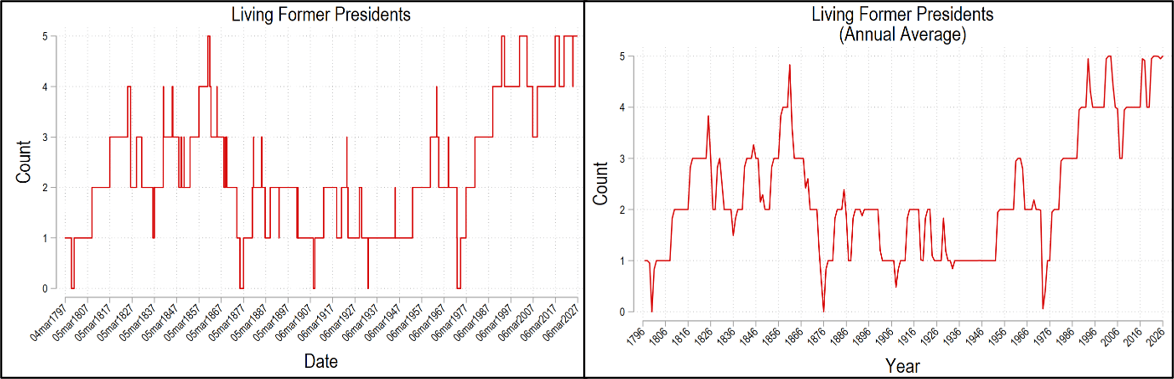
In fact, besides Washington, we’ve had four other periods when there were ZERO ex-presidents living. The first was under Grant (18th). This changes my perspective of that period. Living ex-presidents provide a sense of continuity – that something from the past continues today. They give us hope that our country will continue into the future. Grant presided over part of the reconstruction era. For part of this presidency, there was no one else who knew how he felt and no living person who had been in his position. What a tenuous time!*
The other presidents who, at some point, had no living predecessors were Theodore Roosevelt (26th), Herbert Hoover (31st), and Richard Nixon (37th). But since 1981, we’ve had three or more living presidents. So, most of us feel like that’s “normal”. Imagine if there was just Trump, and that’s it. That’d feel jarring.
1) Are More People Becoming President?
A presidential term is four years and only one president was in office for more than two terms, Franklin Roosevelt (32nd). Let’s take a 24-year trailing average. With 8-year tenures, the least number of presidents is 3. With 4-year tenures, the greatest number of presidents is 6. Assassinations and other deaths of sitting presidents can push the number higher. The graph below is the number of unique people to act as head of state over the prior 24 years (I say ‘unique’ because Cleveland (22nd & 24th) and Trump (45th & 47th) both served two non-consecutive terms).
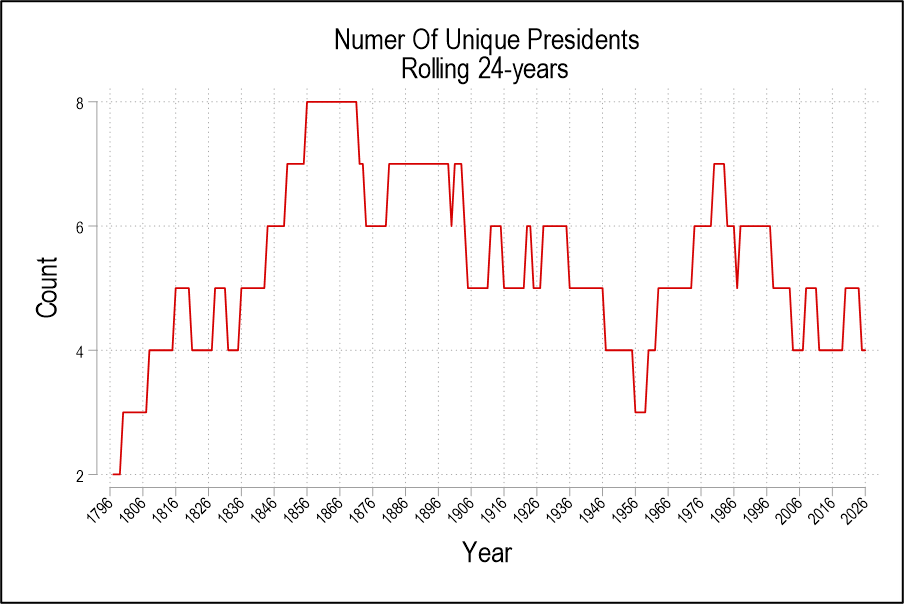
We can conclude that the number of unique presidents is not exceptionally high at this time. The historical average is about 5.2 unique presidents. We’ve been below that since 1998 owing to a higher proportion of two-term presidents since then. Before Biden (46th), Bush (41st) was the last time that we had a one-term president. So, in terms of executive regimes, the 21st century has been unusually stable. But this stability also places downward pressure on the number of surviving ex-presidents. So, we’ve had many living ex-presidents despite our few regime changes. Reason 1) doesn’t explain why we have so many living ex-presidents now.
2) Are President Lifespans Longer?
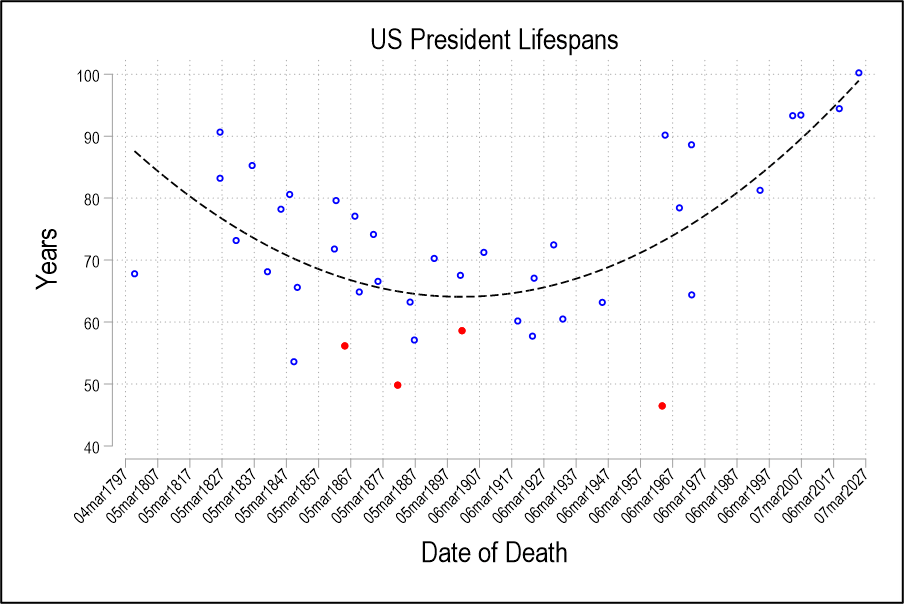
See the scatterplot below where assassinations are noted in red. Even if you ignore those data points, the lifespan of US presidents and ex-presidents has been rising since about 1900. There’s a nice quadratic shape wherein the early presidents lived a long time, maybe owing to their high socioeconomic status and lack of urban industrial exposure. Regardless, ex-presidents who’ve made it to the 21st century are living longer.** Longer lifespans, reason 2), is a contributing factor to why we have so many living ex-presidents.
3) Do Presidents Leave Office Younger?
The final possible reason that we might have so many living ex-presidents is that they leave office at a younger age. The below-left graph plots the age at which presidents left office. Again, red dots are assassinations.*** This story is more mixed. The trend has been for our recent presidents to be older when they leave office. Carter (39th), Clinton (42nd), and Obama (44th) were below the average historical age when they left, but all of the other recent presidents have been older than the average of 61 years. In fact, Biden (46th) and Trump (47th) will have been the two oldest presidents to leave office. So, while our geriatric presidents are not helping to increase the number of living ex-presidents, the three younger ones are.

The final graph above-right is the remaining years of life after leaving office. I’ve again omitted living ex-presidents, but the quadratic pattern remains even if they all die by the end of 2026. Every president since Nixon has lived at least another 15 years after leaving office. That’s well above the historical average of 11.5 years. However, Trump and Biden, the oldest presidents ever, may cause a deviation from trend.
In conclusion, we currently have an unusually high number of living ex-presidents. Their austere presence is driven by improvements in lifespan. Since 1900, their estimated life span has increased from 65 to 100 years of age. Relatedly, the estimated age of presidents leaving office has also increased: age 58 in 1900 vs age 70 in 2026. Estimated remaining years of life has also increased: 6 years in 1900 vs 30 in 2026. So, the estimated lifespan is outpacing the estimated age when presidents leave office. We know that reaching older ages come with technological advancement and greater real income. More living presidents is also a consequence.
*Grover Cleveland and Trump both had two nonsimultaneous terms. I count them as living while they were in office for the 2nd time (1893-1897 & 2025–).
**I’ve omitted currently living ex-presidents. The pattern remains even if they all die by the end of 2026.
***Cleveland’s and Trump’s first terms are omitted.


I vaguely remember that Nixon took office when there was a record high of surviving predecessors, and they all died. Is that right? Or maybe it was Reagan?
LikeLike
Nixon entered office in 1969. All three living former presidents died while Nixon was in office: Truman (1972-12-26), Eisenhower (1969-03-28), & L. Johnson (1973-01-22).
The record high number of surviving predecessors is 5. It first happened under Lincoln, then 5 more times since the 1990s. No former president died while Reagan was in office.
LikeLiked by 1 person
Thanks! My memory of this assertion probably goes back to the early 80s, but it was wrong then.
LikeLike