Most Published Research Findings Are Directionally Correct

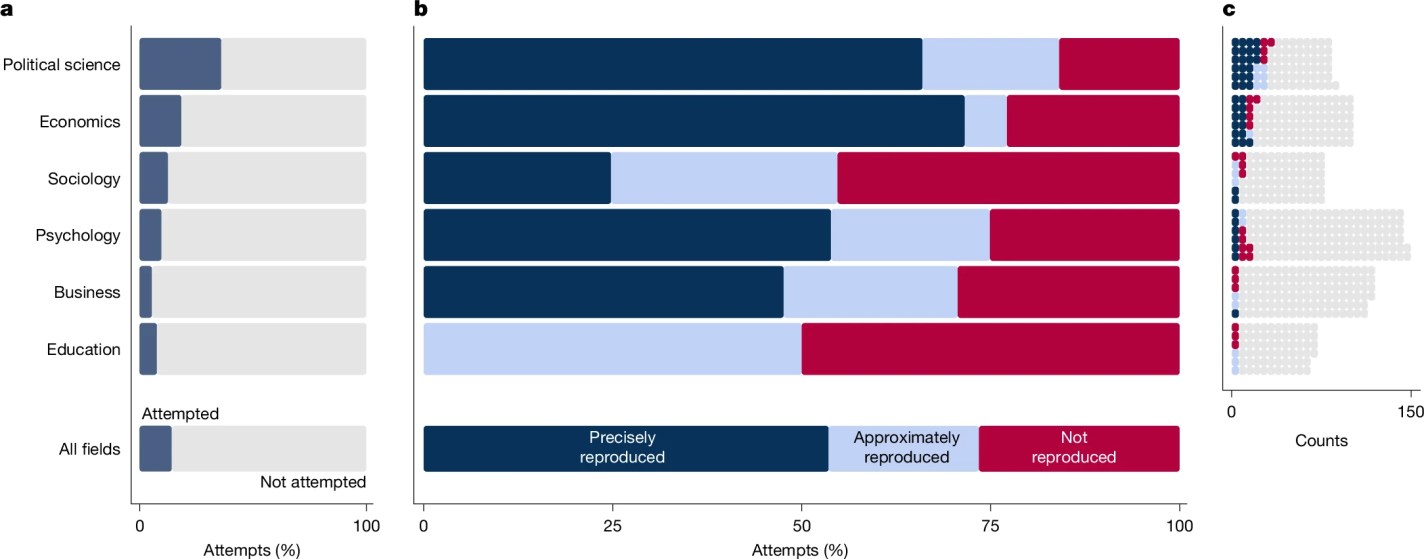
As a new quick rule of thumb inspired by the Nature papers, you could do worse than “cut estimated effect sizes in half”. If a published paper says that a college degree raises wages 100%, then chances are the degree really does raise wages, but more like 40–50%. In 2005, John Ioannidis said that “most published research findings are false”. By 2026, we seem to have improved to “most published research findings are exaggerated.”

That’s the conclusion of my piece out today at Econlog: “Is Economics Finally Becoming Trustworthy?

There’s plenty of both good and bad news for economics and the social sciences in both my piece and the Nature special issue it describes. It’s kind of like the Our World in Data motto:
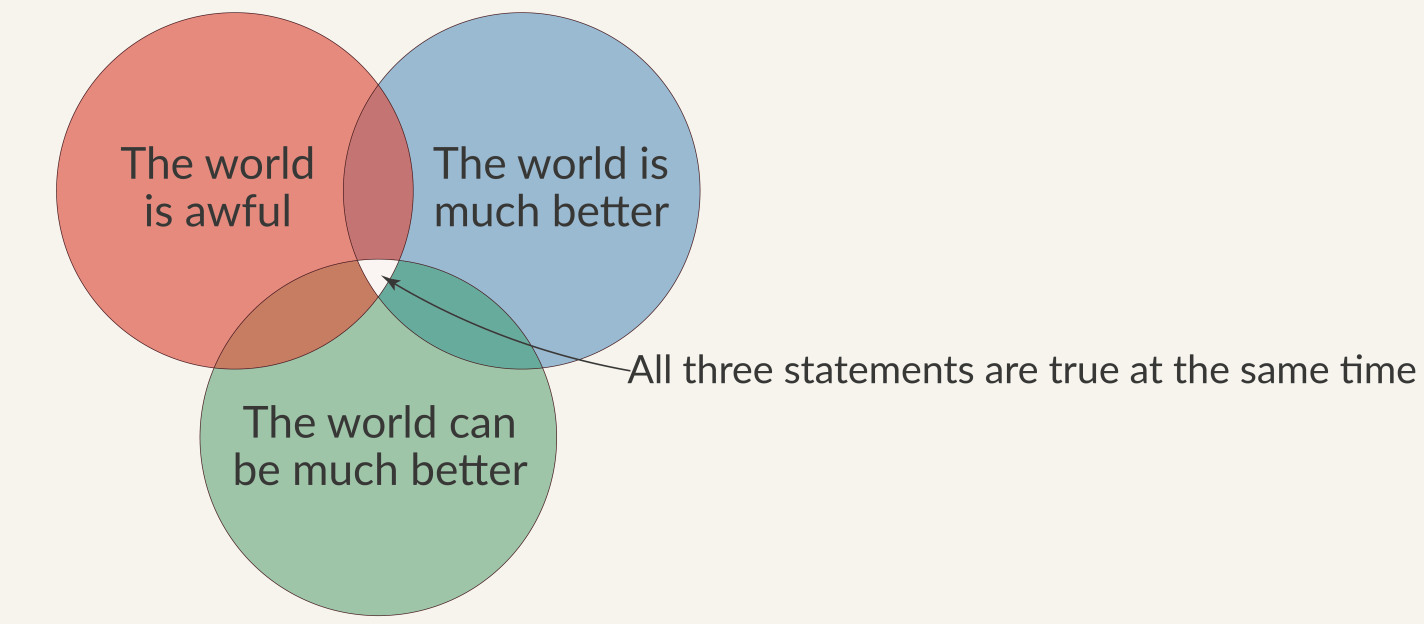
In short, our attempt to replicate hundreds of papers showed that published social science results shouldn’t be trusted precisely today, but they seem to be getting more reliable over time, and they are much more reliable than chance. Economics and political science look the best, though we are still very far from perfect:
You can read the full piece here.

How Much To Trust Research Papers? My Rules Of Thumb

  1. Trust literatures over single papers
  2. Common sense and Bayes’ Rule agree: extraordinary claims require extraordinary evidence
  3. Trust more when papers publicly share their data and code
  4. Trust higher-ranked journals more up to the level of top subfields (e.g. Journal of Health Economics, Journal of Labor Economics), but top general-interest journals can be prone to relaxing standards for sensationalist or ideologically favored claims (e.g. The Lancet, PNAS, Science/Nature when covering social science)
  5. More recent is better for empirical papers, data and methods have tended to improve with time
  6. Overall effects are more trustworthy than interaction or subgroup effects, the latter two are easier to p-hack and necessarily have lower statistical power
  7. Trust large experiments most, then quasi-experiments, then small experiments, then traditional regression (add some controls and hope for the best)
  8. The real effect size is half what the paper claims

That last is inspired by a special issue of Nature out today on the replicability of social science research. An exception to rule #4, this is an excellent project I will write more about soon.