I missed Alan Kreuger’s 2019 book on the economics of popular music when it first came out, but picked it up recently when preparing for a talk on Taylor Swift. It turns out to be a well-written mix of economic theory, data, and interviews with well-known musicians, by an author who clearly loves music. Some highlights:
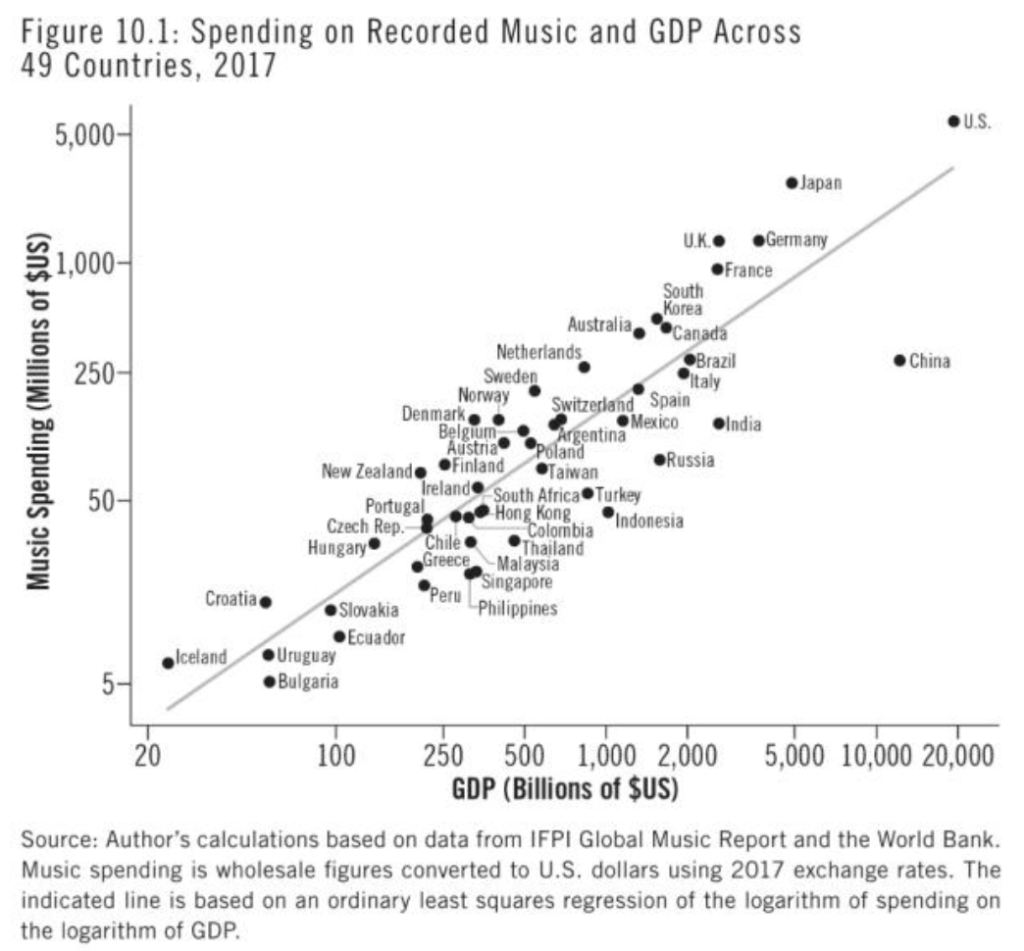
[Music] is a surprisingly small industry, one that would go nearly unnoticed if music were not special in other respects…. less than $1 of every $1,000 in the U.S. economy is spent on music…. musicians represented only 0.13 percent of all employees [in 2016]; musicians’ share of the workforce has hovered around that same level since 1970.
there has been essentially no change in the two-to-one ratio of male to female musicians since the 1970s
The gig economy started with music…. musicians are almost five times more likely to report that they are self-employed than non-musicians
30 percent of musicians currently work for a religious organization as their main gig. There are a lot of church choirs and organists. A great many singers got their start performing in church, including Aretha Franklin, Whitney Houston, John Legend, Katy Perry, Faith Hill, Justin Timberlake, Janelle Monae, Usher, and many others
Kreuger explains that concerts used to be underpriced as a loss leader to sell albums. Now things have flipped, and recorded music is used as a loss leader to promote concerts. As a result:
The price of the average concert ticket has increased by more than 400 percent from 1981 to 2018, much faster than the 160 percent rise in overall consumer price inflation
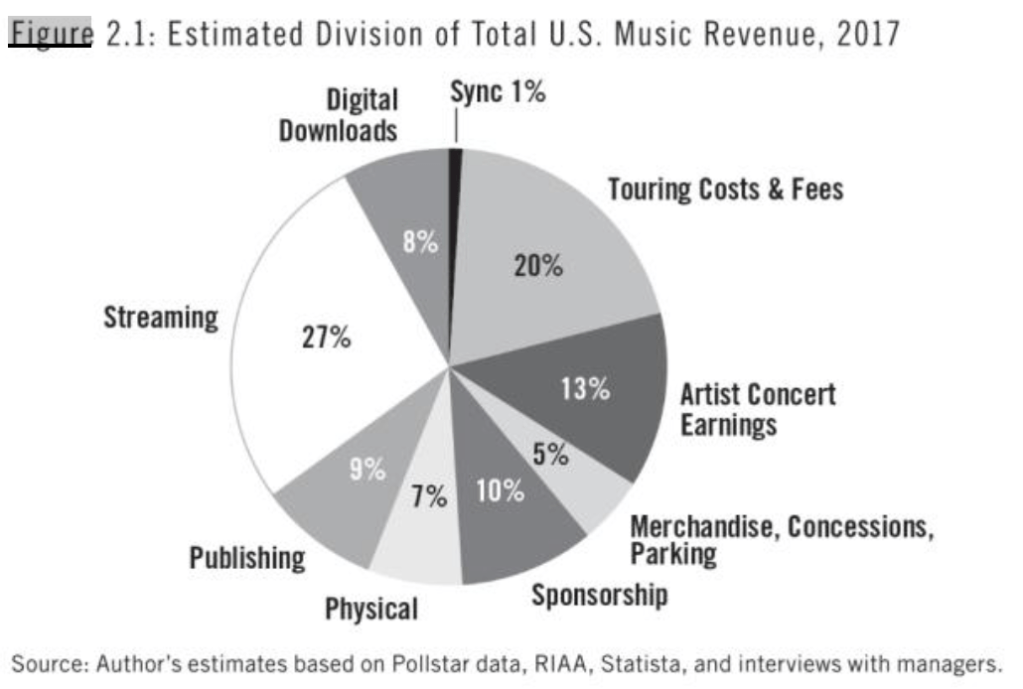
This is especially true from the artists’ perspectives. They might get a share of “13 to 14 percent” of the royalties on recorded music, but closer to a 50 percent share of concert revenue. So even though consumer spending of recorded music is still somewhat higher than on live, most artists are making most of their money on live music. Some exceptions come from the indie labels:
Small independent labels cannot afford to have too many artists who fail to cover their costs. As a result, they tend to give artists smaller advances and pay higher royalty rates, and they often invest less in promotion. However, artists who strike it big with an independent label [like the Lumineers] stand to make a lot of money because of the higher royalty rate.
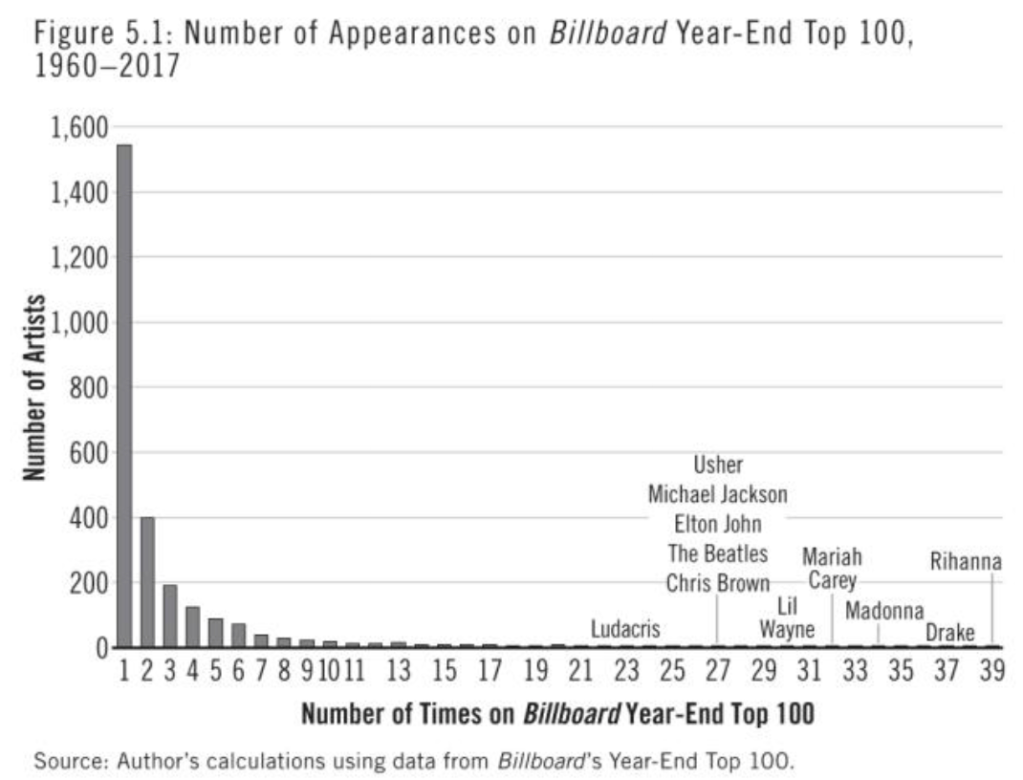
One-hit wonders are more common than I realized:
Of the 2,591 artists who recorded a Top 100 song since 1960, only 40 percent managed to do it more than once
Mostly this is because making popular music is hard, though Kreuger’s interview with the frontman on Semisonic (known for their one hit “Closing Time”) shows that sometimes bands have other reasons. Because of his daughter’s health issues, Dan Wilson said:
The thought of being away for two hundred nights a year touring seemed less and less sustainable. So I applied a lot of creativity to figure out how to write songs for other people
This worked:
He has shared songwriting credit with Carole King, Taylor Swift, Halsey, John Legend, and more than one hundred other collaborators
The big record companies operate similarly to venture capitalists, losing on most of their investments but making up for it with a few big hits:
Only one or two of every ten records produced by a major label ends up covering its advance and expenses.
Everyone complains that streaming is unfair to artists, but streamers tend to pay more than half of their revenue to artists; radio is much worse:
Under longstanding copyright law, American radio stations do not pay for recorded music performance rights; they only pay for composition rights. As a result, Aretha Franklin was not paid when her iconic rendition of “Respect” was played on the radio, but the song’s composer, Otis Redding, or his estate, was paid royalties. Iran and North Korea are the only other countries that do not require the payment of performance rights when songs are played on the radio…. music radio stations pay out only 4.6 percent of their operating budget for music
Overall the music industry can be rough for artists apart from a few superstars, but it is a great deal for consumers:
The average consumer spends less than a dime a day on recorded music. Yet the average person spends three to four hours a day listening to music. Few activities absorb as much time as music yet provide as much pleasure.
I’d recommend Rockonomics to anyone interested in music; I learned a lot from it as an economist, but I think it would still be an easy read for most people.
 Economist Writing Every Day
One thought on “Rockonomics Highlights”