Economists rely on trade data. The historical Foreign Commerce and Navigation of the United States reports detailed monthly figures on imports, exports, and re-exports. This dataset spans decades, providing a crucial resource for researchers studying price movements, consumption patterns, and the effects of war on global trade.
The U.S. Department of Commerce compiled these reports to track the nation’s commercial activity. The data cover a vast range of commodities, including coffee, sugar, wheat, cotton, wool, and petroleum. Officials recorded trade flows at a granular level, enabling economists to analyze seasonal fluctuations, wartime distortions, and postwar recoveries. Their inclusion of re-export figures allows for precise estimates of domestic consumption. Researchers who ignore re-exports risk overstating demand by treating imports as goods consumed rather than goods in transit.
Trade economists who investigate historical markets will find valuable insights here. U.S. merchants imported significant volumes of coffee during World War I, but much of it did not stay in the country. The U.S. re-exported large quantities, as its naval protection made American ports a safe waypoint for South American shipments. When the war ended, re-exports collapsed. Without re-export figures, analysts might misinterpret import data and underestimate the postwar increase in US coffee demand.
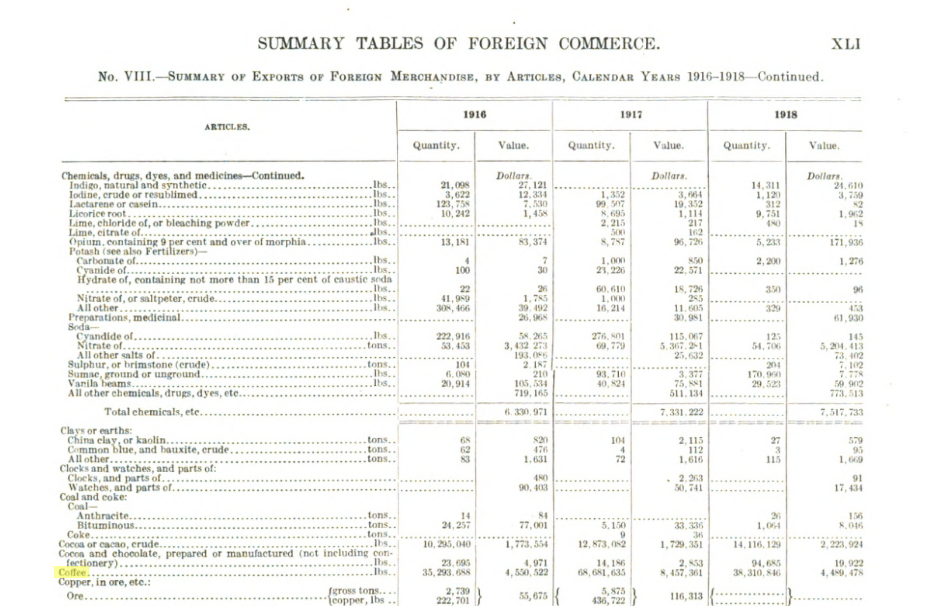
These datasets also offers a foundation for studying trade elasticities, terms of trade, and government interventions like tariffs. Researchers can examine how wartime disruptions affected commodity prices and how postwar adjustments reshaped global supply chains.
Digitization would greatly enhance access to this data. The report’s structure complicates direct extraction, as optical character recognition (OCR) software struggles with dense tables and formatting inconsistencies. A team that processes and standardizes the figures could transform this historical record into a rich resource for empirical research. The statisticians of the early 20th century compiled trade data with remarkable precision. Today’s scholars should recognize its value and apply modern analytical techniques to unlock its full potential.
 Economist Writing Every Day