Recently, I learned what humidity is. That might sound stupid, so let me clarify. I knew that humidity is the water content of the air. I also knew that the higher the number, the more humid. Finally, I also knew that the dew point is the temperature at which the water falls out of the air. But, now I understand all of this in a way that I hadn’t previously.
First, what does it mean for there to be 70% humidity? As it turns out, it’s a moving target. There are two types of humidity: specific and relative. Specific humidity is the mass of water in, say, a kilogram of air. So, more humidity means more water. This is obvious. There’s a related concept called absolute humidity, which is more like mass of water per volume of air (sometimes used in place of specific humidity). Again, more humidity means more water. Neither of these is the way that humidity is reported on the weather channel.
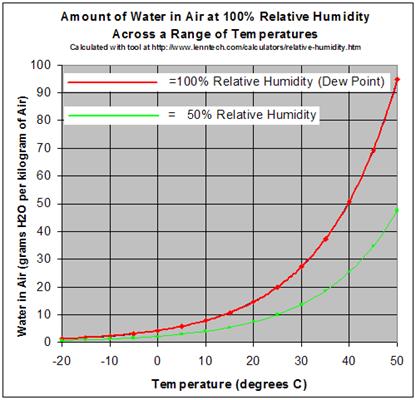
Relative humidity is the number that you see in your weather app. What’s that? Relative to what? First, we need to know that warm air can hold more water than cool air. Pressure also matters, but atmospheric pressure doesn’t change enough to make its effect on humidity significant on relevant margins. So, all of this discussion, and the number in your phone, is at atmospheric pressure. Below is a graph that illustrates the maximum amount of water that can be in the air at different temperatures (red line). So, at 30 degrees Celsius (86 degrees Fahrenheit), there can be as much as 27 grams (0.95 oz or ~2 tablespoons) of water in the air.
More after the jump.
That red line is the maximum, which is different from the actual amount of water in the air. That can obviously be less than the maximum. But this still doesn’t explain what the percent humidity number means. As it turns out, the percent humidity refers to the mass of water in the air *relative* to the maximum possible mass at a particular temperature.
For example, at 30 degrees Celsius 10 grams of water in the air is 37% humidity (10/27). At 20 degrees Celsius, 10 grams of water in the air is 66% humidity (10/15). I’m eyeballing these values from the graph above. This means, that even with the same amount of water in the air, the relative humidity changes with the temperature. What the heck!
Why would we want to know the relative humidity? It’s not simply a matter of saying “hey, it could be worse”. Rather, humidity affects evaporation and how cool we feel, what with sweat dissipating from our skin. At all temperatures, the humidity determines how quickly some mass of water (or sweat) on a surface will evaporate. Evaporation causes cooling on a surface. So, the relative humidity is directly related to how effective your sweat is at cooling your body. This is why we report relative humidity. Absolute humidity only matters for evaporation relative to the maximum possible water that the air can hold at any given temperature.
What about the dew point? Given some temperature and absolute humidity, the dew point is the temperature for which the relative humidity would be the 100%. Look again at the graph. 37% relative humidity at 30 degrees Celsius (86 F) is 10 grams of water. For what temperature is 10 grams the maximum absolute humidity? The red line intersects 10 grams at about 14 degrees Celsius (57 F). As the temperature falls, the relative humidity rises as the carrying capacity of the air falls. Once the temperature falls to 14 degrees, the air can hold no more and the water condenses out of the air. We get dew droplets covering the ground and patio furniture. It’s literally falling out of the air. This is why you can get less dew on a table by loosely covering it or even by having an open umbrella. The dew falls on the covering rather than on the surface beneath it.
There we have it. Relative humidity is the water in the air relative to how much there could be at the specific temperature. It implies a different amount of water in the air when the temperature is different. We use it because it’s related to evaporation and the efficacy of our sweat in cooling us.
 Economist Writing Every Day
An important topic in Florida and Alabama.
LikeLiked by 1 person