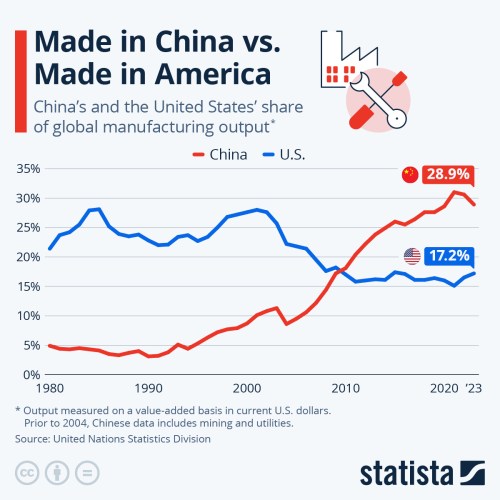
Many regular Americans and policymakers say they want the US to manufacture more things domestically. But when they ask economists how to accomplish this, I find that our most common response is to question their premise- to say the US already manufactures plenty, or that there is nothing special about manufacturing. It’s easy for people to round off this answer to ‘your question is dumb and you are dumb’, then go ask someone else who will give them a real answer, even if that real answer is wrong.
Economists tell our students in intro classes that we focus on positive economics, not normative- that we won’t tell you what your goals should be, just how best to accomplish them. But then we seem to forget all that when it comes to manufacturing. Normally we would take even unreasonable questions seriously; but I think wondering how to increase manufacturing output is reasonable given the national defense externalities.
So if you had to increase the value of total US manufacturing output- if you were going to be paid based on a fraction of real US manufacturing output 10 years from now- how would you do it?
I haven’t made a deep study of this, but here are my thoughts. Better ideas at the top, ‘costly but would increase manufacturing output’ ideas at the bottom:
- Full expensing of Research and Development costs
- Support science and engineering by funding research and education and making immigration easy for those with STEM degrees
- Deregulation, especially around building factories and infrastructure (e.g. permitting reform), and in areas critical for national defense.
- Remove tax incentives for offshoring (many ways you could do this, but a simple one is to cut corporate tax rates to the the same level as Ireland’s)
- If you want more of something, subsidize it. This could get very expensive if applied to all manufactured goods, but it could be restricted to areas where the national defense externality is most plausible, like drones and ships.
- US gov often fails by trying to push the costs of its goals onto the private sector through regulation, burdening the private sector like taxes would but failing to achieve their goals; the Jones Act is an extreme example. If you want a merchant marine so badly, just pay for it with dollars.
- Smart tariffs (unlike what we have now) could increase manufacturing output (still at the expense of consumers). Start by putting tariffs only on final goods to make sure US manufacturers can still get the inputs they need. Any tariffs on intermediate goods that don’t already have substantial production in the US need to be announced years in advance to allow time to build up domestic suppliers.
- Weaken the US dollar to make exports competitive (but this is costly and not well targeted)
Some ideas from others:
- What Would a Pro-Free-Market ‘Industrial Policy’ Look Like?, Robert Tracinski
- Journal of Economic Perspectives 2014 symposium on manufacturing, 2024 symposium on industrial policy.
- The Techno-Industrial Policy Playbook, Brand new series of proposals, odd mix of authors, some of whom are very smart
I think one thing that often confuses people here that they think of manufacturing output and manufacturing employment together. Some people want to bring manufacturing jobs back, but that isn’t happening; even China has been losing manufacturing jobs while their output soars thanks to automation. Economists realize that bringing manufacturing employment up substantially would be hugely expensive, but fail to explain that bringing manufacturing output up substantially could be much cheaper.
I look forward to seeing more specific ideas from others. But overall I think economists and free-marketers (and America) would be much better served if we changed our knee-jerk response to “lets bring back manufacturing” from something like “No, that’s dumb” to something like “Yes, and that’s why we need permitting reform”.
 Economist Writing Every Day