From Warren Nutter’s “The structure and growth of Soviet industry: A comparison with the United States.” The Journal of Law and Economics 2 (1959): 147-174.:
“Let us acknowledge at once that all statistics contain faults and errors. Let us also acknowledge that no government or other agency resists the temptation to stretch figures to its own account if it feels it can get away with it. Representative government, competitive scholarship, and free public discourse are the Western institutions that have counteracted error and misrepresentation in statistics, imperfectly to be sure, but at least to some degree.
The peculiar difficulties with Soviet statistics stem, in the first instance, from the system of authoritarian, centralized planning-from what has been called a “command economy.” Published statistics come from only one source: the state. There are no independent sources to restrain each other or used as checks against each other, except to the extent that related figures published by different state agencies might not be fully coordinated before publication. At the same time, the suppliers of data to the central authorities -the economic and administrative units- have a stake in the figures they report, since their performance is judged on the basis of them. The Soviet statistical authorities do not hide their concern over the misreporting that results from this feature of the economic system. A second set of difficulties stems from the crusading nature of Soviet communism. Statistics are grist for the propaganda mill. Knowing the ideological views of Soviet leaders, one cannot expect them to dispense facts in a passive and detached manner.”
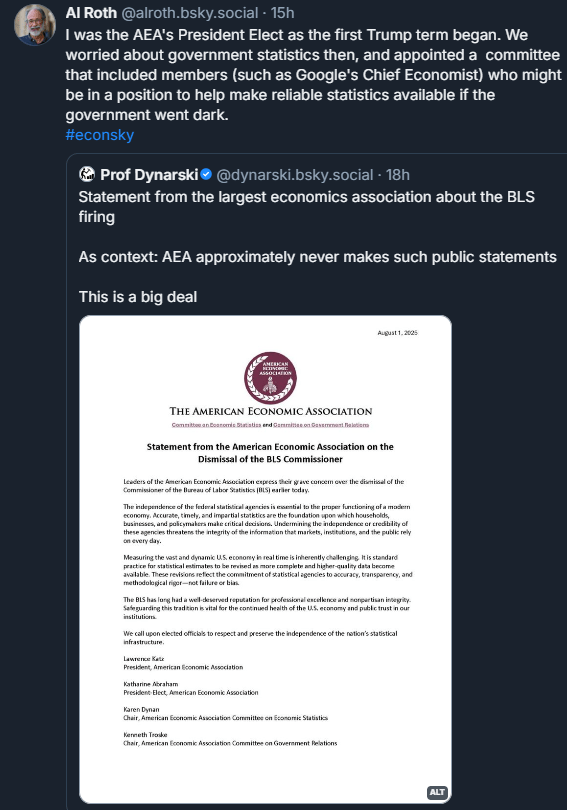
As many of you likely know, the President fired the director of the Bureau of Labor Statistics because he didn’t like that the newest employment numbers painted an unflattering portrait of the US labor market. Fortunately, the US continues to benefit from alternative to government statistics, but make no mistake, the BLS produces the absolute best labor market measurements the world has ever known.
It’s telling that while Soviet data seemed to often fool outsiders at the time (despite the occasionally raising of doubts), there was no such delusion within the Soviet Union, where provincial leaders would consistently look to outside sources for accurate economic reports.
Nutters is credited with co-founding the “Virginia School of Political Economy” at the University of Virginia with future Nobel Laureate James Buchanan. The Virginia school is most associated with public choice economics, something which by the 70s was often construed as an intellectual counterbalance to the modeling of government as infallible corrective to market failures that was particularly enticing to those favoring a socialist planned economy. That an administration and political coalition that loves to rail against omnipresent socialist threats is demanding that the US embrace a Soviet-style data apparatus is a reminder that history is never without irony.
 Economist Writing Every Day
One thought on “The (attempted) return of Soviet economic statistics”