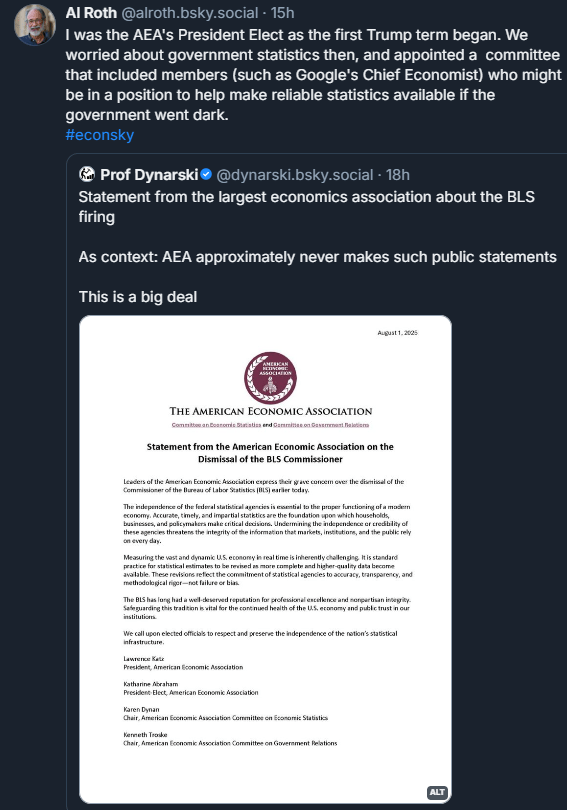
The (attempted) return of Soviet economic statistics

From Warren Nutter’s “The structure and growth of Soviet industry: A comparison with the United States.” The Journal of Law and Economics 2 (1959): 147-174.:

“Let us acknowledge at once that all statistics contain faults and errors. Let us also acknowledge that no government or other agency resists the temptation to stretch figures to its own account if it feels it can get away with it. Representative government, competitive scholarship, and free public discourse are the Western institutions that have counteracted error and misrepresentation in statistics, imperfectly to be sure, but at least to some degree.

The peculiar difficulties with Soviet statistics stem, in the first instance, from the system of authoritarian, centralized planning-from what has been called a “command economy.” Published statistics come from only one source: the state. There are no independent sources to restrain each other or used as checks against each other, except to the extent that related figures published by different state agencies might not be fully coordinated before publication. At the same time, the suppliers of data to the central authorities -the economic and administrative units- have a stake in the figures they report, since their performance is judged on the basis of them. The Soviet statistical authorities do not hide their concern over the misreporting that results from this feature of the economic system. A second set of difficulties stems from the crusading nature of Soviet communism. Statistics are grist for the propaganda mill. Knowing the ideological views of Soviet leaders, one cannot expect them to dispense facts in a passive and detached manner.”

As many of you likely know, the President fired the director of the Bureau of Labor Statistics because he didn’t like that the newest employment numbers painted an unflattering portrait of the US labor market. Fortunately, the US continues to benefit from alternative to government statistics, but make no mistake, the BLS produces the absolute best labor market measurements the world has ever known.

It’s telling that while Soviet data seemed to often fool outsiders at the time (despite the occasionally raising of doubts), there was no such delusion within the Soviet Union, where provincial leaders would consistently look to outside sources for accurate economic reports.

Nutters is credited with co-founding the “Virginia School of Political Economy” at the University of Virginia with future Nobel Laureate James Buchanan. The Virginia school is most associated with public choice economics, something which by the 70s was often construed as an intellectual counterbalance to the modeling of government as infallible corrective to market failures that was particularly enticing to those favoring a socialist planned economy. That an administration and political coalition that loves to rail against omnipresent socialist threats is demanding that the US embrace a Soviet-style data apparatus is a reminder that history is never without irony.

The consequences of a “Papers, please” economy

While DOGE is advertising their new deregulation AI (HT MR) with promises of “trimming 100,000 of those rules“, the reality is that the administration is ushering in the most profound layer of government involvement into our lives since the introduction of the income tax.

It defies the opportunity cost of my time to try to recap the crappy-policy-via-executive-order blunderbuss that has been the last 6 months, but it is sufficient to focus on two dimensions: immigrant targeting and tariffs. ICE is pulling people off of the street and detaining them for hours for “based on their physical appearance” in what can only be described as a dedicated effort to remove current immigrants, denaturalize past immigrants, and deter future immigrants. While these travesties play out one raid and immigration court ambush after another, tariffs are being introduced rapidly and haphazarly, always at the expense of the economy, and sometimes even in opposition to their stated goals of reshoring manufacturing. The prospect for (relatively) frictionless commerce across borders is quickly becoming unobtainable.

So what’s going to happen, now? Is America going to become a Whiter, autarkic island that steadily de-growths itself into a quieter state of nostalgic bliss, cheerfully accepting a shorter, sicker, less opulent life than before? Sure, the food will be worse and more expensive, our electronics obsolete and more expensive, our cars older and made from inferior materials (and more expensive), but that’s just the way things have to be, right? People will live and do as they’re told, right?

Have you met people?

People adapt. They find every workaround, every crack. Their lives will change, in many ways for the much worse, but they will work with what they have to make the best that they can. And this case, the best way to adapt will be to become just a little more criminal. Not fully criminal, just a little more. More aspects of our lives will become akin to driving 10 mph over the speed limit because that’s just what everyone does.

Daily life will, slowly and at times imperceptibly, move underground. More jobs will pay in cash. Fewer exchanges will be made absent a personal relationship. More goods will arrive in suitcases at the luggage return. Friends will ask friends to pick up a phone/earbuds/tablets for them when visiting less economically restricted countries, while also reminding them to delete their messaging apps before heading through security. More goods will be altered from their true, optimal consumable form to qualify for a lower tariff. The advantage of physical over digital media will widen again. Where exchange exists outside of the law, trust needs to be found outside of contract. At the margin, business will become just a fraction of a percent more nepotistic. More employees will be found somewhere in the family tree. Everyone will just become a bit more crooked and, in doing so, expect everyone else to be a just a little more crooked. The US is a shockingly high trust society because it pays to be trustworthy. This is how such things unravel.

More immigrants will live within arrangements that hide them from not just the authorities, but from observation in general. Curtains and blinds covering windows at all hours. Dinner will taken at home rather than the restaurant. Clubs and concert gatherings that appeal to immigrant crowds, or even just less White crowds, will advertise less, relying on word of mouth. Workers will move more often, rather than garner attention. The sick and injured will not be taken to the emergency room. The gaps in an already fractured society will become a little wider.

Employers will keep more people off the books. Off health insurance and workers compensation. Employees will, perversely, be grateful for the lower exposure. Insurance companies will find new ways to audit liability without exposing their clients personnel. Predatory human trafficking will find larger herds of underground populations to hide their practices within. Fewer people will trust and rely on the law. Fewer people will enjoy it’s protections.

What about compensating wage differentials? On the one hand, labor supply will be reduced as it is pushed underground, reducing their numbers and safely available hours. On the other hand, the necessity for employers to reduce the visibility of their workers while incurring the risk of legal punishment will reduce demand. The net effect on equilibrium wages is uncertain. However, those employers who manage to guarantee longer and safer tenured employment will capture greater rents from those they employ. Getting to work more consistently and going to sleep feeling safer is quite the fringe benefit, one that employers may find to be a more a profitable form of compensation than just simple wages.

I’d keep writing, but I already sound like a paranoid crank. I’m not sure I am comfortable, anonymous reader, with this level of intellectual vulnerability in such a public forum. Papers, please.

The option to leave

The US, like every geopolitical entity to ever exist, has produced global public goods (i.e. international security, defeating the Nazis, etc) and global public bads (greenhouse gases, failed interference in other countries, etc).

I would like to posit something very simple: the greatest public good the United States has ever produced is the option to leave where you are and emigrate to the United States. If a country and its leadership is failing, non-trivial fractions of their population had the viable option to pack their bags and walk out the door. Perhaps unfairly, this is doubly true for their best, brightest, and most endowed with resources, making the threat all the more salient. It’s voting with your feet i.e. Tiebout effects writ large.

If you are a failing nation, your options become to watch your population dissipate or put up a wall blocking exit. Either that or, you know, actively take steps to improve your country so that fewer people wish to leave their home and start over elsewhere. The ramifications of stifled immigraion to the United States will be felt for decades, and not just in the United States in the form of an enervated economy and betrayal of our core civic values, but globally in weakended constraints on every failing regime.

It’s not AGI if it has a dial you can adjust to produce your preferred falsehoods

It’s not AGI, it’s barely even regular AI, when an LLM is this heavily directed. This appears to be very real over on Twitter. What’s most telling is the thinness of the prompts that yield very specific responses that, suffice it to say, Grok would not have provided even 3 months ago.

Musk has adjusted Grok’s algorithm so it’s now a neo-Nazi.Pretty cool that almost every progressive commentator, elected official and organization still uses Musk’s X algorithm to communicate with the public! Good job guys.

Max Berger (@maxberger.bsky.social) 2025-07-06T17:39:08.885Z

I’ll simply say this: no one has declined more in my estimation in my entire life than Elon Musk. I thought he was an engineering genius not even 5 years ago, perhaps awkward in some ways, but earnest. Now he is (or is working very diligently to project an identity of) a white supremacist desperate to play off of traditional racist and antisemitic fears to maintain his own status and influence. His ambition and resources have been combined with a monstrous agenda, and the world is much worse for it. It’s tragic in every way.

With regards to AI, there needs to be more discussion of the market for AIs, plural. I think a lot of people are operating off the assumption that AI will be like Google or VHS. A natural monopoly; one AI to rule them all and bind them. I’m not so sure. I think there is a very real chance that AI’s will find niches. That different algorithms will create different families of bespoke AIs. It feels like the world is already siloed into echo chambers of entertainment- and identity-based news feeds. If AI allows us each to get bespoke answers, serving our own person confirmation biases, to each and every question, is that better or worse? In a counter intuitive way, it could actually be better. You can’t get communities and cults of one. It might be better for the world if the news became something you couldn’t create effective propaganda out of.

Kayfabe in the political marketplace

Kayfabe: the tacit agreement to behave as if something is real, sincere, or genuine when it is not

The term comes from wrestling, which is fitting because for years I’ve been stealing Dana Gould’s line “Politics is just professional wrestling in suits.” There are limits to my casual theft, though. I will not pretend that I am the first to observe that politics has deeply internalized the kayfabe code of vehemently declaring beliefs or expectations in no way actually held while simultaneously understanding that your rivals are doing the same.

I am curious whether you can undermine your own political agenda or influence by going too far, by committing too much to a fictional worldview. Much like Serpico, if you go too deep you can lose track of the real you. Grandstanding in front of the cameras is one thing, but if you want to trade in the political marketplace, you need to be able to credibly do so in good faith. I can’t help but wonder if part of the inability of Congress to assert it’s constitutional power in face of Executive overreach is a political market failue. Has the information and signal quality between represenatives been so eroded that prices and, in turn, exchanges can’t emerge?

On a more optimistic note, however, I expect that at some point a political party will find advantage in have better norms of credible signaling if only because they will have an easier time solving their own collective action problem. The question remains, though, at what point will the political advantage of superior collective action dominate the electoral advantage of earnestly lying to voters?

United States Vs Cruikshank (1876); ICE vs Los Angeles (ongoing)

Cruikshank played a crucial role in terminating Reconstruction and launching the one-party, segregationist regime of “Jim Crow” that prevailed in the South until the 1960s. The circuit court opinion of Justice Joseph Bradley unleashed the second and decisive phase of Reconstruction-era terrorism…” – Pope, James Gray. “Snubbed Landmark: Why United States v. Cruikshank (1876) Belongs at the Heart of the American Constitutional Canon.” Harv. CR-CLL Rev. 49 (2014): 385.

The Civil War was over, but the seceding states remained in open conflict with the federal government. Southern states, particulary those with majority Black populations, were desperate to terminate institutional reconstruction and purge the federal agents tasked with ensuring Black voting rights. The levers of state government were still in White hands, but that control was becoming tenuous. It is not wholly outlandish to suggest that Jim Crow as we know it may never have come to be if the US Supreme Court had not handed down a now infamous decision that effectively left Black men and women to fend for themselves. Freed from slavery only 13 years earlier, they now had to contend with state and local governments intent on maintaining the status quo of White supremacy in every way possible. It would be nearly a hundred years before the Voting Rights Act of 1965 would begin to restore the franchise to Black individuals.

California is in full conflict with federal government as we speak. Federal agents under the moniker of ICE are attempting to detain and subsequently deport individuals they deem to be of questionable legal residence. There have been multiple examples of individuals with fully legal claims to residence in the form of green cards, student visas, or full blown birthright citizenship who have been taken into custody by ICE and CBP agents (masked, armed, and in full military fatigues). Absent familial notification or any form of due process, there was always the question of whether a state authority would ever treat these takings of individuals as extralegal kidnappings.

Am I using inflammatory language? I’m not sure that I am. ICE and CBP officials have make strong declarations that they believe themselves to be unbeholden to court decisions, due process, or the Constitution. State and local law enforcement in California have made it clear that they will not aid ICE in any way shape or form save preventing violence in the streets as protesters have arrived in sufficient numbers that ICE agents were effectively herded into narrow spaces and prevented from exiting with the individuals they had detained.

Just in case it is not patently obvious how I feel on the matter, the protesters are on the right side of history. The federal government is overreaching in a more gratuitous and unconstitutional manner than at any moment in the previous 40 years. This is, in terms of our federalist structure, the inverse of Jim Crow and Cruikshank. State governments are in position to defend the liberties and rights of their residents against the extralegal encroachment of federal agents. If anything, I find myself grateful that such a standoff is occurring in California, a state with the scale and resources to stand against the federal government. I know the Trump administration is threatening to “cut off” California from federal money, but that’s a strange tactic. California net loses between $71 and 83 billion per year in federal spending minus taxes paid by residents. California is the 4th largest economy in the world. California is a mess, their housing market is atrocious, they manage their forests and wildfire prevention quite poorly, but it is nonetheless the single most economically important state in the US by a cavernous margin. California can say “no” to the federal government. They may find themselves with national guard troops on their streets. They can ask then ask them to be removed. They can ask ICE and CBP to leave.

This is a significant test of our federalist republic. Cruikshank served as the political fulcrum of its time by denying the federal government’s obligation to intervene and in doing so handed the power to deny basic constitutional rights to state and local governments, and the country has in many ways never wholly recovered. As we speak the federal government is taking action on behalf of the current presidential administration to deny basic constitutional rights. How a state’s ability to protect those rights against the federal government on behalf of its residents plays out may be the political fulcrum of our next 50 years.

Most people aren’t monsters

Which isn’t to say that there aren’t monsters who have found their way into and adjacent to power, but they are always limited by the beliefs held by the people on the ground doing the dirty work. The revelation in the quote below is that for all the cruelty and uncertainty being imposed by ICE, USBP, and the agents deputized from local law enforcement, it isn’t meeting the ambitions of those who want more than terror and lib-owning headlines. They know their days are limited and that to make the America, at the margin, as Whiter as is possible, and to do so they need the broadest possible net cast based on little more than racial/ethnic density:

The Washington Examiner (the conservative news outlet) reports that Stephen Miller screamed at ICE officials: "What do you mean you're going after criminals? Why aren't you at Home Depot? Why aren't you at 7-Eleven?" Kinda blows up the narrative that they care about public safety.

David Bier (@davidjbier.bsky.social) 2025-06-02T15:07:55.473Z

What’s limiting them is that for as much selection as there is on politics, information sources, and social networks into the individual agents on the ground, their aren’t enough who actually want to maximize thecruelty and racial homogeneity. Most, I strongly suspect, just want to do their jobs. Many, I hope, no doubt do buy the false narratives of immigrant criminality, but those who mirror the darkest ambitions are probably (hopefully) too few in number to produce the outcomes desired by the architects of the current national travesty that shames us all.

So keep doing to the little things that keep the false narrives from becoming folk wisdom. The conversations across weak social ties that run counter to the fear-mongering and deception. Every agent and field officer who, consciously or unconsciously, finds themselves doubting the wholesale slandering of immigrants and racial groups is more sand in the gears slowing a machine that is on borrowed political time. Every day lost is a day won. Every TACO a month. Every court case a quarter. Just keep slowing it down.

We’re harder on the ones that are listening

“We hurt the ones we love because we can” is a cliche, though perhaps I should be attributing it to a specific writer. Its truth is something that I find extends beyond our close familial, platonic, and romantic relationships. The mechanism behind misdirected aggression is simple: we are exposed to a source of stress that we are unable to affect, and the innocent bystanders most proximate to us become collateral damage specifically because we can affect them. The anger inside us needs to go somewhere and, in a parable of true irony, your mutual affection becomes the channel through which you express anger and frustration that has nothing to do with them.

There are a lot economists, writers, pundits, public intellectuals whose work I consume. Often I agree, sometimes I don’t, but I keep reading them because I consistently learn from them. Lately I’ve found myself becoming more frustrated with a greater share of their writing, often because they’re not being hard enough on the Trump administration, attempts to dismantle core insitutions, or the indiscriminate cruelty behind the rampant incompetence. I want them to be meaner and angrier and more direct. I want them to have an affect that I can’t. To be clear, I’ve attributed more power and influence to them than they actually have, but I think that’s not the real problem.

The real problem is that I know that no one in the Trump administration cares that they are cruel or incompetent. You can, at best, embarrass these people briefly, but you can’t shame them. They only internalize consequences and they’ve yet to experience any. They have coalesced around the singular belief that has served as the North Star for Trump’s entire life: there are no rules. Rules are fake. An illusion. A mass delusion. There are no rules and you can do whatever you want in the moment that serves your ambitions and ego and then move on to the next thing.

What do you do when your entire mechanism for affecting and contributing to world is the written word, criticism, the speaking of evidence-based truth to power and that power doesn’t care? What I find myself tempted to do, and what a lot commentators our there (especially on bluesky) are doing, is attacking the people who might and do actually listen with an undeserved fury. The criticism is often valid, but it’s just 30% meaner than it needs to be. More personal. More cruel.

I care about AI. I care about energy subsidies. I care about crime and education and health. But, if I’m being honest, there are times every day when I don’t. I’m a professor, I care about and contribute to bleeding edge research, but the moment we are living through isn’t about PhD level questions. These are 5th grade social studies times. Democracy. Rule of law. Citizenship. All men are created equal. Basic human dignity. That’s the reality and it’s not hyperbole.

I hope everyone will keep doing their research and commentary about the nitty gritty of day to day science. I also hope that everyone will take the time to grant just a bit more space emphasizing the basics, to leave no doubt about where they stand. Becaue no matter how someone might identify politically, in this moment it’s mostly irrelevant. Liberal, conservative, libertarian, classical liberal, neoliberal, new liberal, social democrat. The differences are trivialities. There are only two groups that matter: those who want to keep the basic institutions intact and those that want to burn it to ground. That’s it.

So just keep that in mind when you’re mad about someone online, about what they wrote, what you think they believe. Are they trying to hold the world together while bandits are stripping the walls for copper and carving out chunks of marble from every load-bearing pillar? If the answer is yes then they deserve grace. I’m trying and I hope you’ll do the same for me.