As of 10:30am this morning Berkeshire Hathaway is down 5.6% on the news that Warren Buffet is retiring at the end of the year. At first blush, this makes sense. Buffet is an irreplaceable input into their production function. However, the man is 94 years old, a full 24 years after nearly everyone retires, so this was not exactly an unforseeable event. Why wasn’t more of this already baked into the price? Further, this would appear a far better outcome – announcing retirement more than 6 months in advance- than a more sudden and unfortunate event, such as the passing of a man in his mid 90s. It’s not unreasonable to suggest that both event possibilities would be baked into the price and, with his retirement beingthe better outcome, thus the price could have even gone up.
To me, this is a reminder that there limits to how much Knightian uncertainty can be baked into a price. Put another way, it is a reminder of the costs that uncertainty (nearly?) always imposes on markets. We would all, voters and legislaters, be wise to remember that as the current Presidential administration continues to inject seeming daily boluses of constitutional, existential, and economic uncertainty into our lives.
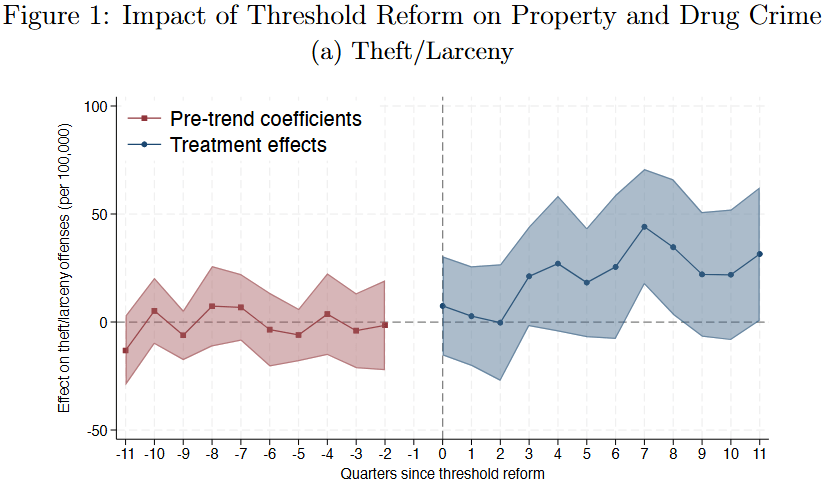
“From 2005 to 2019, forty US states raised the dollar value threshold delineating misdemeanor and felony theft, reducing the expected punishment for a subset of property crimes. Using an event study framework, we observe significant and growing increases in theft after a state reform is passed. We then show that reduced sanctions for theft have broader effects in the market for illegal activity. Consistent with a mechanism of substitution across income-generating crimes, we find decreases in both drug distribution crimes and the probability that a released offender previously convicted of drug distribution is reincarcerated for a new drug conviction.”
For those interested in a bit more of the nitty-gritty, we analyze both arrest and recidivism data within a stacked event study because we are dealing with staggered (diffent years) and fully-absorbing treatments (i.e. once they raise it they never lower it back). States raise their felony theft thresholds for a portfolio of stated and unstated reasons, but the reality is that the value of the marginal stolen good is often deteriorated by decades of inflation only to be doubled or tripled by a single act of legislation. This makes for an excellent before/after experimental setting to test the effect on crime.
We’re going to look at two things broadly: arrests and recidivism. The importance of arrests is straightforward: they give us a sense of the rates of crime across populations. Recidvism is more subtle. More on that in a bit.
In the quarters leading up to a threshold change (above) we see flat pre-trend with a coefficient of zero i.e. nothing happening. Nothing happening is good, it means that neither law enforcement nor criminals exhibit any sign of anticipating the change. Once a given state makes the change, we see an uptick in rates of theft within 6 months that persists for three years. Speculating beyond that is dangerous – too many other things happening in the world. But criminals seem to be responding.
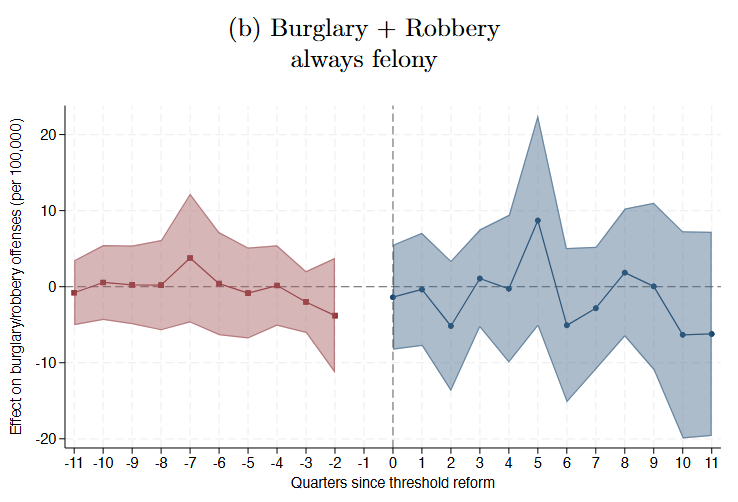
We don’t see any effect on Burglary or Robbery, however (below). This is also a sign of rational criminals since these thresholds don’t apply (i.e. they are always a felony, regardless of property value). In other words, we don’t see an effect on all property crime, just on those crimes for which expected punishment is reduced.
We do, however, see an interested effect on drug distribution (below). In the quarters after a theft threshold reduction, we see a significant and persisting reduction in drug arrests. Yes, we include controlling covariates for medical and recreational marijuana legalization. There’s something else going on here. Are people exiting one income-generating crime for another?
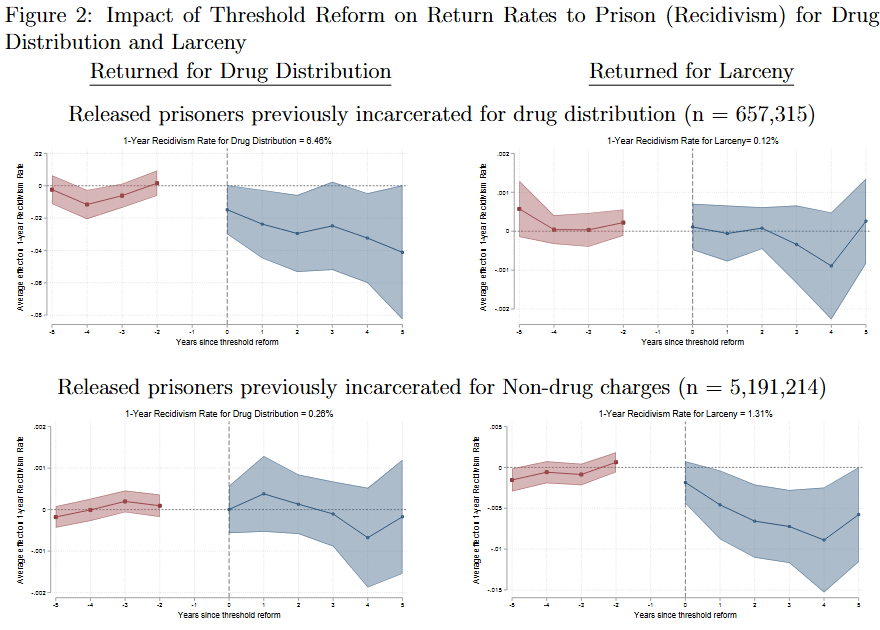
This is where recidivism comes in. Using detailed, restricted-access, prisoner records, we track when prisoners are released and if/when they are returned to prison. By stratifying the analysis by the crime types they were previously incarcerated for, we can separately estimate the effects of felony threshold changes on individuals with human and social capital in the drug distribution business from those who do not. What we observed is both striking and subtle.
For indidividuals previously incarcerated for drug distribution (top left), their rate of return for future drug convictions is immediately lower with a reduction in the felony threshold. For those who were never in the drug trade, there is no effect (bottom left). Reducing the expected punishment for theft is pulling individuals out of the drug business.
Now let’s look at the return rate for felony larceny. For most prisoners (bottom right), there is a massive reduction in the rate of return for larceny. This makes complete sense – if more theft is classified as a misdemeanor, you are much less likely to be re-incarcerated with a new sentence for it. When we look at prisoners previously incarcerated for drug distribution, however, there is no observed effect (apologies for the changing y axis scales, there’s no good way to keep them constant). What does this mean? We interpret this as evidence that the reduction in punishment for theft is canceled out by the shift into theft as a preferred way of earning income. The labor substitution effect cancels out the effect of reduced punishment.
There’s obviously a lot more in the paper. No, there is not an effect on violent crime (Table 2). No, there is not an observed effect on officer enforcement intensity (Appendix Table A3). No, we can’t do a regression discontinuity at the threshold values (too much bunching, see Appendix Figure A7). The conclusions are both obvious and subtle, but the most important may simply be the reminder that all policies have tradeoffs and spillovers, no matter how narrow they might seem.
TLDR; When states increase the property value threshold delineating misdemeanor from felony theft, prospective criminals respond by a) committing more theft and b) substituting out of drug distribution and into theft. This pattern of substitution in the criminal labor market is more evidence that criminals are not only rational and respond to deterrence incentives, but are also selecting across criminal options, which means we should expect spillovers across crimes when policies create differential changes in expected punishments, enforcement, and returns.
What, you think I’m going to pretend anyone is paying attention to anything but the trainwreck on Wall Street? As of 10:15AM this morning, the market is down 8% in 5 days, almost 20% off it’s peak, and is still falling. It’s entirely attributable to a unfathomably stupid trade war that has been forecast for months, if not years. This is the kind of probabalistic event that is usually internalized within the market in advance, which suggests that either very few people thought Trump a) was telling the truth, b) would be able to execute, or c) other forces within government would be able to stop him.
The legislative branch has largely ceded power to the executive, with only the judicial hanging on as some check against power. The open question, then, is at what level of damage will the legislative branch find incentive to reassert itself against an executive that (probably) doesn’t have the constraint of a future electoral victory to pursue? Will the destruction of great swaths of the US and global economy warrant reclaiming of power or impeachment of an executive?
I’m finally watching the Ken and Sarah Burns documentary on Da Vinci. It is, predictably, excellent. If you are heavily read on Da Vinci then there probably isn’t much that will be new to you, but the visual composition really adds something to what is less a propulsive story and more an attempt to capture the raw capaciousness of this person’s mind. It’s breathtaking, humbling, and inspiring.
There is a temptation to marvel at his dedication, ability to learn, and breadth. To relegate his accomplishments to the realm of outlier genius. Fight that temptation. Instead, take a moment to consider how dedicated he was to being unencumbered. To finding projects and patrons that would service to subsidize his pursuits in totality.
More than anything, observe a brilliant person for whom both the prospect and opportunity of boredom led him to follow his curiousity into whatever intellectual avenues it wanted to pursue, and then turning his imagination into product manifest in text and on canvas.
Boredom is an opportunity we increasingly don’t afford ourselves nearly enough of. We are starved for boredom. Allow for its sustenance.
“In a room sit three great men, a king, a priest, and a rich man. Between them stands a sellsword. Each of the great ones bids him slay the other two. Who lives and who dies?”
…“Power is a curious thing, my lord. Perchance you have considered the riddle I posed you that day in the inn?” “It has crossed my mind a time or two,” Tyrion admitted. “The king, the priest, the rich man—who lives and who dies? Who will the swordsman obey? It’s a riddle without an answer, or rather, too many answers. All depends on the man with the sword.” “And yet he is no one,” Varys said. “He has neither crown nor gold nor favor of the gods, only a piece of pointed steel.” “That piece of steel is the power of life and death.” “Just so… yet if it is the swordsmen who rule us in truth, why do we pretend our kings hold the power? Why should a strong man with a sword ever obey a child king like Joffrey, or a wine-sodden oaf like his father?” “Because these child kings and drunken oafs can call other strong men, with other swords.” “Then these other swordsmen have the true power. Or do they?” Varys smiled. “Some say knowledge is power. Some tell us that all power comes from the gods. Others say it derives from law. Yet that day on the steps of Baelor’s Sept, our godly High Septon and the lawful Queen Regent and your ever-so-knowledgeable servant were as powerless as any cobbler or cooper in the crowd. Who truly killed Eddard Stark, do you think? Joffrey, who gave the command? Ser Ilyn Payne, who swung the sword? Or… another?” Tyrion cocked his head sideways. “Did you mean to answer your damned riddle, or only to make my head ache worse?” Varys smiled. “Here, then. Power resides where men believe it resides. No more and no less.” “So power is a mummer’s trick?” “A shadow on the wall,” Varys murmured, “yet shadows can kill. And ofttimes a very small man can cast a very large shadow.” Tyrion smiled. “Lord Varys, I am growing strangely fond of you. I may kill you yet, but I think I’d feel sad about it.”
Will they be subpoenaed? If yes, will they comply? If they comply will they be arrested? If arrested will they be tried and convicted? If convicted will they be pardoned? If pardoned will he be impeached? If at any point your deductive reasoning concludes with a “no”, then you can reason backwards inductively to why this is happening.
Homan: "We're not stopping. I don't care what the judges think. I don't care what the left thinks. We're coming."
Trade. Diplomacy. Aid. National Defense. Social Security. Medicaid. National Institute of Heatlh.
These are big things and they are under duress at best, out right attack at worst. It’s useful to when observers point out that bad policies are bad, that people are getting hurt, that there are consequences in play that have not been in play in since the early days of the Union. It’s useful, but what’s the next step? What is actionable?
I’m curious about the political incentives for damage control. Is there credit to be had for politicians who lay themselves on the tracks in front of an administration that seems to run on spite, to draw the kind of attention that will lead to retribution against their districts and states? Are we seeing so little action on the part of the opposition party because there is no political incentive to take action?
Put another way, how do you sell opposition to constituents as they begin the feel the pain of new policy regimes? Is it simply going on TV to lay the blame ex post or do you tell them the pain is coming in advance? Is it good politics to serve as the messenger of doom for someone else’s policies?
This isn’t building up to a big observation. I don’t know. These are just the questions I’m walking around with. There’s something about the current administration that makes political opposition feel like punching a cloud. No one is sure what the adminstration can and can’t get away with. What the courts will strike down or hold up. What the next hour’s executive order will be. How do you oppose chaos if chaos is the sole (governance) objective?
The simple answer may simply be to begin building institutions at the subnational level. That takes time, and tax dollars, to be sure, but sometimes you have to plant trees whose shade you will never sit in. It doesn’t just have to be single states, either. Why can’t New York, California, and Massachusetts have their own health consortium to prepare flu vaccines and fund research? Why can’t Texas, Oklahoma, New Mexico, and Arizona set aside resources to grow solar power generation? I don’t know how you escape federal tariffs legally, but such considerations don’t seem to be slowing down the executive branch. Why can’t California or Michigan play the same game?
I don’t know where this is going, and the entire political landscape may shift the first time Social Security checks go out a week late, but at some point the opposition will have to pivot from anger and resistance to building for a new and different governance landscape, and that will include rebuilding newer, perhaps more resilient or even redundant institutions. It’s all pie in the sky until it isn’t.
The future is always uncertain, but the short term returns on Luka Doncic to the Los Angeles Lakers already look better than some would have forecast. While he isn’t up to his highest previous standard of play yet, the reduced burden and additional space being enjoyed by Lebron James is already evident in his play. You’ll find no predictions regarding the rest of the season here, but it is a healthy reminder that complementarities are harder to anticipate than substitutes. The possibility of substitution between inputs is more than anything else revealed by their sameness, an attribute that alllows revelation by comparions. Complementarity, on the other hand, is far more complex and often obfuscated by the near infinite ways two or more inputs can be different. Substitutes can be predicted with information and attention to detail, and is therefore more easily reduced to a repeatably applied formula. Predicting complementarities demands more bespoke creativity, an art that is far harder to differentiate from luck.