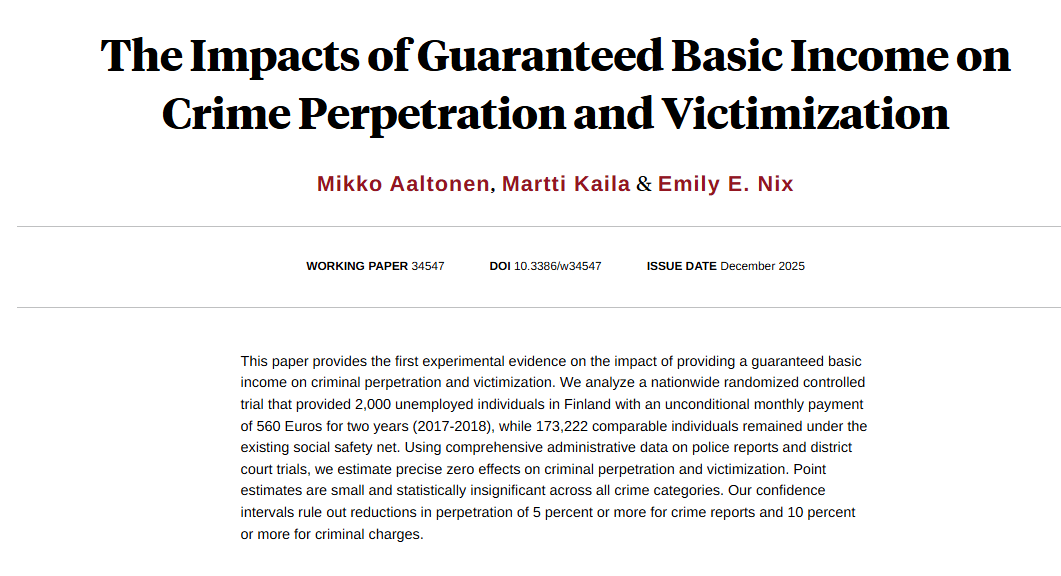
There’s no getting around the fact that UBI experiments are not producing the kind of results many expected, myself very much included. Now, to be clear, this is in Finland, which has a quite robust social safety net, but precise zeros from a sample of 2,000 unemployed subjects is not something that can be ignored either. If you asked me five years ago where a new UBI might, at the margin, have a zero effect, I would have picked a Nordic country, but still…
“Companion” (2025, written and directed by Drew Hancock) is a perfect example of a film that doesn’t get much of a chance these days in theaters, but is creative, entertaining, and best consumed without information or presumption going in. It’s not a “twist” or “paradigm shift” film. You will piece together many, but not all, of the reveals a half-step before they are revealed. In short, it is an excellent film currently streaming on HBO Max. It’s also part of the ever-growing evidence that the post-Hollywood sweet spot may in fact be low-ish budget projects ($10 million in this case), filmed far from LA, with talented and competent actors, but without tabloid-level stars. If that means we’re getting a second wave of Friedkinesque 70s filmmaking with a smidge of CGI and 80% less actor (and civilian) endangerment, I am all for it. What might be a crash for studios, agents, and publicists could be another golden age for creatives (writers, directs, actors, editors, set designers, etc) and film-goers.
But don’t put too much on my amateur prognosticating. And certainly don’t read a review or even watch a trailer. Just give it 90 minutes of your life.
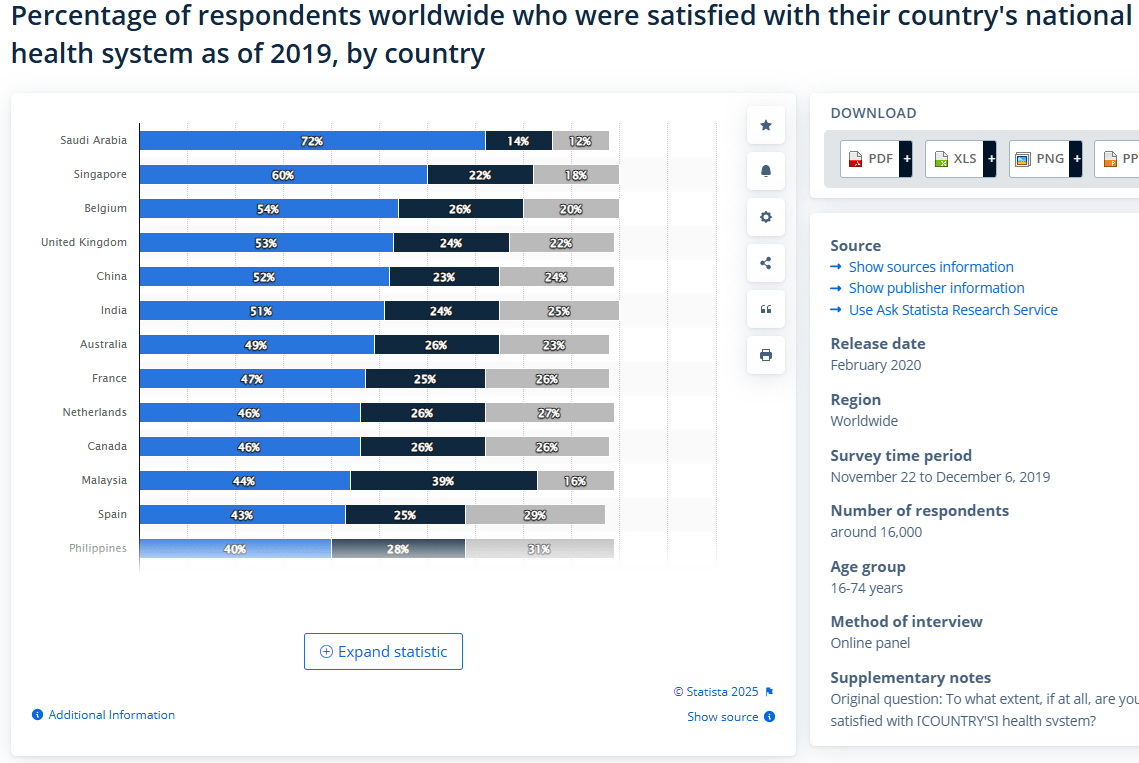
There is a broad consensus that healthcare in the United States is suboptimal. Why it is suboptimal is, of course, a subject of much debate, but that’s not what I am curious about at the moment. When people argue against the merits of the status quo, the superior systems of western Europe, Canada, the UK, and (occasionally) Singapore are mentioned. But if you look at most of those countries, the rate of satisfaction is, by the standards of most goods we consume, quite poor. In the survey reported below, 30% of US consumers are satisfied with their healthcare, compared to 46% of Canadians. The high water mark of “non-city states whose data I actually believe” is Belgium at a whopping 54%, and this is a survey conducted before the Covid-19 pandemic!
So while I have no doubt that improvements can be made in any system, there’s perhaps an under-discussed obstacle that may be unavoidable in any democracy: there is no stable political equilibrium because voters will never be happy with the status quo.
Here’s my simply reasoning.
The wealthier we get, the more expensive healthcare will get. Healthcare is example 1A of Baumol’s curse in the modern world. No matter how much our economies grow, the cost of labor will grow commensurately, meaning healthcare will keep getting more expensive until we find a significant capital substitute for labor. (This is not a cue for AI optimists to chime in, but yes, I get it. We’ve been waiting for a “doc in a box” for a long time, and if the speed with which I got a Waymo is any indicator, we’ve got a ways to go before Docmo get’s real traction.)
The wealthier we get, the more we value our lives. With that greater valuing comes greater risk aversion, and a greater willingness to pour resources into healthcare. If the labor supply of sufficiently talented and trained doctors can’t keep up, then wealth inequality is going to have a lot to say about how access to healthcare quality is distributed. Yes, there are positive spillovers as wealthiest individuals dump resources into healthcare, but are those spillovers enough to overcome envy?
Citizens in wealthy countries are deep, deep into diminishing returns on healthcare expensitures. Combine that with growing risk aversion, and you’re got yourselves something of a resource trap, where you’re chasing a riskless, decision-perfect, healthcare experience that you can’t afford and likely doesn’t even exist.
Fully socialized medicine a la the UK is of course an option, but the perils of connecting your entire healthcare system to the vicissitudes of politicsis something being keenly felt since Brexit. Put bluntly, I always struggle with the idea of making healthcare wholly dependent on voters who will happily vote for anything so long as it doesn’t increase their taxes…
If economic growth allows for greater health, but that greater health itself pushes your baseline expectations for health farther out, then you’re on something akin to a hedonic treadmill— one where cost disease keeps increasing the incline. If the world getting better means that increased demand for healthcare will always outstrip increases in our ability to supply it, that it will always be too expensive and overly distributed to those wealthier than us, and if and when we do socialize healthcare voter demands will, again, outstrip their willingness to be taxed for it…I don’t see a clear path to satisfied consumers.
Maybe this is just me projecting, but I don’t have a hard time imagining that I’d be complaining about the quality of health care I’m receiving no matter what country I lived in, though I’d be willing to try out “Billionare in Singapore” if anyone wants to support a one household experiment.
A large portion of my favorite art and artists frame themselves as “anti-capitalist”. Now, I know I am repeatedly on the record saying that the terms “capitalism” and “socialism” have been stripped of most meaning at this point, with limited ability to communicate any useful information save group signaling or mood affiliation (i.e. everything I don’t like is an exemplar of late-stage capitalism or crypto Marxist socialism), but the language is used enough within the art I like that it’s worth pondering a moment.
Now, I think it’s a bit of a trap to impose strong interpretations on how artists interpret themselves or their art. It’s their art, not mine. I also think it’s a memeable offense to try to “gotcha” artists who sell their art in the marketplace as capitalists who doth protest too much.
Yeah, I get it, everyone has to eat, even if you would prefer to live in a socialist utopia. I do think there is more worth untangling, though, and as an act of good faith I will spoil part of my conclusion. I don’t think there is anti-capitalism art anymore than there is pro-capitalism art. Rather, I think there is art and there is propaganda.
Art is one of many luxuries yielded by the remainder of time not subsumed by the needs of survival. A society that builds within itself a marketplace that rewards specialization, innovation, and efficiency will find itself suffused in art. I’m sure there are things beyond relationships, purpose, and art that make life worth living, but I can’t think of any. If in pursuing your purpose you can find art and build community, well, that’s a life well-lived.
So does art depend on the marketplace or is it an act of rebellion against it? Can it be both? I think it can. The true threat to art is not the intercession of commerce but service to power. Art is characterized more than anything by a direct, if parasocial, relationship between the artist and their audience. Service to power corrupts that relationship, demanding service to an intentionally unobserved third party. The perceived communication from the artist is now an act of deception, surrepticiously communicating the preferred messaging of the third-party. Beyond just robbing the artist of their integrity, it undermines the confidence an audience can have in all the art it consumes. Propaganda is, in this manner, a negative externality, polluting everything that art can and does provide in our lives.
When writers and other artists complain about the interventions of private equity, they are complaining about a couple things. First, and probably foremost, it is often the insistence on a revenue model (high risk, high growth) that simply does not translate to the current media landscape. It’s a bad model and makes for bad business. It should not be ignored, however, that one of the failures that a high-growth revenue model brings to a media context is a necessary subserviance to power. Service to large equity stakes (i.e. evil rich people), yes, but also service to regulatory authorties, cultural authorities, anyone and everyone that might derail your path to the hearts of the largest common denominator, to the other side of a dreamed of (and likely wholly imaginary) tipping point beyond which the glories of power law scaling will turn your tens of millions into hundreds of billions.
When a story teller places you in a dystopian future where the vagaries of a galactic-scale marketplace lead to the devaluing of life on wholesale planetss in service to the profits of preexisting conglomerates, corporations, and sultanates, it is often framed as anti-capitalist fiction. And that’s a natural summation: people are commodified, exchanged, and disposed of. But of course the power behind commodification comes with military bodies, royal lineages, and a sci-fi feudalism whose roots always trace back eventually coercive force. Commerce may be the engine producing the resources underpinning your evil army (soldiers gotta have something to eat, a way to get there, and something to shoot), but in the end the big bad evil empire is always pointing a gun.
Conversely, when a comedian both sets up shop in Austin, TX and underpins a genre of comedy that frames itself as “anti-woke”, it is not disappinting to most artists because it is “pro-capitalism”. It’s disappointing because once you scratch the surface, it becomes clear it is in service of power. It’s not aligning itself as anti-woke because there are three words that audiences will shame them for using. It’s doing so in the hopes that punching down on the same vulnerable, (often extremely) small minority populations targeted by other locuses of political and media power, they can acquire the same kind of most-favored nation status that have lifted the careers of others whose mediocre talents were insuffient to garner an audience on their own.
Art is inherently, maybe even necessarily, anti-power, because there is no room in the relationship with it’s audience for the interests of a third party. Art needs patrons, yes. The marketplace is a boon to the production and consumption of art. But when the movies, television, writing, music, video games, dance, etc of our lives is compelled to serve the interests of anyone but the artist and the audience, people sniff it out. They rebel. They blame. Whether they blame the market, the government, or religious authorities, well, that just depends on the current framing of power. And honestly, I’m not sure the framing matters all that much. It might show up in the artist’s statement next to the installation or in their AMA on reddit, but most people don’t read those, they already know who to be mad at. And besides, the art already exists. They don’t need intervention from any third-parties, maybe not even the artists.
Sports gambling is entering it’s first series of major crises since widespread legalization. While there is the typical handwringing around the intersection of vice and broad entertainment, there is also the added dimension of the role that insider information can and should play within any speculative market. Those arguments, conducted earnestly, are of course completely valid, but I think they are not giving enough attention to a key distinction in the online incarnation of sports gambling.
Speculating on sports outcomes produces the same elicitation and aggregation of information as a more traditional speculative market, such as commodities futures or stock equity markets. Information, acted upon through purchase, reveal each individual’s beliefs about the true value of a contract paid upon the conclusion of a sporting event or the price of agricultural commodity at a given date and time. The market exchange of these contracts aggregates these beliefs into a collective piece of information in the form of a market price. Some contract holders get richer, some poorer, and the broader world benefits from the distillation of private information into public prices. The problems within sports gambling stem from the second channel through which entertainment is provided and paid for: random outcome generation.
Sports match outcomes are something you speculate on. Random outcomes are something you gamble on. Yes, there is random chaos in sports the same way there is random weather in agriculture. There is no speculating on a roulette wheel, however, that’s a pure gamble. I believe the major sports leagues and the online gambling companies they partner with have made a grievous error allowing their sites to offer (nearly) pure gambles.
Think about how much casinos invest in the integrity of their games as pure and fair gambles. Dice are rigorously inspected and routinely replaced. Roulette wheels are engineered with astounding tolerances. Card games occur under multiple layers of scrutinous observation. Manipulation under such conditions is sufficiently costly such that it is almost never worth undertaking.
How do you go about making similar investments in monitoring 6 inches of horizontal manipulation of the first pitch of a baseball game? Of a marginal player taking himself out of a game injured a few minutes early? The answer is you largely can’t. So now you have human roulette wheels who can decide what number they land on. Which brings us to the second, closely related problem in the new regime of sports gambling: inframarginal game outcomes. Once a game is probabalistically decided before its official conclusion, teams will often play their substitutes to finish out the formality in order to rest their main players and protect them from injury. These players typically earn smaller salaries, often over far shorter careers, with less scrutiny over their quality of play. These are the exact players for whom a couple hundred thousand dollars may be worth incurring a small amount of risk. The product of their play in terms of success (i.e. scoring, hitting, etc) is still highly conditional on their ability relative to their opposition, but the play itself (i.e. shooting, swinging, pitching choices, fouling, etc) is entirely within their control. It may be less purely random, but it is nonetheless sold to gambling customers as fair.
Whether the outcomes in question are quasi-random outcomes or merely inframarginal, what matters is that they are not joint products of competition. To significantly manipulate these outcomes does not require the explicit or implicit coordination of multiple individuals across competing teams. Yes, one player can tilt the odds, but if you are looking to make significant money manipulating sports gambling, you can’t just tilt the odds a few percentage points. There’s a reason the Black Sox Scandal of 1919 involved eight players (seven if you consider Buck Weaver innocent, which I do).
As I love to point out, coordination across individuals is very difficult. Crimes involving coordination are, in turn, far easier to monitor. Online gambling massively reduced the transaction costs in sports gambling, opening the door for orders of magnitude increases in the number and variety of bets that could be taken. There’s obviously demand for pure gambling alongside outcome speculation, and that demand could now be met through random and inframarginal in-game player outcomes.
The danger, of course, is that few of these events are truly inframarginal. Every pitch and available player counts towards the outcome. Enough manipulation by enough players will graze away the integrity of the core product. The subsidy of lower end players through gambling will change how they approach their careers and how management approaches their employment. Fans will react accordingly as well, adjusting how they view outcomes. We’re already seemingly hardwired to view everything as causal and conspiratorial, overestimating bias in refereeing and player preferences. This will only stoke those fires further.
Organized crime famously offered a “numbers game” prior to state lotteries. Desperate for a credibly random outcome, a common mechanism was to use the middle three digits of the number of shares traded on the NYSE as the winning number. There are no shortage of lotteries now, but there obviously remains latent demand, and customers clearly enjoy bundling gambling with a product far more entertaining to consume than scratching off a ticket. Pro sports was unable to deny the profits from exactly such a bundling, but the cross contamination with their core product may prove to be of greater cost.
I’m not businessman, just a lowly economist and sports fan, but if I were running a $11.3 billion per year firm, I would be far more risk averse.
Universities continue to turn down the “Trump Compact”. The intitial nine schools targeted with an “invitation” were from a seemingly curated list of elite institutions, though some are perhaps notably less wealthy or more aspirational than the others. I can’t help but think there was some attempt to create a prisoner’s dilemma situation, where one more eager or fearful university might start a domino effect by committing first. That has not occurred.
What I do expect at some point in the coming weeks is a broadened offering of the compact to schools across the country. I expect messaging that specifically targets large public universities in states with Republican-controlled state legislatures that will be leveraged to pressure schools to sign on to the compact in hopes of currying favor with the administration and their voter base. I expect several schools to sign.
Here’s why I think that would be a grave mistake.
The compact comes with promises of “most-favored” status for applicants to federal grants through institutions such as the NIH, NSF, and Department of Defense. The thing is, they can promise that all they want. They don’t actually have that much influence over the review process. They’ll no doubt work to tip the scales on a few grants and promote them heavily, but the media coverage will vastly outweigh the dollars being shifted by the compact. It will, as always, be theater first and governance last.
But let’s say your school does procure several grants. Perhaps you’re a school that has in the past carried $20 to $30 million in active grants from the NIH and NSF, amounting to roughly $5 million per year in operating expenses. That sounds like a lot, but it’s not. Johns Hopkins University, by comparison, had $843 million in just NIH grants active in 2023. If you’re operating with $5 million a year in grant money, you have an office of sponsored projects, an Internal Review Board for human subjects research, and maybe an office for industry sponsorship. That maybe amounts to 15 to 20 personnel. What happens if the Trump administration comes through, putting its thumb on the scale for you, doubling or tripling your active grants within two years?
Chaos. Institutional chaos.
Sponsored research requires capital, personnel, and resource management. It requires legal compliance, doubly so if you’re spending federal money. It requires experienced leadership and management that know how to check boxes, file reports, track money, review protocols, and continuously train ever-churning research personnel.
But hey, that’s the point, you might be saying. We want to be ambitious and grown, we want to hire new and experienced personnel. We want to grow into an important research institution and this is our big chance! Be careful what you wish for. It’s one thing to incrementally grow over years and decades. It’s a whole other thing to try to do it in reaction to a sudden influx of money. Which, to be clear, isn’t just money. It’s an obligation. An expectation to produce scientific contributions on the US taxpayers’ dime. Obligations come with many things, but patience with incompetence borne of growing pains isn’t one of them.
But none of that is the problem. The real problem. Thetrap.
The trap is that this money isn’t going to stick around. This regime isn’t permanent. They aren’t invested in any way in scientific public goods or even science as a conept. This is, again, theater. They will move on to other things the instant it fails to the get the traction they want. They will lose elections, political tides will turn, etc. And what your institution will be left with is the reputation you earned.
And what will that reputation be? One of compliance with an anti-science, anti-public health, anti-intellectual regime. Further, you will judged on the fruits of that compliance. At the margin, it will be science that was undersupported, delayed in launch, stalled in execution, and eventually delivered short of expectations. You will have sold your reputation for a ticket on a ride you weren’t tall enough to be on yet. Grants will dry up, returning to previous levels or worse, leaving you with a bloated staff you no longer need, trying to find ways to lay off employees with all the protections of state government labor regulations.
There is no getting rich quick in academic research. There’s only avenues of over-reaching impatience ending in tears.
Perhaps a more accurate title would be “AI isn’t going to be what you want it to be or are afraid it will be.” And by “you” I mean specifically you. Whatever you have in your mind’s eye, that’s what you should correct your expectations against. Those rare times where we have the slow unveiling of a revolutionary technology, over the span of years or even decades, there is a window of time where we all form an expectation of that it will look like in it’s final form and we’re all wrong. Everyone of us. Except Neal Stephenson, but that is another story.
I think we come by this bias honestly. There’s this tendency to see a new technology and either try to will it into being exactly that thing that would be a optimal for you, or succumb to pessimistic paranoia that this is why you were always fated to lose. In the early 00’s, the start-up tech boom and, later, stock market bubble were driven, I think, but the irresistable optimism that “The Internet” was a way that someone could enter a new market via their garage and bootstrap their way to millions while skipping those less than fun decades of grinding your way to a customer base. If you had a clever concept, then millions of customers were a click away. It was “idea person” catnip. And by idea person I mean someone who has lots of ideas but rarely can be bothered to follow through with anything more a few days. Eventually enough vaporware was a bought and sold that people started to question what was real, Microstrategy got caught cooking the books, everyone had the “maybe this thing isn’t real” thought all at once, and the market tanked. Flash foward 15 years and the internet had radically changed everyone’s life, but how it did so was in hard to foresee ways, through firms that were painstakingly built by experts and/or exploded into market leadership through network effects they’ve been teaching in Econ 101 for at least 30 years.
I observed a similar effect in my own research career. In my early years I was obsessed with agent-based computatonal modeling (something I’ve written about before). For all the optimism I carried for the methodology, it always paled in comparison to expectations and claims made by other. There was an observable pattern, too. What I saw was a way to model things that weren’t tractable in other economic methods, be it classic analytics, game theory, or dynamic stochastic general equilibrium models. What they saw was a way to write and publish economic models without having to learn high level math. Its both a way in and a way around. A way to skip a stage that they wanted to believe was unnecessary to make a scholarly contribution and/or make a career in academic social science. For some it was also a way to retake scientific territory annexed by economists. In either case, their expectations were deeply biased.
What I hear within a lot of a commentators, particularly those most obsessed and optimistic for AI, is wishing into existence the tool that would best serve them. To reimagine the cliche of a hammer in a world full of nails, they are toolbox that is missing a screwdriver, but have no fear, AI will be the universal screwdriver. No need for screwdrivers anymore, everyone will have a near infinite supply of (near) zero marginal cost universal screwdrivers, ready at a moments notice. If you are a professional screwdriver, well, you are out of luck, but that’s how the fates work and bully for me because I can accomplish so much now that I have an infinite supply of the skill I lacked. I am neither constrained by my own personal deficiencies, nor am I constrained by resources insufficient to hire a team of screwdrivers. I am what I always I dreamed I would be: a specialist in what the world still needs that is no longer dependent or deferential to people with the skills I lack. If a prognosticator is predicting a specific future for AI that will greatly increase their relative status among a narrow strata of professionals or scholars, you should index their prediction accordingly.
The inverse of this, of course, is the people who imagine themselves to be the screwdrivers in the previous story. They have specialized in labor product that is soon to be available at zero marginal cost. They’re value will be decimated and thus there is no hope. The irony, of course, is that it is the exact same story but perhaps seems more likely now that it is put in a pessimistic light. Obsolescence happens, after all. They’re both almost guaranteed to be wrong, though. Both sets of expectations are being radically biased by the narcicissm of the imaginer.
My impulses are, of course, similar to everyone elses. I try to keep this in check through my experience with the tech bubble (N=1, I know). AI will change our lives, but it will probably take at least 5-7 years longer than expected, and at least that long before that change is successfully “monetized”. The changes will be significant, it will show up in almost all of our work lives. It will disappoint in many ways. I remember telling someone that our expectations for the internet were too high for it to ever meet them. Then the iPhone came out and suddenly its penetration into our lives was fully actualized.
I don’t know what you think AI will be, but you’re wrong. And that’s ok. We all are.
An overlooked part of being a good Bayesian is revisiting your past failures of imagination, so that past stuggles with Knightian Uncertainty can be transformed into simple failures to accurately forecast probailities.
I posted earlier today about things getting weirder, but it’s worth considering the exercise proposed by Jonathan V. Last over at The Bulwark, where he goes through his own worst case scenario from November of 2024 and then compares it to the current observed reality.
JVL provides the following list of current events that he never even considered as possible. Going through the list below, which of these would you have considered as genuine possibilities? Not whether you predicted they would happen, but whether you would have even considered in your forecast that they could happen.
I think there are only two items, maybe three on that list I would have thought of as >1% chance of happening. That’s a failure of my imagination and I don’t think I am alone. If we’re good Bayesians, I think that means not just updating our priors, but updating how we update, and opening the door to the darker parts of our imagination when forecasting going forward. No, I’m not enjoying it either.
Tomorrow the first of the “deferred resignation program” windows close, adding to the growing sources of a chaos as the signs of a recession continue to mount. The supply chain is filled with tariff uncertainty. The tech sector is scrambling to deal with a potentially crippled H1-B channel (conditional on court rulings). Layoffs are showing up in retail and tech. Employers everywhere are coping with worker absences due to chaotic National Guard call-ups.
Between 150k and 200k employees took the government up on option to defer resignation i.e. collect 8 months of pay before resigning. This is about 2% of the federal workforce, though it’s notable that 20% of the IRS workforce took the offer in anticipation that they were going to be laid off with fewer benefits if they didn’t. For at least half of those who accepted DRP, it appears to simply be letting them coast into an already planned retirement, but it could also feasibly be used to bridge you to your next job, on the only condition that it be outside of the federal government.
A 100k workers showing up in the job market in the next few weeks isn’t catastrophic by any means, but combined with a government shutdown that would turn off benefits weeks or months before individuals planned is just another injection of chaos into an already uncertain labor market.
I’m not telling you if and when a recession will officially hit. I’m not in that kind of forecasting business. But I am comfortable saying their is more uncertainty about the state of the economy and institutions now than at any point since 2008, more concern over a speculative bubble surrounding a new bundle of technologies than any time since 2000, and more uncertainty around the robustness of the rule of law since I was born. Make of that what you will.
There’s nothing to untangle here. No confusion over the underlying economics. No panic or fear mongering through false claims of violent crime. It’s blocking high skilled workers our economy is desperate for in hopes that the prospects of enormous damage will create yet another source of power that will lead to wealth being transferred from industry into the pockets of the administration.
It’s bad. It’s getting worse. It’s the first time I’ve experienced a steady stream of economic policy that there is no one to argue with because there is no earnest belief that this will improve social welfare. It’s just a grift.
The only thing that remains certain is that there will be a new version of this every week and month until they are stopped. I’m pretty sure I can just replace the details of the story, and then copy and paste the rest of this post going forward.