I learned about the children’s cartoon Gravity Falls this year from my kids.
Bluey is wonderful for kids and adults, but it does feel like a baby show since the younger dog Bingo is 4. If you are getting out of the baby stage with kids, Gravity Falls is great next step with 12-year-old twins. The jokes are funny, especially for American parents today who would have grown up with the cultural references.
Gravity Falls has emotional depth. These days the young folks are in “situationships” trying not to catch feelings (I hear). In Gravity Falls, everyone catches feelings so hard. It’s tragically beautiful like Anna Karenina. You can watch it on Disney+ and YouTube.
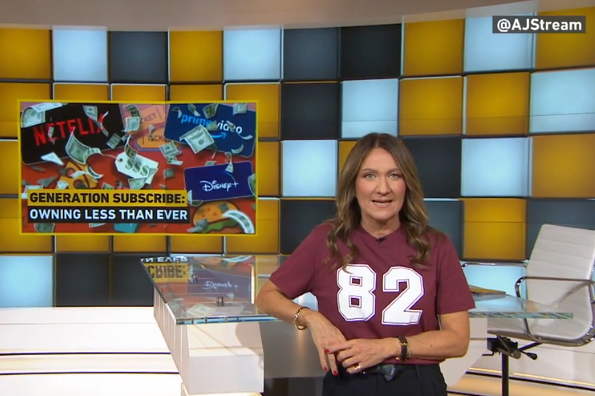
Our episode began with some clips from TikTok of young people expressing anger over feeling trapped in “the subscription economy.” Watch our show at the link above to see.
The subscription economy is a business model shift where consumers pay recurring fees for ongoing access to products/services (like Netflix, SaaS) instead of one-time purchases, focusing on “access over ownership” for predictable revenue. Gen Z feels upset that they are getting charged for subscriptions, some of which they simply forgot to cancel. They have nostalgia for the days of toting a zipper case of CDs onto the yellow school bus in 2004.
My commentary starts around minute 5:30 in the show. The first thing I point out is that, by and large, we have more entertainment available to us at a lower price than people did in that bygone era of mostly cable TV and physical discs. (This is a bit like the point I made on The Stream in March 2025 about how fast fashion represents more stuff for consumers at lower prices, which is good.)
In the episode, we discussed how people can still buy CDs today. Sanya Dosani made the point that, “there’s a place for buying and a place for renting.” Everyone should be aware of how cheap DVDs, books, and CDs are at rummage sales in the United States in 2025. You can get a music album for 50 cents. Some youths have (re)discovered that DVD players are cheaper than a year of streaming subscription costs.
Around minute 17, I got to bring up my research about intellectual property, digital goods, and morality.
We find that people do not feel bad about taking the digital goods, or “pirating.” We even find that, in a controlled experiment with no previous context for what we might call intellectual property protection, the creators of these digital goods do not call such taking stealing either. It seems to be understood that folks will take and share if they can.
The proposed reason for artificially restricting the taking and resale of intellectual property is that creators need a way to profit from providing a public good. (Intellectual property rights in the U.S. Constitution are covered by Article I, Section 8.)
I said in the interview, “If you were able to just give a song to all of your friends, you probably would, and then that artist might not be able to make songs the next year.”
Thus, I suggested, “The subscription economy is a reaction to the fact that most people don’t view it as wrong to take things they can take and not necessarily pay for them. Companies had to find a new way to be able to make money and stay in business.”
I’ll clarify that I have not done quantitative research to prove that subscription models emerged causally because of pirating. I’m speculating. Another side to this is that people simply want to stream and companies are providing exactly what people want (despite the complaints circulating on TikTok). People reminisce about the “golden days” of early Netflix, but most people forget that the company was losing money at that time. Media production and distribution companies have to make money to stay in business.
At the end, the host asked me, “… what does it mean for who we are as humans, more of an existential question, where we are going with this age?”
That’s a deeper question than you might expect for a conversation about CD-ROMs. However, people do care about having some tangible form of art about them. Think of the ancients buried alongside beads and dolls. Netflix will never be the only thing that people want. As for Gen Z being upset about convenient Spotify, “what does it mean for who we are” has got to be part of it.
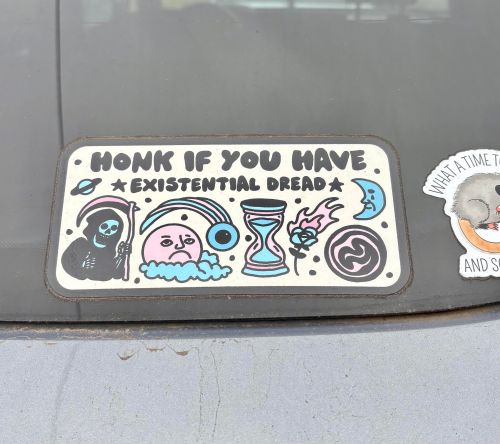
As an aside, furthermore, I’ll say here on the blog that Gen Z is by some measures the most entertained generation in history. For spiritual, not financial, reasons, I encourage them to cancel their subscriptions, take out their AirPods, and feel the silence and dread for a week.
I don’t spend a lot of time watching TV, but sometimes I do for fun. If you loved The Office and Parks and Recreation, then here are two new shows that are currently free on Netflix (September 2025).
I normally ignore lawyer shows (and cop/crime shows). But my first recommendation is an Australian lawyer show called Fisk.
Summary: A corporate lawyer must take a job at a suburban law firm after her life implodes in Sydney, and struggles to find her feet navigating grief, money, family, and entitlement.
I have only seen the first three episodes. I have no idea where the story is going, and I love that. Right now Helen has started a new job and is trying to get back on her feet after a divorce. I think it’s safe to say that the character is neurodivergent. The tone reminds me of Ricky Gervais’s The Office (maybe because Australian humor is close to British humor).
Like most Americans, I first discovered Leanne Morgan on Instagram. The real comedian has an interesting story (what Henry Oliver might call a Late Bloomer). So, I was excited when her TV show finally dropped. The first episode might not have hooked me if I didn’t already like her. I thought it picked up as the season went on, and I enjoyed the whole thing. It’s a bit like 30 Rock complete with an appearance by Jack McBrayer.
Satire news shows are, in my opinion, one of the higher forms of art that my country has produced (and an example of our exports). “Meet Tariff Tilly, the perfect replacement for the 37 dolls your kid does not need” from The Daily Show
“Tariff Tilly” builds. There is even a comment on interest rates (addressed in my previous post).
The Chair on Netflix is entertaining and I’d recommend it to EWED readers.
Plot, via Wikipedia: Professor Ji-Yoon Kim is the newly appointed chair of the English department at Pembroke University. The first woman chosen for the position, she attempts to ensure the tenure of a young black colleague, negotiate her relationship with her crush, friend, and well-known colleague Bill Dobson, and parent her strong-willed adopted daughter.
Something I like about the writing is that there is genuine suspense. Going into the last episode, I didn’t know what would happen with the romance or the threat of job dismissals.
The show is funny, occasionally. If you are looking for something easy to watch in 30-minute episodes at the end of the day that won’t leave you too upset, this will work.
Some of the issues they raise deserve serious treatment, but the serious treatment will not be found in The Chair. It’s for Netflix, with binge watching potential. Without offering any spoilers, I’d say they supply the kind of ending that viewers want. You need not overthink it.
I did go see the Barbie movie (last month I had to put up someone else’s blog about it). Kate McKinnon and the Birkenstock choice is my favorite part. You can catch part of that scene in the middle of the trailer.
Here is America Ferrera’s monologue:
It is literally impossible to be a woman. You are so beautiful, and so smart, and it kills me that you don’t think you’re good enough. Like, we have to always be extraordinary, but somehow we’re always doing it wrong.
You have to be thin, but not too thin. And you can never say you want to be thin. You have to say you want to be healthy, but also you have to be thin. You have to have money, but you can’t ask for money because that’s crass. You have to be a boss, but you can’t be mean. You have to lead, but you can’t squash other people’s ideas. You’re supposed to love being a mother, but don’t talk about your kids all the damn time. You have to be a career woman but also always be looking out for other people.
You have to answer for men’s bad behavior, which is insane, but if you point that out, you’re accused of complaining. You’re supposed to stay pretty for men, but not so pretty that you tempt them too much or that you threaten other women because you’re supposed to be a part of the sisterhood…
Movies and Money
The Barbie movie is doing well commercially. So many other special projects, such as the all-female remake of Ghostbusters, flopped at the box office. Barbie and Taylor Swift concert tickets were serving as the primary examples of spending in “Hot Profit Summer“. Congratulations to Greta Gerwig on a huge success.
Barbie has unresolved existential angst, universe portals, mother-daughter conflicts and fight scenes. To that extent, Barbie reminds me of Everything Everywhere All At Once. The big commercial successes within the same decade often share key components. Earlier I wrote about how Frozen and The Queen’s Gambitare similar.
One could write a very serious post about the Barbie movie and the portrayal of female reality. Instead, let’s acknowledge that the movie is fun, just like American life generally. No one needs Kate McKinnon (to survive). We get to watch her on TV because the world is rich now. Not only has child mortality fallen because of economic development, but life has gotten more fun.
I noted this when I reviewed the movie Austenland. The film shows that when an American woman goes to a Regency-era simulation she gets bored.
… afternoons spent on needlepoint projects were not so much painful as boring to the heroine. Boring. Matt Ridley tells us in The Rational Optimist that life in pre-modern England was more miserable than we imagine in terms of health outcomes. An underrated feature of modernity is how much more interesting the world is now that we can read widely and travel and tweet. If you were rich enough to escape endless manual labor in 1810, your options for leisure time were still very limited.
John Maynard Keynes predicted that future people would only work for 15 hours per week. Why, then, did the Barbie dolls (who don’t need money) talk so much about careers? President Barbie and Doctor Barbie seem happy.
Do we keep working past 15 hours a week because it is fun? (Tyler says it is in Big Business.)
Would it be accurate to say that professionals spend less than 15 hours a week on tasks that they truly hate? Maybe striding down a clean hallway to a meeting with coffee in hand is what we like to do? Or is that a strictly American phenomenon?
Interestingly, the human mom character (America Ferrera) does not love her job. She is not President or a Doctor. Would she prefer to be unemployed?
I want to know if the career barbies sell, but I could not find the data. The Guinness Book of World Records indicates that the best-selling Barbie is “Totally Hair Barbie”.
Where is my 600 words on the Barbie movie? I’m trying to get ready for the Fall semester, which includes two classes that I have never taught before. In the university slang, that would be “two new preps.” There is someone out there living my dream of dropping hot current cultural takes on schedule. I’m going to direct you over to Maia Mindel. Along with Adam Minter, she is someone I would love to meet.
For more economics of Barbie, Jeremy wrote “Barbie Dolls and Women’s Wages“. “… the gains for women in the labor market since the introduction of Barbie are large and worth celebrating.”
For more on film, I did list some thoughts and links for Oppenheimer.
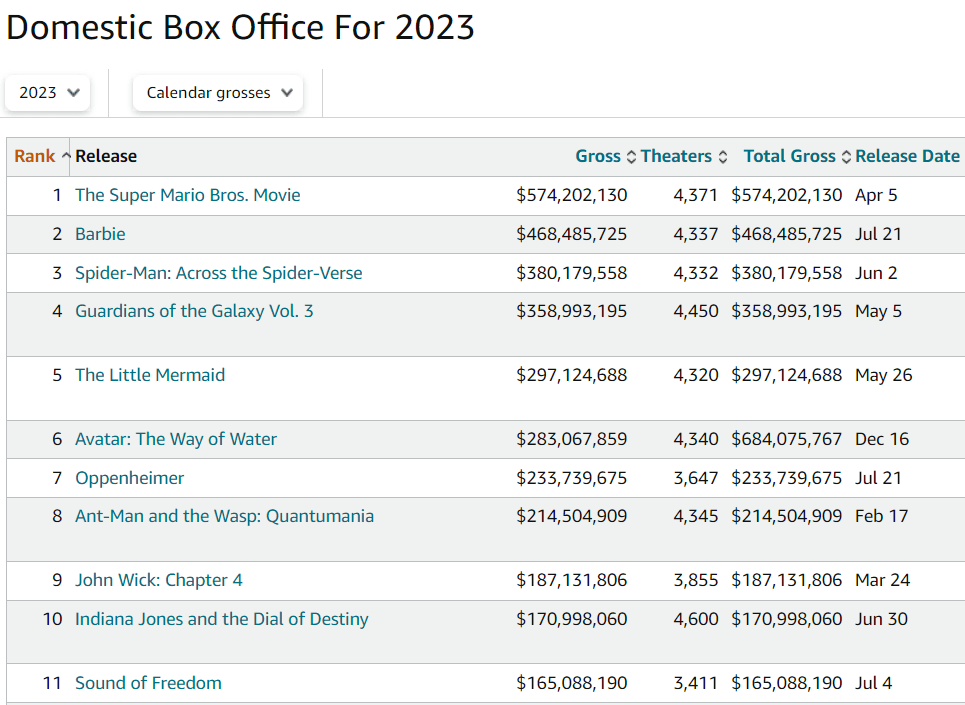
Here is the Box Office Mojo report on 2023 American theater sales, as of August 2023. In less than a month, Barbie reached #2! And Oppenheimer is doing well for a serious historical movie.
Even though I had already heard that it will disappoint high expectations, I wanted to be in on the conversation. I’m going to link the film to some other posts and ideas.
I can see why Tyler was disappointed. However, if you don’t go in with those high expectations, it still is a thoughtful period piece. It’s more interesting than the next Marvel installment.
Los Alamos National Laboratory, Attribution, via Wikimedia Commons
Though it almost drowns in the unwieldy plot, this is a movie about talent. Hitler was alienating and killing Jews in Germany, which affected the kind of talent mobilized on both sides of the war. There are several explicit references to antisemitism and motivation among physicists. Matt Yglesias observes, “They beat Heisenberg to the bomb — in part because Niels Bohr refuses to help the Nazis…”
I had written about talent and wars earlier, also concerning World War II but a different kind of doctor. “In 1939, Keynes had hired János Plesch, a Hungarian Jewish doctor who had relocated to London after fleeing Nazi persecution.”
How to manage talent becomes the challenge once brilliant scientists have been recruited to Los Alamos. The scientists did coordinate their activities enough to succeed in making the bomb, but some of the drama hinges on their rebellions against Oppenheimer. Now that machines are becoming smart, this ties into a previous post about managing artificial intelligence. “A question this raises is whether we can develop AGI that will be content to never self-actualize.”
Yet another theme of the film is the Communist movement in America in the 1930’s. I have studied this through the biographies and essays of Joy Davidman. Davidman was a committed member and then left the Party, as did several characters in the film.
And yet another tiny theme was women scientists on the project. There is a woman who complains that she was asked to be a typist even though she went to Harvard for science. Oppenheimer briskly puts her on one of the scientist teams. It goes by fast. I felt like the director was saying, “If you went to see Hidden Figures, here’s a 20 second recap of Hidden Figures for the people who like that, NEXT!” This is an example of hurrying everything in order to stuff 8 movies into 3 hours. The Advanced Placement Program® (AP) has a blog on “Women Scientists of the Manhattan Project” I know from my research on getting people to code, that women today study AP Computer Science at a considerable lower rate than male high school students.
It’s time to revisit American Girl Dolls and the Saturn V rocket. The trending topic among millennials is the new “historical” American Girl doll who lives in the year 1999.
Previously, I blogged about the historical Courtney doll from 1986 in “Complacency and American Girl Dolls.” I used Courtney’s accessories to illustrate stagnation in the physical environment (within rich countries) of recent decades. Courtney has a Walkman for playing cassette tapes and she has an arcade-style Pac-Man game to entertain herself. I pointed out that ’80’s Courtney had to be given the World War II doll Molly just to keep life interesting.
What do Isabel and Nicki have a decade later in 1999?
They have a personal CD player and floppy disks. It’s cute and the toys will sell. However, it does not seem like innovation has introduced many new capabilities. Isabel can listen to music through her headphones and be entertained on screens, just like Courtney could.
Isabel eats Pizza Hut and has dial-up internet access. There is no sense of sacrifice or expanding the frontier. The world was settled, and history had ended.
What counts for adventure in 1999? Shopping vintage clothing. Just like Courtney, Isabel revisits the past to get a sense of purpose or excitement.
This is Isabel’s diary. Having nothing to do besides look at clothes from past decades, she obsesses over status. Presumably “Kat” complimented her hat in person. Facebook didn’t start until 2004, so Isabel is not worried about “Likes” in social media.
So, what did I do with my kids for their school break on Presidents’ Day? We went to the U.S. Space and Rocket Center to see the Saturn V rocket.
You watch a romantic comedy to feel good. I was tired at the end of last week, so “Wedding Season” Netflix looked like it might be funny. I was not expecting that the protagonist would be an economist.
First, how was the movie? The first half was somewhat entertaining. The second half is too sappy and long for me.
This movie is one of the few movies I know that is just unironically set in New Jersey. There were no jokes about Jersey or Shore folk. New Jersey is where immigrant families from India are making dreams come true. The dialogue about immigrant Indian culture, including arranged marriages, was interesting.
You know the trope about a character becoming rich because they inherited money from an estranged uncle? In Wedding Season, the guy becomes unexpectedly rich from Facebook stock.
Second, how was economics portrayed?
Here is the plot summarized by Wikipedia
Asha is an economist working in microfinance who has recently broken off her engagement and left a Wall Street banking career behind to work for a microfinance startup in New Jersey. Asha’s mother Suneeta, concerned for her future and against the advice of her husband Vijay, sets up a dating profile through which Asha meets Ravi.
In the beginning of the movie, Asha pitches microfinance to investors from Singapore. Asha tries to convince them using graphs and statistics. The investors turn her project down.
Microfinance was hyped in the 2000’s. I believed, so I became a Campus Kiva Representative as an undergraduate. I convinced teens in my dorm to pool our dollars to sponsor a loan for a woman in a poor country. Since then, economists have done empirical work to show that microfinance is not as effective as we hoped (see work by 2019 Nobel Prize Winners Esther Duflo and Abhijit Banerjee). The filmmakers either do not know the latest research or they don’t care. The pitch is still as emotionally appealing as it was when I heard it for the first time 15 years ago, so it makes for good movie scenes.
The irony in Wedding Season is not only that Asha succeeds in getting bankers from Singapore to invest in microfinance but also how she goes about it.





 Economist Writing Every Day