The Dietary Salt Wars

For many years, it has been stated as settled science that Americans need to cut back their sodium intake from the current averages of about 3400 mg/day to less than  2400 mg sodium (about 1 teaspoon of table salt). The 2400 mg figure is endorsed by the National Academies, as described in the 164-page (we’re from the government and we’re here to help) booklet Dietary Guidelines for Americans published by USDA and HHS. The reason given is that supposedly there is a roughly linear relationship between salt intake and blood pressure, with higher blood pressure correlating to heart disease. The World Health Organization (WHO) recommends less than 2000 mg.

The dietary salt boat has been rocked in the past several years by studies claiming that cutting sodium below about 3400 mg does not help with heart disease (except for patients who already incline toward hypertension), and that cutting it much below 2400 mg is actually harmful.

The medical establishment has come out swinging to attack these newer studies. A 2018 article (Salt and heart disease: a second round of “bad science”? ) in the premier British medical journal The Lancet acknowledged this controversy:

2 years ago, Andrew Mente and colleagues, after studying more than 130000 people from 49 different countries, concluded that salt restriction reduced the risk of heart disease, stroke, or death only in patients who had high blood pressure, and that salt restriction could be harmful if salt intake became too low. The reaction of the scientific community was swift. “Disbelief” was voiced that “such bad science” should be published by The Lancet.  The American Heart Association (AHA) refuted the findings of the study, stating that they were not valid, despite the AHA for many years endorsing products that contain markedly more salt than it recommends as being “heart healthy”.

This article went on to note that, “with an average lifespan of 87·3 years, women in Hong Kong top life expectancy worldwide despite consuming on average 8–9 g of salt per day, more than twice the amount recommended by the AHA recommendation. A cursory look at 24 h urinary sodium excretion in 2010 and the 2012 UN healthy life expectancy at birth in 182 countries, ignoring potential confounders, such as gross domestic product, does not seem to indicate that salt intake, except possibly when very high, curtails lifespan.”

A more recent (2020) article by salt libertarians, Salt and cardiovascular disease: insufficient evidence to recommend low sodium intake, stated in its introduction:

In 2013, an independent review of the evidence by the National Academy of Medicine (NAM) concluded there to be insufficient evidence to support a recommendation of low sodium intake for cardiovascular prevention. However, in 2019, a re-constituted panel provided a strong recommendation for low sodium intake, despite the absence of any new evidence to support low sodium intake for cardiovascular prevention, and substantially more data, e.g. on 100 000 people from Prospective Urban Rural Epidemiology (PURE) study and 300 000 people from the UK-Biobank study, suggesting that the range of sodium intake between 2.3 and 4.6 g/day is more likely to be optimal.

… In this review, we examine whether the recommendation for low sodium intake, reached by current guideline panels, is supported by robust evidence. Our review provides a counterpoint to the current recommendation for low sodium intake. We suggest that a specific low sodium intake target (e.g. <2.3 g/day) for individuals may be unfeasible, have uncertain consequences for other dietary factors, and have unproven effectiveness in reducing cardiovascular disease. We contend that current evidence, despite methodological limitations, suggests that most of the world’s population consume a moderate range of dietary sodium (1–2 teaspoons of salt) that is not associated with increased cardiovascular risk, and that the risk of cardiovascular disease increases when sodium intakes exceed 5 g/day.

The keepers of orthodoxy fired back the following year in an article with an ugly title Sodium and Health: Old Myths and a Controversy Based on Denial  and making ugly accusations:

Some researchers have propagated a myth that reducing sodium does not consistently reduce CVD but rather that lower sodium might increase the risk of CVD. These claims are not well-founded and support some food and beverage industry’s vested interests in the use of excessive amounts of salt to preserve food, enhance taste, and increase thirst. Nevertheless, some researchers, often with funding from the food industry, continue to publish such claims without addressing the numerous objections.

Ouch.

I don’t have the expertise to dig down and make a ruling on who is right here. But I do feel better about eating my tasty salty chips, knowing I have at least some scholarly support for my habit.
Slips of the Atheist’s Expert Tongue

People have a lot of opinions about diet. For many, dietary opinion is individual – they don’t prescribe that anyone else adopt their beliefs and practices. Others have a more universal bent. Some people are dead-set against starches and others think that meat is taboo – for themselves and others. There are a lot of beliefs about diet.

The reasoning that people use for their dietary beliefs are just as diverse. Motivations range from religious beliefs, moral systems, social signaling, personal experimentation, anecdotal evidence, and so on.

Some people use the theory of evolution. They reason that we have canine teeth, like carnivores, so our ancestors had advantages in meat-eating. Others reason that we have relatively long small intestines, like herbivores, so our ancestors had advantages in plant-eating. Expert scientists from any one of a plethora of subjects are interviewed or write as authorities on the matter.

Scientists who are atheists say things like “Were humans designed to eat meat?”, or “If humans were meant to eat meat, then…”, or “our canines aren’t specially meant for processing meat”.

The problem, of course, is that using words like ‘meant’ or ‘designed’ implies one who ‘means’ or one who ‘designs’. For most religious people, there is no conflict. For an atheist, it’s strange turn of phrase. Why? Because evolution has two parts: 1) mutations that introduce variety and 2) natural selection. The former occurs prior to an animal’s birth. The latter occurs as a result of environmental reproductive pressure and opportunity.

In other words, to an atheist, there is no designer. So, what gives? I’ve settled on several plausible good-intentioned explanations that I order by increasing charity.

  1. Poor Evolutionary Understanding: The atheist scientist’s understanding of evolution is flawed. Maybe their theory includes first-person or third-person intentionality. An example would be that giraffes stretched and intended that their necks would become longer over the generations. An alternative poor belief is that environmental pressures, including predators and vegetation, intended that giraffe necks would lengthen. Environmental pressures achieved their goal through reward of the long-necked and the punishment of the short-necked. I like to think that scientists have a better handle on their area of expertise rather than having beliefs such these.
  1. Poor Grasp of English: The atheist scientist has a perfect grasp of evolution, but they are unpracticed at English in contexts of emergent order. Economists often have similar challenges and often refer to speaking allegorically as a crutch. Economists will say that prices ‘want’ to change or that a government desires social outcomes. Neither of which is true. Suppliers lower prices as their sales become lackluster.  Policy outcomes are desired by someone within a governing process – though the social outcomes may be desirable by nobody. Similarly, predators desire to eat and unknowingly exert selective pressure for genetic traits. Or, a drought causes smaller lizards to survive and larger ones to dehydrate and die. English speakers have difficulty discussing biological processes without intention-denoting verbiage.
  1. Implicit Theism: The atheist is really no atheist at all, but has belief in God that they cannot shake, despite their professions and logic otherwise. Using the past perfect tense in regard to the design of humans is case of parapraxis – a Freudian slip.
  1. An Expertise Gap: Specialists in arts and sciences utilize highly specific jargon so that very specific concepts can be expressed concisely. But such jargon muddies communication with those who aren’t specialists in the field. The specialist grapples with this expertise gap. Although the struggle deserves sympathy, anthropomorphizing is far different from the expert’s idea of the truth.
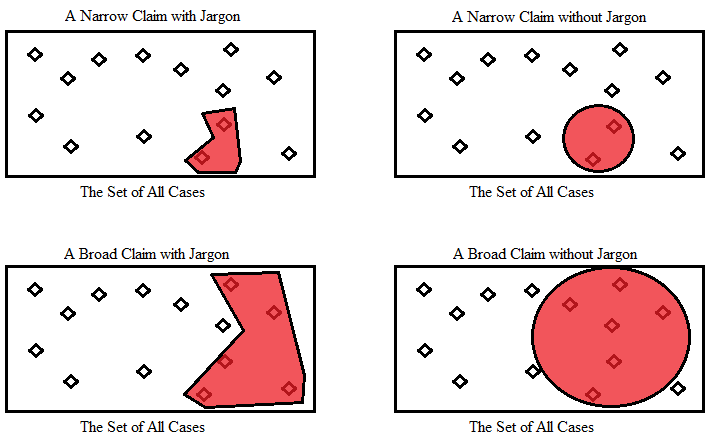
  • The problem is that jargon has highly a specific meaning. So, when a specialist makes a claim with jargon, the claim is also specific. A narrower set of applicability has less room for credible challenges at the margins of a claim and ideas can be clearly communicated precisely – though, the applicable cases may not be interesting. As the breadth of a claim increases, jargon can help to ensure that the breadth is limited to appropriately specific cases.
  • When the listener is not an expert, the scientist is uncertain of the gap in knowledge. They attempt to make relatively broad and interesting claims, but without the aid of their case-narrowing jargon. The result is that the expert says something which is clearly false to another specialist, but may be mostly true – or true enough for the listener.

Again, these four interpretations of misspeaking and miscommunicating experts are ordered by charity. I especially sympathize with the last interpretation. Imagine trying to teach a student that inflation is always costly, but sometimes more beneficial than costly. And that the costs still exist when the benefits outweigh the costs. So, should we have a policy of inflation? The true answer is highly specific.

Does an atheist scientist understand that there is no designer of human bodies – much less one that had diet in mind? Very much. Does the same atheist scientist know how to communicate unintentional biological advantages to the non-specialist? They do not.  What’s more is that they are not alone. Specialization introduces a knowledge gap and the unavailability of common jargon prevents adequately finessed broad claims.