Let’s talk game theory. I’ve written in the past about Pure Strategy Nash Equilibria (PSNE). They identify possible equilibrium strategies, even if players are unlikely to adopt those strategies in real life. Students don’t like the implausibility of many PSNE strategies, and they sometimes struggle to limit their conclusions to the premises that yield PSNE. Students have a similar dissonance to Mixed Strategy Nash Equilibria (MSNE).
What is MSNE? A set of MSNE strategies allow a player to choose some strategies probabilistically – with probabilities that are less than 100%. That’s the feature of MSNE that distinguishes it from PSNE. In PSNE, a strategy is chosen with 0% or 100% probability.
Here’s an example to illustrate. Imagine that you are shopping at the grocery store with your shopping cart. You’re at one end of the aisle and another shopper is at the other end and your heading straight toward one another at a snail’s pace. Ideally, you’d not hit each other or awkwardly arrive in each other’s path. For simplicity, let’s say that each of you can walk on the right or the left side of the aisle only.* Below is a simultaneous normal form game with arbitrary payoffs.
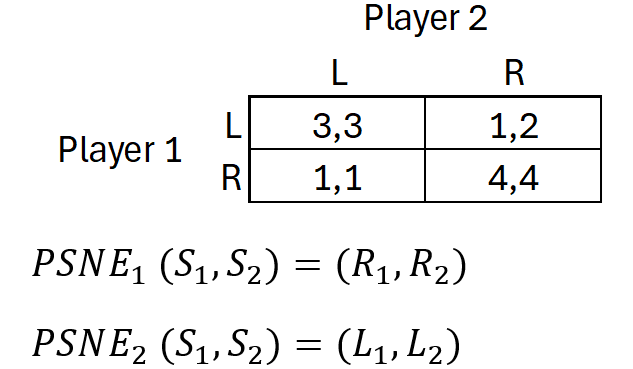
There are two PSNE in the above game: each person walks on their right or their left side of the aisle. If you and the other person are both walking on your respective rights or lefts, then neither of you has an incentive to deviate. The alternative is that you are heading straight for one another and one of you must veer from their path or play an awkwardly low stakes game of chicken.
Continue reading Economist Writing Every Day