What Tariffs Mean For Your Finances

That’s the title of a talk I’ll be giving Saturday at the Financial Capability Conference at Rhode Island College. Registration for the conference, which also features personal finance speakers and top Rhode Island politicians, is free here.

A preview: after many changes, the average tariff on the goods Americans import has settled in the 15-20% range:

If the tariffs stay in place, which is far from certain, this will represent roughly a 2% increase in overall costs for Americans (a ~17% tax on imports which are ~14% of the economy predicts a 2.4% increase, but a bit of that will be paid by foreign producers lowering prices).

This is bad for US consumers, but not as bad as the Covid-era inflation, and likely not as bad as our upcoming problems with debt and plans to weaken the dollar. It is more valuable for most people to make sure they are getting the personal finance basics right than to think about how to avoid tariffs, though they may want to consider investments that hold their value with a weakening dollar.

Do Required Personal Finance Classes Work?

41 states now require students to take a course in economics or personal finance in order to graduate high school:

Source: Council for Economic Education

12 states representing 21% of US high schoolers passed mandates for personal finance classes just since 2022. This sounds like a good idea that will enable students to navigate the modern economy. But does it work in practice?

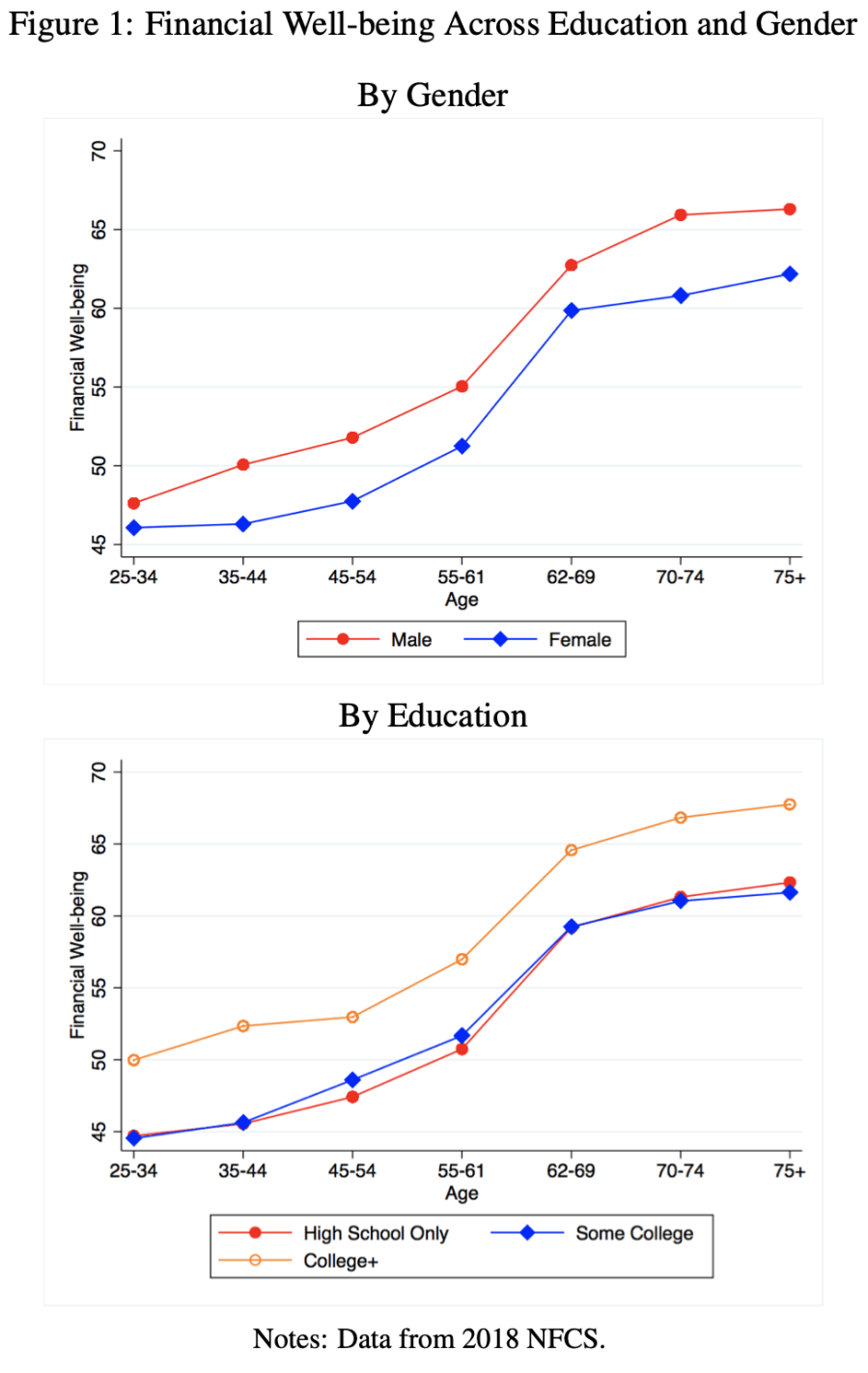
A 2023 working paper “Does State-mandated Financial Education Affect Financial Well-being?” by Jeremy Burke, J. Michael Collins, and Carly Urban argues that it does, at least for men:

We find that the overall effects of high school financial education graduation requirements on subjective financial well-being are positive, between 0.75 and 0.80 points, or roughly 1.5 percent of mean levels. These overall effects are driven almost entirely by males, for whom financial education increases financial well-being by 1.86 points, or 3.8 percent of mean financial well-being.

The paper has nice figures on financial wellbeing beyond the mandate question:

As soon as I heard about the rapid growth in these mandates from Meb Faber and Tim Ranzetta, I knew there was a paper to be written here. I was glad to see at least one has already tackled this, but there are more papers to be written: use post-2018 data to evaluate the new wave of mandates, evaluate the economics mandates in addition to the personal finance ones, and use a more detailed objective measure like the Survey of Consumer Finances.

There’s also more to be done in practice, hiring and training the teachers to offer these new classes:

our estimates are likely attenuated due to poor compliance by schools subject to new financial education curriculum mandates. Urban (2020) finds evidence that less than half of affected schools may have complied. As a result, our estimated overall and differential effects may be less than half the true effects

LIFE Survey Comes Alive

Last year I posted that the Philly Fed had started a new quarterly survey on Labor, Income, Finances, and Expectations (LIFE). I thought it looked promising but had yet to achieve its potential:

It will be interesting to see if this ends up taking a place in the set of Fed surveys that are always driving economic discussions, like the Survey of Consumer Finances and the Survey of Professional Forecasters. If they keep it up and start putting out some graphics to summarize it, I think it will. My quick impression (not yet having spoken to Fed people about it) is that it will be the “quick hit” version of the Survey of Consumer Finances. It asks a smaller set of questions on somewhat similar topics, but is released quickly after each quarter instead of slowly after each year. If they stick with the survey it will get more useful over time, as there is more of a baseline to compare to.

But a year later the survey now has what I hoped for: a solid baseline for comparisons, and pre-made graphics to summarize the results. It continues to show complex and mixed economic performance in the US. People think the economy is getting worse:

They are cutting discretionary (but not necessity) spending at record levels:

They are worried about losing their jobs at record levels:

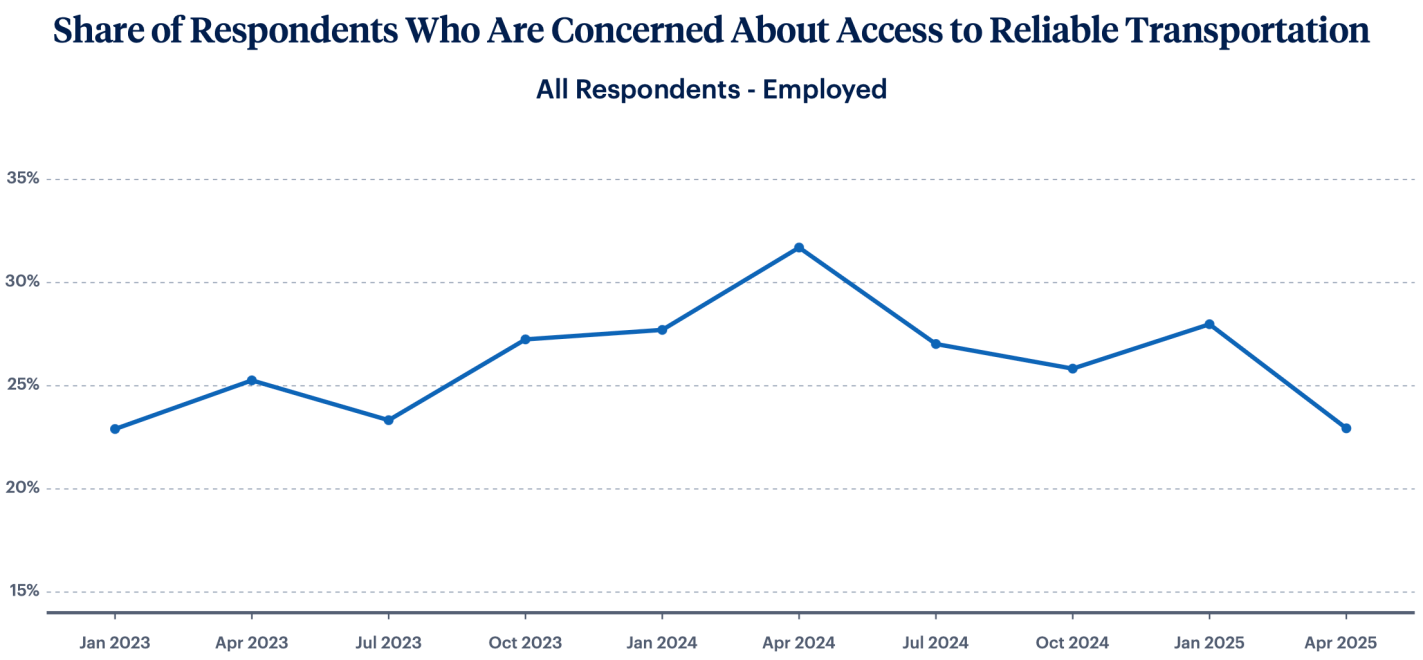
But key areas like housing, childcare, and transportation are stabilizing:

Overall I think we can synthesize these seemingly contradictory pictures by saying that Americans’ finances are fine now, but they are quite worried that things are about to get worse, perhaps due to the tariffs taking effect. You can find the rest of the LIFE survey results (including all the non-record-setting ones) here.

The Calming Psychology of Money

Morgan Housel’s Psychology of Money is not much like other personal finance books. Rather than making recommendations about exactly what to do and how to do it, Housel tells stories about how people’s different attitudes toward money serve them well or poorly. His stance is that most people already know what they should do, so he doesn’t need to explain that, but instead needs to explain why people so often don’t do what they know they should (e.g. save more). The book is not only pleasant to read, but at least for me exerts a calming effect I definitely do not normally associate with the finance genre, as if the subtext of “just be chill, be patient, follow the plan and everything will be alright” is continually seeping into my brain. Some highlights:

The idea of retirement is fairly new. Labor force participation for men over 65 is only about 20% today, but was well over 50% prior to the introduction of Social Security. Even once it started, Social Security paid in real terms about a quarter of what it does today. Plus pensions weren’t as common as people think; as of 1975 only a quarter of those over 65 had pensions, and most of those didn’t pay much. The 401k didn’t exist until 1978; the Roth IRA until 1998. “It should surprise no one that many of us are bad at saving and investing for retirement. We’re not crazy. We’re all just newbies.”

If you are disappointed whenever the price of your stocks goes down, you are in for a bad time, though you will do well if you can just ignore it:

“Netflix stock returned more than 35,000% from 2002 to 2018, but traded below its previous all-time high on 94% of days. Monster Beverage returned 319,000% from 1995 to 2018- among the highest returns in history- but traded below its previous high 95% of the time during that period…. this is the price of market returns.”

Housel isn’t very prescriptive because he recognizes how much people differ: “I can’t tell you what to do with your money, because I don’t know you. I don’t know what you want. I don’t know when you want it. I don’t know why you want it.”

At the end explains what he does with his own money: “Effectively all of our net worth is a house, a checking account, and some Vanguard index funds.” He convincingly argues that his way isn’t for everyone; he paid off his house early but “I don’t try to defend this decision to those pointing out its flaws, or to those who would never do the same. On paper it’s defenseless. But it works for us. We like it. That’s what matters.”

The closest he gets to specific recommendation is “for most investors, dollar-cost averaging into a low-cost index fund will provide the highest odds of long-term success.” There are lots of more general recommendations about good mindsets to take, for instance:

The few people who know the details of our finances ask, ‘What are you saving for? A house? A boat? A new car?’ No, none of those. I’m saving for a world where curveballs are more common than we expect.

Overall this is an easy book to recommend- it is both pleasant and easy to read, and gives good advice. My main complaint is that it is short on the nuts and bolts of how you actually do this stuff; for someone who doesn’t already know, it would pair well with a book that is stronger on that front, like I Will Teach You to Be Rich.

Amazon Credit Card Rewards

I have a credit card that gives me rewards. I get a nice 5% cash-back on purchases from Amazon and a lower cash-back rate on other purchases. Sometimes, there are promotions that provide a rate of 10% or even 15%. But what are these rewards worth?

To simplify, there are two reward options:

Option 1 adds to my Amazon gift-card balance. It’s attractive. When I’m checking out at Amazon, it shows me my reward balance and it also shows me what the total cost of my purchase could be if I applied the gift card. It’s like they’re trying to pressure me to redeem my rewards in this particular way.

Option 2 is simply to transfer my rewards as a payment on my credit card or as a credit to my bank account (for the current purposes, they’re identical). Either way, the rewards translate to the same number of dollars.

Say that I spend $1,000 at Amazon. Whether I choose option 1 or 2 has value implications.

Option 1

The calculation is simple. If I spend $1,000 at amazon this month, then I can spend another $50 in gift card credits at Amazon next month. That’s the end. There are no more relevant cashflows. I used my credit card one month, and then was rewarded the next month. The only detail worth adding is the time value of money, which at 7% per year*, yields a present value of rewards at $49.72. Option 1 is nice in the moment. It’s so enticing to have a lower Amazon check-out balance due.

But you should never select Option 1.

Option 2

Continue reading