What Makes Rhode Island Special?

Other than being the smallest state, of course. In other places I’ve lived, it was more obvious what made them stand out. Boston has the most high-quality universities, including the oldest one (though it is expensive and traffic-ridden). New Orleans has the best food, live music, and festivals (though terrible crime and roads). I’ve lived in Rhode Island since 2020 and I’ve enjoyed how it seems to have no big negatives the way many other places do- it’s been pretty nice all around. But it has been harder to see anything where Rhode Island really stands out.

What should a tourist see or do here that they couldn’t do elsewhere? The Italian food is great, but that’s true of several other cities. You can find Portuguese food here in a way you can’t in most of the US. Probably the Cliff Walk in Newport is our best entry: a 3-mile trail along cliffs where you can see the Atlantic on one side, and Gilded-age mansions on the other.

For those living here, what stands out is the compactness. This makes sense for the smallest state, but it is even more true than you would expect, because even within Rhode Island most people are clustered within the small portion of the state that is within 5 miles of Providence.

Because of this, I almost never feel the need to drive more than 10 miles or 20 minutes; this wasn’t so true any of the other ~dozen places I’ve lived. I can easily walk to the Bay, the Zoo, and my kids’ school; then its a 20 minute drive or less to work, several good hospitals and universities, sailing, several beaches, forest hikes, the state capital, the excellent airport, Amtrak, every good grocery store, leaving the state, et c. Most other places either lack some of those things entirely or involve longer drives to get to them, though probably there’s somewhere else like this I don’t know about.

Or perhaps the best thing about Rhode Island is our people:

What do you think I missed about Rhode Island? Or if you haven’t been here, what do you think is most special about where you live?

Cool the Schools

Short post today because I’m busy watching my kids, who had their school canceled because of excessive heat, like many schools in Rhode Island today.

I thought this was a ridiculous decision until my son told me he heard from his teacher that his elementary school is the only one in town that has air conditioning for every classroom. Given that, the decision to cancel given the circumstances is at least reasonable, but the lack of AC is not.

It’s not just that hot classrooms are unpleasant for students and staff, or that sudden cancellations like this are a major burden for parents. Several economics papers have found that air conditioning significantly improves students’ learning as measured by test scores (though some find not). Park et al. (2020 AEJ: EP) find that:

Student fixed effects models using 10 million students who retook the PSATs show that hotter school days in the years before the test was taken reduce scores, with extreme heat being particularly damaging. Weekend and summer temperatures have little impact, suggesting heat directly disrupts learning time. New nationwide, school-level measures of air conditioning penetration suggest patterns consistent with such infrastructure largely offsetting heat’s effects. Without air conditioning, a 1°F hotter school year reduces that year’s learning by 1 percent.

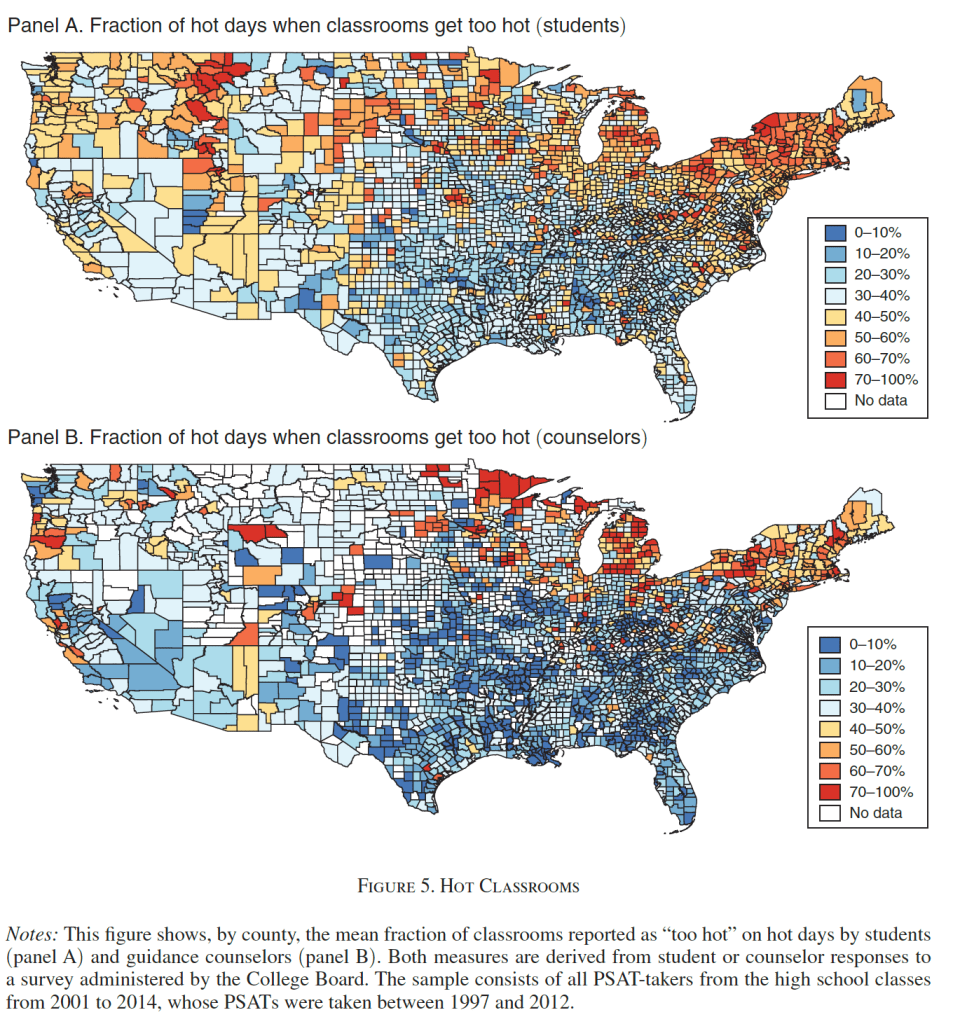
This can actually be a bigger issue in somewhat Northern places like Rhode Island- we’re South enough to get some quite hot days, but North enough that AC is not ubiquitous. Data from the Park paper shows that New York and New England are actually some of the worst places for hot schools:

This is because of the lack of AC in the North:

The days are only getting hotter…. it’s time to cool the schools.

Lessons from a Failed Merger

The two largest hospital systems in Rhode Island, Lifespan and Care New England, wanted to merge. I wrote previously that:

Basic economics tells us that if a company with 50% market share buys a company with 25% market share in the same industry, they have strong market power and are likely to use this monopoly position to raise prices…. I think the Federal Trade Commission will almost certainly challenge the merger, and that they will likely succeed in doing so

It turns out I was right about the FTC challenge, but wrong that it would be necessary. The same day that the FTC challenged the merger, Rhode Island Attorney General Neronha blocked it. The law in Rhode Island is such that he doesn’t need to convince a judge like the FTC would; the merger was done unless the parties tried to appeal. But today they gave up and officially terminated the merger.

I was surprised by the AG’s move because the merging parties have so much political clout in the state, and many politicians like Senator (and former RI AG) Whitehouse had expressed support for the merger. I expected that even if state leaders didn’t like the merger, they would approve it with the expectation that the FTC would step in and be the bad guy for them. So AG Neronha blocking the merger was a pleasant surprise.

I also said previously that the FTC might challenge the merger for creating a monopsony (predominant employer of health care workers) as well as a monopoly (predominant provider of hospital services). This turned out to be one vote short of true. The FTC voted 4-0 to challenge the merger, but released two concurring statements explaining why. The two Democratic commissioners wanted to challenge the merger on both monopoly and monopsony grounds, while the two Republican commissioners thought it would only be a monopoly. This didn’t matter for this case, since they all thought it would be a monopoly, and since the AG blocked it. It was also odd that the Democratic FTC commissioners were more worried about labor than the actual unions involved. But it may be a sign of more monopsony challenges to come, particularly once the vacant spot gets filled and a 3rd Democrat is breaking the ties.

This was the first big political / economic issue I’ve got involved in since moving to Rhode Island, and I have to admit I was worried about making enemies. But despite speaking against the merger at the same forum as its most powerful proponents, speaking to several journalists, and at the AG’s public forum, I didn’t hear a single angry response; if anything I made friends.

One final surprise in all this is that the two hospitals systems are reported to have spent $28 million pursuing the merger. Apparently money can’t buy everything. But what a lot to spend on something that so many of us thought was clearly destined to fail.