Learnings From Trading Short Volatility Funds, 2. Use Leveraged Stock Funds Instead

In last week’s post, I described how short volatility funds work. They are short (as opposed to long) near-term VIX futures. This means that when a market panic hits and VIX (as measure of volatility) spikes, the prices of these short vol funds plunge, along with stock prices. But as optimism returns to the markets, prices of short vol funds start to recover, as do stocks.

Thus, both short vol funds and general stock funds are reasonable ways to play a market panic. If (!!!) you manage to call the bottom and buy there, you can hold for maybe a couple of weeks until prices recover, and then sell at a profit.  I tried to do just that with the market meltdown last month in the wake of the president’s tariff ultimatums: I bought some short vol funds (SVXY, which is a moderate -0.5X VIX fund, and the more aggressive -1X fund SVIX), and also some leveraged stock funds. I discussed leveraged funds here.

I chose to buy into SSO, a 2X leveraged S&P 500 stock fund, whose daily price moves up (or down) by twice the percentage as does the S&P. Obviously, if you think stocks will go up say 10% in the next month, you will make more money by buying a fund that will go up 20% instead, which is why I bought a 2X fund rather than a plain vanilla (1X) stock fund. A related fund, which I did not buy this time, is UPRO, which is a 3X stock fund.

Things are always clear in hindsight. After the smoke of battle clears, you can see right where the bottom was. But it is not clear when you are in the thick of it. I erred by committing much of my dry powder trading funds too early, maybe halfway through the big drop. C’est la vie. It’s hard to improve on that for next time. But a significant learning, that I will act on during the next panic, was how differently short vol versus leveraged stocks recovered from the crash. They both plunged and recovered, but leveraged stocks recovered much better.

It turns out that much of the time, the price movements over say a six-month period of SVXY and SSO largely match each other, so these are useful for comparisons for trading short vol versus leveraged stocks. For instance, below is a chart of SVXY (orange line) and SSO (green line) over the past six months or so. The blue arrow notes the April crash, which bottomed roughly April 8. For November through early April, the price movements of the two funds roughly matched. By April 8, both had plunged to a level some 35% lower than their starting prices. However, by May 12, SSO had recovered to -10% (relative to starting), which is about where it was in late March (green level line drawn in). SVXY, however, remained 21% below its start.

Chart of SVXY ( -0.5X VIX ETF, Orange line) and SSO (2X Stock fund, green line), Nov 2024-May 2024. Blue arrow marks April 2025 volatility spike/stock crash. Chart from Seeking Alpha.

Thus, from its nadir (-35%) to its recovery as of Tuesday, May 12, SSO gained by 38% (i.e., ratioing 0.90/0.65), whereas SVXY gained only 21% (from ratioing 0.79/0.65). Also, it looks like SVXY will not regain its earlier price levels any time soon. So SSO looks like the winner here.

We can do a similar comparison between the -1X VIX fund SVIX and the 3X stock fund UPRO. These two funds are plotted below, along with a plain (1X) S&P 500 stock fund, SPY (in blue). SVIX (orange) and UPRO (green) trend pretty closely for October through March. When the April crash came, SVIX dropped much harder, down to a heart-stopping -59%, compared to -44% for UPRO. SPY dropped only to -15%.  SPY comes to a full recovery (0%) by May 12, while UPRO recovers only to -13% [1].    SVIX has recovered only to -21%. If you managed to buy each of these funds on April 8, and sold them today, you would have made the following gains:

SPY 17% ; UPRO 55%;  SVIX  43%.    Clearly the winner here in short term trading of the April crash is the 3X stock fund UPRO.

Chart of SVIX ( -1X VIX ETF, Orange line), UPRO ( 3X Stock fund, green line), and SPY (1X Stock fund, blue line), Oct 2024-May 2024. Chart from Seeking Alpha.

As a cross check, below is a plot of SVXY (orange) and SSO (green) covering the August, 2024 volatility spike. This was a peculiar event, discussed here, where volatility went crazy for a couple of days, while stock prices experienced only a moderate drop. If (!!!) you timed it just right, and bought at the bottom and sold a week or so later, you could have made good money on SVXY. But zooming out to the larger picture, SVXY never came close to recovering its old highs, whereas SSO just kept going up and up (green arrow). So SSO seems like a safer trading vehicle: it is a reasonable buy-and-hold, whereas SVXY may be hazardous to your portfolio’s health if you don’t get the timing perfect.

Chart of SVXY ( -0.5X VIX ETF, Orange line) and SSO ( 2X Stock fund, green line), Oct 2023-Oct 2024. Blue arrow marks early August 2024 volatility spike. Chart from Seeking Alpha.

Over certain longer (say one-year) periods, there are regimes where short vol could out-perform leveraged stocks (discussed earlier), but that is the exception, rather than the rule.

Disclaimer: Nothing here should be considered advice to buy or sell any security.

ENDNOTE

 [1] While UPRO changes X3 the change of SPY on a daily basis, for reasons discussed earlier, the longer-term performance of UPRO diverges from a simple X3 relationship with SPY. In volatile times, UPRO tends to fall well below a 3X performance over say a six-month period.

Learnings From Trading Short Volatility Funds, 1. The Tantalizing Promise of Quick Riches

The VIX is a calculated measure of stock market volatility, based on the prices of stock options. It spikes up when there is a market upset, then seemingly always settles back down again after a few days or weeks. So, it seems simple to make a quick profit from this behavior: short the VIX when it spikes, and then close your trade when it comes back down. What could possibly go wrong?

VIX Index, May 2024-April 2025. From Seeking Alpha.

It’s a bit more nuanced than that, since you can’t directly buy or sell the VIX. It is just a calculated number, not a “thing.” However, there is a market for VIX futures. The value of these futures is based on expectations for what VIX will be on some specific date. The values of these futures go up and down as the VIX goes up and down, though there is not an exact 1:1 relationship. There are funds that short VIX futures, which are a proxy for shorting the VIX futures yourself.  So, the individual investor could buy them after the VIX spikes (which would drive down the short VIX fund price), then sell them when VIX declines (and the short VIX fund goes back up).

The chart below shows the VIX (% change, orange curve) in the past twelve months prior to May 1.   There were three episodes (Aug 2024, Dec 2024, Apr 2025) where VIX spiked up. These episodes are marked with green arrows. As expected, when VIX spikes up, the short volatility fund SVIX (purple line) drops down. In August and December, if you were clever enough to buy SVIX at its low, you could turn around and sell in a week later for a good profit. The movements of SVIX are dwarfed this plot by the gyrations of VIX in this chart, but a couple of short red horizontal lines are drawn at the bottoming values for SVIX, to show the subsequent rise. A 3x leveraged S&P 500 fund, UPRO, is shown in blue.

There are important nuances with these funds. One is that a long or short VIX futures fund, at the end of the trading day, must buy and sell some futures shares to meet their performance mandate. As of say May 1, the -1X VIX fund SVIX was short 14,311 May VIX futures contracts (expiring 5/20/2025), and short 10,222 June futures (exp. 6/17/2025). To keep its exposure centered at on one month out from the present date, the fund must buy back some near month (here, May) contracts each day, and short some additional next month (June), at the close of every trading day. If the market value of the near month VIX futures contract is lower than the next month contract (being in “contango”), as it generally is during periods of low volatility, this rolling process makes money every day, to the tune of maybe 5% per month. That compounds big time over time, to over a 60% gain in twelve months. That’s the good side. The VIXcentral site shows current and historical VIX futures prices for the next several months out.

A bad side of these short funds is that the day-to-day inverse movements can rachet the fund value down and down, as VIX goes up and down. So even if the VIX ends up in six months at the same value as it is today, it is possible for a short VIX fund to be lower or higher. This can lead to a more or less permanent step down in fund value. Also, in volatile times, the near futures price is higher than the next month out, and so the daily roll works against you.

There is a term that trading pros use for amateurs who jump into volatility funds without really knowing what they are doing: “volatility tourists”. These hapless investors sometimes hear of big profits that have been made recently in vol, and then buy in, often at what turns out to be the wrong time. Then market storms arise, things don’t go the way they expected, and they get shipwrecked.

Such was the case in 2018. SVXY at that time was a fund that moved inversely to volatility futures, on a -1X daily basis. This short vol trade made insane profits in 2H 2016 and in 2017, far outpacing stocks. Someone who bought into SVXY at the start of 2017 would have quintupled their money by the end of the year. (See chart below, orange line).

However, February 5, 2018 is a day that will live in volatility infamy. Because of the roaring success of short VIX in the previous two years, investors had piled into short VIX ETFs. The VIX suddenly doubled that day, and the short vol funds could not do the daily futures trades they needed, and so their value was decimated. This event is known as Volmageddon. The chart below shows the rise (and fall) of the -1X VIX fund SVXY in orange, compared to a stodgy S&P 500 fund SPY (in green).

Folks who bought SVXY looked like geniuses, until Feb 5. Then they lost it all, more or less. The tourists licked their wounds and moved on, and short vol went clean out of fashion for a while. One short VIX fund, XIV, actually an exchange traded note (ETN), went to zero and closed. SVXY itself lost over 90% of its value. After this near-death experience in 2018, SVXY contritely modified its charter from being -1X VIX futures to being -0.5X. That reduces its exposure to vol shocks. That modification served it well in March, 2020 when the world shut down and VIX shot to the moon and stayed there for some time. SVXY lost something like 70% of its value then, but it lived to trade another day, and slowly clawed its way back.

However, short vol has made a comeback in recent years. The -0.5X SVXY was joined in mid-2022 with a new -1X VIX fund, SVIX (for investors who don’t remember what happened to -1X funds in 2018! ). Short vol actually had a very good run in 2022, 2023, and first half of 2024:

The chart above shows SVIX ( -1X, purple) and SVXY (-0.5X, blue), along with the S&P500 (stodgy orange line) over the past three years. The two inverse vol funds totally smoked the S&P through July, 2024. Investors in SVIX were up over 300%, compared to 35% in stocks. Even the more conservative vol fund SVXY was up 165%. Yee-haw!

The volatility tourists poured in, and then came August 5, 2024, with a short, sharp, unexpected spike in volatility. As we noted earlier, it was not so much that stocks cratered, but there was a hiccup in the global financial system, mainly around unwinding of the yen carry trade. The values of the short vol funds got decimated. Then the recent brouhaha over tariffs in April 2025 whacked them again. This drove the value of SVIX below the three-year rise in stocks, although SVXY still outpaces stocks (57% vs 35% rise).

There were dips in SVIX and SVXY in March 2023 (Silicon Valley Bank blowup), October 2023 (Yom Kippur attacks on Israel by Hamas), and April, 2024, corresponding to spikes in VIX. In those cases, it worked great to buy the dip, since within a few months SVIX and SVXY churned to new highs. Many were the articles in the investing world on the wonderful virtues of the daily VIX futures roll. But then August 2024 and April 2025 hit, where there was no complete, rapid recovery from the huge price drops.

What to take away from all this? What comes to my mind are well-worn truisms like:

If it looks too good to be true, it’s probably not true; There is no free lunch on Wall Street; It’s not different this time.

The reason I know this much about these trading products is that I got sucked in a bit by the lure of monster returns. Fortunately, I kept my positions small, and backstopped some trades by using options, so all in all I have probably roughly broken even. That is not great, considering how much attention and nail-biting I have put into short vol trading in the past twelve months.

In an upcoming post, I will report on an alternative way to trade volatility spikes, which has worked out much better.

Disclaimer: Nothing here should be considered advice to buy or sell any security.

Why Is Stock Market Volatility ( VIX ) So Low?

What is the VIX and why should you care? The CBOE Volatility Index (VIX) is a measure of the expected near-term price swings in the S&P 500 stock index (SPX). The VIX value is derived from the prices that market participants are willing to pay for options that expire roughly 30 days in the future. Typically, movements upward in VIX correspond to movements downward in broad market averages, since price volatility is usually associated with some “problem” cropping up. During market turbulence, the VIX can shoot up very high, very fast, with a percentage of change far higher than for stock prices.

The VIX is know as the “fear gauge,” since it provides a standardized measure of market volatility expectations. It is thus a number that conveys significant information about the attitudes of market participants. Also, it provides opportunities for investors to make (or lose) a lot of money quickly. You cannot invest directly in the VIX (it is just a calculated number), but you can buy/sell VIX futures and options on those futures. Also, there are convenient funds that buy (e.g., VXX) or short (e.g., SVIX) the VIX futures. Because the VIX makes much bigger percentage moves than stock themselves, you can make a killing with a modest investment, providing you get the timing right.

For instance, over the past twelve months, the SPY S&P 500 fund has gone up by about 18%, so $10,000 would have gone to $11,800. That’s pretty nice. But in that same period, SVIX went up by 143%, which would take $10,000 to $24,300 (see below).  (Nerdy notes: (a) SVIX shorts the VIX, so it generally goes up when VIX goes down, i.e., when stocks go up. (b) There is another factor with SVIX called the monthly roll, when tends to make it rise something like 2-4% a month on average. This monthly roll factor is layered on top of the rise and fall in SVIX value based on VIX level. So even if VIX is flat, SVIX may go up something like 30% in a year. )

SVIX and SPY share prices for the past year. Source: Seeking Alpha

Of course, the price swings on SVIX cut both ways. It is down hugely from its highs a month ago, as VIX has increased from roughly 14 to 20. You can go even more crazy by purchasing/shorting VIX-related funds like UVXY that are leveraged at more than 1.0X.

Even you were even more clever, you could have made even more, much more, by working VIX options. Also, if you just want to hedge your stock portfolio against sudden drops, it is often more economical to do that by buying (call) options on the VIX, than by buying (put) options on the stocks (e.g., SPX, SPY) themselves.

During long periods of market stability, the VIX tends to slowly drift downward, to an asymptote  somewhere in the 12-13 range. For example, in the five-year plot below, VIX spend much of 2019 around 13, then shot up over 80 within a month when the scope of the COVID pandemic became apparent. It then drifted downwards (with many spikes along the way, especially during the big bear market of 2022), getting down to around 14 for much of June-September of this year.

VIX Level for past five years. Source: Seeking Alpha.

It is notable for VIX to be this low, considering a number of serious current market concerns (the relatively high valuation of the stock market, stubborn inflation, hawkish fed, gridlock in Washington, etc.). And now with serious conflict in the Middle East resulting from the massive attacks on Israeli civilians, the VIX has so far only risen to 20.

A number of market commentators have noted the seemingly anomalously low level of the VIX, and have proffered various explanations. They observe that macroeconomic outlook continues to look probably OK. They also point to some fundamental changes in the stock market operations. One factor is the rise of zero-day options, very short-term stock options that expire within one day. More of the speculative action has gone to those options, with proportionately less in the month-out options that drive the VIX.

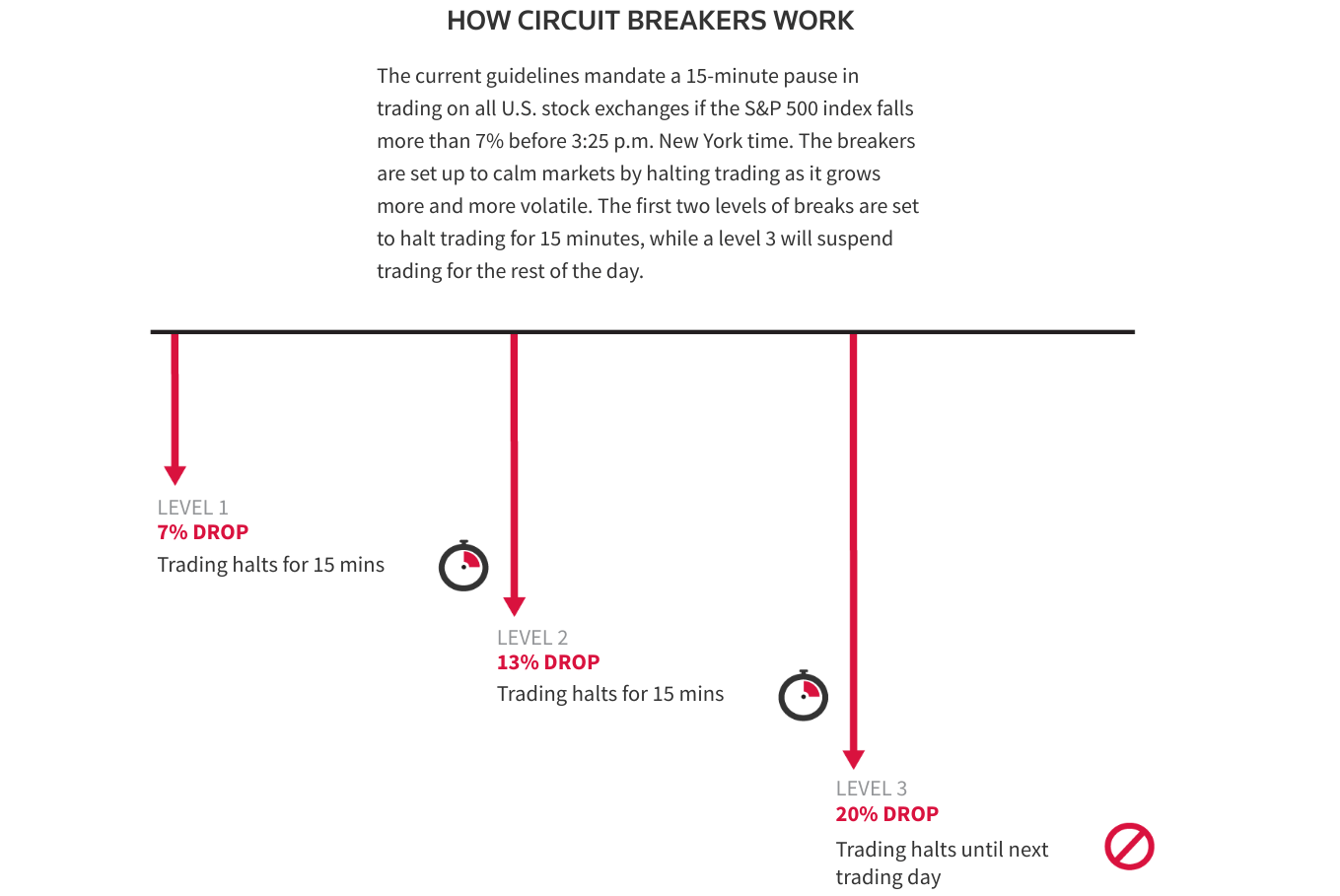
Also, the stock exchanges have implemented various “circuit-breakers,” which halt trading for specified time periods, if swings in stock prices get out of hand. This gives participants a chance to cool off and recalibrate, and not have to make frantic, quick (possibly losing) trades in order to protect themselves. Here is a diagram illustrating these circuit breakers, which are triggered by big moves in the broad S&P 500 stock average:

 Source: Seeking Alpha, article by Christopher Robb

There are also Limit Up/Limit Down (LULD) rules in place that temporarily halt trading in an individual stock if its price swings exceed some designated band.  is designed to stop excess volatility in a single stock.  With these protective circuit-breakers in place, market participants seem less worried about huge price swings coming at them, and hence may feel less of a need to “buy insurance” by purchasing options. This suppression of stock option prices in turn leads to a lower calculated VIX.

As usual, this blog post is not meant to be advice to buy or sell any security. (And seriously, the “never bet more than you can afford to lose” rule applies doubly with the high-volatility products discussed here).