SCORE Replications- Final Call

The Systematizing Confidence in Open Research and Evidence (SCORE) project is an attempt to replicate hundreds of social science papers, and to search for patterns that predict what types of papers are more likely to replicate. You can read all about it at their site, and get a sense of its bigger picture importance in this great post by someone who participated in their prediction markets.

I’ve been involved in the project replicating and reviewing papers, and I plan to do a long post about what it taught me later this year. For now I just wanted to highlight that you can still join the project now, but the chance is ending soon, probably at the end of the month. I think its a great opportunity to advance science, work with the Center for Open Science on a DARPA-funded project, and get paid:

We are recruiting researchers and data analysts across the social-behavioral sciences for replication projects that use existing data that was not part of the original study. For these projects, you will select an original finding to replicate, receive or find alternative data to test the original claim, plan the preregistration of your analysis, receive peer review of your plan, and report your findings in a structured format. You will receive $3,000-$7,800 for each replication study, and you will also be eligible for co-authorship on the report of all replication studies.

Are Special Elections Special?

While the United States does have its problems with democracy, one area where we shine is direct democracy. Rare at the federal level, at the state and local level direct democracy is quite common in the US, much more so than most other democracies (Switzerland also stands out). Almost half the states have some form of citizen initiative or referendum process, and it is used frequently in most of those states. But even more direct democracy takes place at the local level.

And much of that direct democracy at the local level takes place through what are called special elections. I’m not talking about elections to fill unexpected vacancies in office — though of course those do happen. I’m talking about actual voting on issues. Many of these issues revolve around questions of public finance: whether to raise a local sales tax, to approve a property tax millage, or to issue bonds for a capital project.

One very relevant example for me is an upcoming special election in my city of Conway, Arkansas. Citizens are being asked to approve the issuing of bonds to construct a community center, pool, soccer fields, and some other amenities. The bonds would be secured by a tax on restaurants. The tax already exists — city councils can put these in place without a public vote. But to issue bonds, the citizens must be asked. I wrote an op-ed about it in my local paper (if that is gated, try this blog post).

The key is that this is a special election. There are no other issues on the ballot. It takes place on February 8th, not a date that probably stands out in voters minds as an election date. What will this special election mean for voter turnout? A lot of academic research, including a paper that I wrote (currently under review, but summarized here), finds clear evidence that voter turnout will be much lower. Will the result be different? Again, a lot of evidence suggests yes. For example, property tax elections in Louisiana were less likely to pass with higher turnout, and less likely to pass in a general election (my research finds a similar result for sales tax elections in Arkansas).

But why are tax increases less likely to pass in special elections? On this question there are many theories, but they are hard to test. Is it because different kinds of voters show up at special elections, representing a different sample of the population? Possibly, but evidence is hard to find.

A new paper just published in the American Political Science Review sheds some light on these questions.

Continue reading

“Pfumvudza” Planting Technique Revolutionizes Crop Yields in Zimbabwe

Birth of a New Farming Method

Brian Oldreive is a Zimbabwean, born there in 1943. A star cricket player as a young man, he moved on to become a successful tobacco farmer. In 1978, he became convinced (given the harm that tobacco causes) that he should no longer grow tobacco. When he tried to switch to food crops like corn (called maize in Africa), using standard agricultural practices, he could not make a go of it. He ended up losing his farm and his livelihood due to his moral stand against growing tobacco. He went to work for another large farm, but even there it was a struggle to grow food at a profit. Soil was eroding and crop yields were falling.

He began to think that maybe there was a better way to farm than the usual Western model. One day in 1984 when he was walking in the forest, he noticed that the trees and bushes there grew just fine, with no help from humans, no plowing or irrigation. How was that possible? He observed two things. First, the ground was covered with a thick layer of leaves and other debris, which formed a natural mulch. Beneath this mulch layer (“God’s blanket”), the soil was moist. This was while the region was experiencing drought, and regular farmers’ fields were parched. Secondly, the undisturbed mulch layer naturally decayed to return nutrients to the soil.

Oldreive parlayed those observations into a system of no-till agriculture which mimics the created order. He called this “Farming God’s Way”. The emphasis is on high productivity from a small plot. This involves precision planting at the proper time, crop rotation (corn/beans), and deep mulching to retain moisture and keep weeds down. Nutrients are supplied by both compost and chemical fertilizers.

This method can be practiced by farmers owning no tool other than a hoe. This breaks the cycle of farmers or nations going into debt to purchase expensive Western agricultural machinery, which then may become useless due to inadequate maintenance out in the bush.    

This approach contrasts with conventional farming practice which plows up the soil, leaving it to erode away when it rains and to dry out when it doesn’t rain. Plowing also disturbs the natural ordering of the microbial communities within the upper and lower soil layers. (There is aerobic metabolism near the surface, and a whole different anaerobic community in the soil lower down).

Oldreive started by planting one small plot using this approach in the estate he was then managing:

I decided to copy what God does in natural creation and I observed that the leaves fall down on the ground and the grass dies down and there is a protective blanket over the earth, and that is how God preserves soil to infiltrate the water that we receive…

Many people did not believe me and said I was wasting time. But I was not deterred because I was convinced that this method would work. I decided to put the model into practice by starting with just two hectares. I prayed for wisdom and God showed me how to plant maize into wheat straw residue. This is just the same as what God does in nature.

That two-hectare (about 5 acre) plot confounded the skeptics, yielding about ten times more corn per hectare than the local average yields. He then planted more acreage using this approach. Over the next few years, while a number of conventionally-run farms around him went broke, he kept expanding and growing more food with his system.

Oldreive believed these insights were gifts from God which were meant to be shared with others. Therefore, he shifted his effort towards teaching other Africans how to farm with this method.

Things Fall Apart in Zimbabwe

Continue reading

New ideas are the easy part

I was listening to an episode of Planet Money and, as one does, thought of a completely brand new and in no way derivative idea that would make many billions of dollars for myself and my future investors. It was a very exciting drive home. Of course, the prospects and originality of idea did not survive first contact with Google.

The episode in question, “Of Boxes and Boats” was characteristically delightful and informative. TL;DR: the supply chain is a disaster, ports are backed up, and the US is experiencing an especially acute shortage of warehouse space. A moment that especially caught my attention was warehouse manager expressing that there was, in fact, empty space in his warehouse, but that the firm currently leasing that space wasn’t using it, and the warehouse had no means of offering that space to another client.

That’s interesting. That’s a resource that, in the moment, is suboptimally allocated, even if only for the hour, day, or week. That’s an arbitrage opportunity. In fact, this is exactly what AirBnB did: found real estate that was more valuable to potential short-term renters than current lease holders that could be temporarily exchanged between parties, and as a facilitator for that exchange AirBnB could take a cut. Someone needs to make Warehouse AirBnB! I’m a genius.

No, I’m not.

Meet “The Airbnb of Warehouse Space”

Sigh. I wasn’t even first to the incredibly obvious one-line sales pitch. But my fanciful dreams of buying an English (or at least Belgian) soccer team asside, I honestly can’t decide if I should feel better or worse knowing this idea is already out there. On the one hand, it’s good to be reminded how dynamic and responsive entrpreneurs are in identifying problems and offering solutions.

On the other hand, the supply chain is still very much a mess, warehouses are still out of useable space, and I see no evidence that there is in fact a rich secondary market in warehouse space allocations. Clearly something is getting in the way of the market responding. Is the market over-regulated? The Department of Homeland Security apparently makes entry into the shipping and warehouse business pretty costly. Maybe it’s under-regulated? Perhaps firms are squatting on warehouse space rather than sell it to potential long-term competitors. Maybe the intermediaries, real and hypothesized, are so inefficient that their additional costs as a middlemen are prohibitive. Maybe it’s <Insert Politician You Don’t Like Here>‘s fault. That idiot screwed up everything they touched.

The fact remains though that the idea itself was not the limiting factor, and I suspect it rarely is. I thought of it in ten seconds after listening to a podcast. For the people working in such a field, they probably come up with similar ideas daily. No, the limiting factor isn’t inspiration, or likely even perspiration. It’s being able to identify a path from idea to execution. A path that includes sufficient time, energy, capital, and personnel to make it happen. It’s about resources and risk. All of which is obvious. I’m pretty sure the “It’s About Resources and Risk” banner and bunting gets used more than “Happy Birthday” at your modal MBA program.

But it’s good to be reminded of the obvious every now and then. There are great ideas everywhere. When we’re thinking about any prospective policy regarding an issue we care about, it never hurts to think about whether it will be an aid or hindrance to others when they’re trying to solve the problems upstream and downstream from yours. Sometimes the best idea is to just stay out of the way.

On Lockdowns and Hospital Capacity

My home province of Quebec in Canada has been under lockdown since the Holidays (again). At 393 days of lockdown since March 11th 2020, Quebec has been in lockdown longer than Italy, Australia and California (areas that come as examples of strong lockdown measures). Public health scientists admit that the Omicron variant is less dangerous. But the issue is not the health danger, but rather the concern that rising hospitalizations will cause an overwhelming of an exhausted health sector.

And to be sure, when one looks at the data on hospital bed capacity and use-rates, you find that the intensity of lockdowns is well-related to hospital capacity. Indeed, Quebec is a strong illustration of this as its public health care system has one of the lowest levels of hospital capacity in the group of countries with similar income-levels. The question then that pops to my mind is “how elastic is the supply of hospital/medical services?”.

In places like my native Quebec, where health care services are largely operated and financed by the government, the answer is “not much”. This is not surprising given that the capacity is determined bureaucratically by the provincial government according to its constraints. And with bureaucratic control comes well-known rigidities and difficulties in responding to changes in demand. But that does not go very far in answering the question. Indeed, the private sector supply could also be quite inelastic.

A few months ago, I came across this working paper by Ghosh, Choudhury and Plemmons on the topic of certificate-of-needs (CON) laws. CON-laws essentially restrict entry into the market for hospital beds by allowing incumbent firms to have a say in determining who has a right to enter a given geographical segment of the market. The object of interest of Ghosh et al. was to determine the effect of CON-laws on early COVID outbreak outcomes. They found that states without such laws performed better than states with such laws (on both non-COVID and COVID mortalities). That is interesting because it tells us the effect of a small variation in the legal ability of private firms to respond to changes in market conditions. Eliminating legal inability to respond to changes leaves us with normal difficulties firms face (e.g. scarce skilled workers such as nurses, time-to-build delays etc.).

But what is more telling in the paper is that Ghosh et al. studied the effect of states with CON-laws that eased those laws because of COVID. This is particularly interesting because it unveils how fast previously regulated firms can start acting like deregulated firms. They find similar results (i.e. fewer deaths from COVID and non-COVID sources).

Are there other works? I found a few extra ones such as this one in the Journal of Risk and Financial Management that find that hospitals were less overcrowded in states without CON-laws. Another one, in the Journal of General Internal Medicine finds that states with CON-laws tended to have more overcrowded installations — notably nursing homes — which meant higher rates of COVID transmission in-hospital.

All of these, taken together, suggest to me that hospital capacity is not as fixed as we think of. Hospitals are capable of adjusting on a great number of margins to increase capacity in the face of adverse exogenous shocks. That is if there are profit-motives tied behind it — which is not the case in my home country of Quebec.

Modern loneliness in Toy Story 4 and Taylor Swift

I just saw Toy Story 4 (2019) because I’m a parent (don’t keep up with new releases – watch Pixar movies). The depiction of utter loneliness of the Gabby Gabby doll is one of the memorable parts of the movie. She knows that other people are experiencing human interaction, but she has none. Not a single human person notices her or needs her. Can you imagine that being the main plot of a movie made in 1940?

Loneliness is not completely new for humans. In the past, a lonely person might have had extra time to focus on nature, God, or books, or just immediate survival. Today, lonely people can be inundated with images of faces while also knowing that they have no real local friends. The Toy Story toys are like modern rich people in the sense that material survival is far from their minds. The toys can sit on a shelf for decades, awake and alone. No physical needs drive them out to a grocery store or into a service sector job. They have time to obsess over their social status, and the result can be tragic. (The fate of sitting on a museum shelf for years was discussed at length in Toy Story 2.)

Gabby Gabby reminded me of a bleak 2014 song by Taylor Swift called “Wildest Dream”. Swift sings as a female protagonist who sleeps with a handsome stranger knowing that he will leave her right afterwards. Here’s what she is hoping for:

I can see the end as it begins

My one condition is

Say you’ll remember me

Taylor Swift, 2014

She’s concerned that the man won’t remember the encounter at all. That is some malaise, yes? She has no hope at all for a lasting relationship. That is an illustration of one way that loneliness looks in the modern world.

From a male perspective, also in 2014, a similar sentiment is expressed in “Stay with Me” by Sam Smith.

I don’t want you to leave, will you hold my hand?

Again, the singer is asking for someone from a one-night stand to help fill a void of human connection instead of immediately leaving. Swift and Smith wonder aloud if there is some way to at least temporarily feel like they are close to another person.

These forms of loneliness in pop culture resonate with the public. Toy Story 4 yielded over $1B at the box office globally. “Wildest Dreams” was on music charts around the world. These forms are somewhat new, due to new technology and changing social customs. I’m not trying to write the next Bowling Alone (2000) in this blog post, but merely noting some current illustrations, inspired by Toy Story.

I bet a proper classicist could find us some illustrations of old-style loneliness. When I think of ancient loneliness, I think of to-be-King David hiding in desert caves trying to avoid being stabbed by a Bronze Age(?) sword. He chronicled some of those feelings as follows

Turn to me and be gracious to me, for I am lonely and afflicted. Relieve the troubles of my heart and free me from my anguish. … See how numerous are my enemies and how fiercely they hate me!

Psalm 25

David is lonely, but he’s also hiding from numerous nearby fierce enemies. So, it’s not exactly like Gabby Gabby who is sad that no one notices her at all. (In fact, maybe it puts our problems into some perspective.)

There is a recent 2020 New Yorker article, inspired by Covid lockdowns, on the history of loneliness. They consider the idea that this really is new. Maybe there would not have been a Gabby Gabby doll in ancient poems. As usual, economics is part of the story.

In “A Biography of Loneliness: The History of an Emotion” (Oxford), the British historian Fay Bound Alberti defines loneliness as “a conscious, cognitive feeling of estrangement or social separation from meaningful others,” and she objects to the idea that it’s universal, transhistorical, and the source of all that ails us. She argues that the condition really didn’t exist before the nineteenth century, at least not in a chronic form. It’s not that people—widows and widowers, in particular, and the very poor, the sick, and the outcast—weren’t lonely; it’s that, since it wasn’t possible to survive without living among other people, and without being bonded to other people, by ties of affection and loyalty and obligation, loneliness was a passing experience. …  to be chronically or desperately lonely was to be dying. The word “loneliness” very seldom appears in English before about 1800. 

The New Yorker, 2020

Lastly, Mike wrote a great piece on loneliness in art last year. He even introduced a formal economic model!
Fences, Schools, Dryer Lint, & Shower Levers

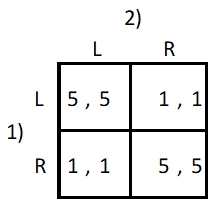
In game theory, coordination games reflects the benefits of everyone settling on the same rules. Settling on the same rules can avoid a conflict and destructive competition. For example, some rules may be arbitrary, such as on which side of the road we’ll all drive. It doesn’t much matter whether a country’s vehicles drive along the right or left side of the street. As long as everyone is in the same lane, we overwhelmingly benefit from our coordination. The matrix below describes the game.

The above game reflects that whether we agree to drive on the left or on the right is trivial and that the important detail is that we agree on what the rule is. Rules like this are arbitrary. No amount of cost benefit analysis changes the answer. Other coordination rules are seemingly arbitrary, but do have different welfare implications. For example, according to English common law, a farmer was entitled to prohibit a herdsman’s flock from trampling his crops even if the farmland had no fence. Herdsmen were responsible for corralling their flocks or paying damages if they grazed on the farm. With lots of nearby farms, total welfare was higher with a rule of cultivation rights rather than grazing rights.

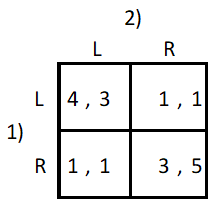
But the property rights could have been assigned to the herdsman instead. The law could have said that the sheep were free to graze with impunity and that the onus was on the farmer to build fences in order to keep the sheep at bay. In a world where there are a lot of farmers who are very nearby to one another, a small flock of sheep can do a lot of damage. And so, the cost-benefit analysis prescribes that herdsmen bear the cost of restricting the flock rather than the farmer. The matrix that describes this circumstance is below.

The above matrix reflects that agreeing on any rule is better than no rule at all. And, the rule that is selected has societal welfare implications. Choosing the ‘wrong’ rule means that we could get stuck in a rut of lower payoffs because coordinating a change in the rules is hard.

Schools

Another way in which the specific rule can be important is by whether it instantiates or works contrary to pre-existing incentives. Before compulsory schooling laws were passed, US states already had very high school attendance rates. Most parents sent their kids to school because it was a good investment. The ages at which children should be required to attend is largely, though not entirely, arbitrary. And wouldn’t you know it, most states applied their compulsory schooling legislation to the age groups for which the vast majority of children were already attending school. Enforcing a law against the natural incentives of human capital investment would have been more costly. The particular ages of compulsory schooling had different welfare implications due to the differing costs of enforcement.

Dryer Lint

Continue reading

South Carolina Certificate of Need Repeal

The South Carolina Senate just voted 35-6 to repeal its Certificate of Need laws, which required hospitals and many other health care providers to get the permission of a state board before opening or expanding. The bill still needs to make it through the house, and these sorts of legislative fights often turn into a years-long slog, but the vote count in the senate makes me wonder if it might simply pass this year. That would make South Carolina the first state in the Southeast to fully repeal their CON laws, although Florida dramatically shrunk their CON requirements in 2019.

Source: Mercatus Center at George Mason University

This seems like good news; here at EWED we’re previously written about some of the costs of CON. I’ve written several academic papers measuring the effects of CON, finding for instance that it leads to higher health care spending. I aimed to summarize the academic literature on CON in an accessible way in this article focused on CON in North Carolina.

CON makes for strange bedfellows. Generally the main supporter of CON is the state hospital association, while the laws are opposed by economists, libertarians, Federal antitrust regulators, doctors trying to grow their practices, and most normal people who actually know they exist. CON has persisted in most states because the hospitals are especially powerful in state politics and because CON is a bigger issue for them than for most groups that oppose it. But whenever the issue becomes salient, the widespread desire for change has a real chance to overcome one special interest group fighting for the status quo. Covid may have provided that spark, as people saw full hospitals and wondered why state governments were making it harder to add hospital beds.

Is the Labor Market Back?

Last month I asked if travel was back. Air travel has recovered a lot from the depths of the pandemic, but it was still only about 80-85% of pre-pandemic levels.

Labor markets also plummeted during the worst of the pandemic, and have slowly (and sometimes quickly) clawing their way back. But are we back to pre-pandemic levels?

The national unemployment rate is now under 4%, a level which is rarely reached even in the best of times. But there is considerable variation across states.

The latest BLS release of state unemployment data shows that some states are at their historic lows, with one state standing out: Nebraska currently has the lowest unemployment rate a state has ever recorded at 1.7% in December 2021 (the data go back to 1976). Utah is also just below 2% in December — at 1.9% it’s the 2nd lowest in history (after Nebraska, of course).

Of course, all is not well everywhere. California and Nevada have the highest unemployment rates, at around 6.5%. This is well above their pre-pandemic levels of about 4%, and also well above what you would expect during normal times, other than during and immediately following at recession.

So is the labor market back in Nebraska, Utah, and other similar states? Not so fast.

Continue reading

European Energy Crisis, Updated: Germans Shut Down Perfectly Good Nuclear Plants, Utilities Send Socks to Shivering Customers and Advise Eating Porridge

As we noted in September, natural gas prices are sky-high in Europe. Coal-burning power plants have been shut down and the windmills have not spun as fast as expected, which led to a drawdown of European natural gas stocks for electric power generation. The Russians are not sending as much gas as hoped through their pipelines, so Europe is scratching around for (very, very expensive) liquified natural gas to be shipped by ship from the U.S. and the Middle East.

As noted, this hurts European economies in various ways. Fertilizer plants and aluminum smelters have shut down because of too-costly natural gas feedstock, consumers are paying much more in utility bills, and some governments are going deeper into deficit by paying subsidies to partially cushion consumers. This energy shortage also makes Europe very vulnerable to Russia, at a time when Putin is menacing Ukraine with invasion.

France derives about 70% of its electricity from nuclear energy. Due to its low cost of generation, France is the world’s largest net exporter of electricity, earning over €3 billion per year from this. China and other countries are ramping up nuclear. (The U.S. is sadly dysfunctional when it comes to building nukes; we can’t seem to do anything without years of delay and billions in cost overruns).

Like nearly everything in Germany, the German nuclear power plants are well-run. They have never had a serious incident. Nuclear power plants pump out gobs of electric power with essentially no CO2 emission.  If you think that green advocates in Germany would therefore desire to keep these plants running, you would think wrong. Such is the loathing for nuclear power that Germany is shutting them down. Every single one. Katja Hoyer writes:

Just before midnight on Dec. 31, Germany switched off three more of its nuclear power plants [including one in Grohnde]. Once it had 17; now only three are left, and they too will be shut down at the end of the year. Soon Germany will produce no nuclear energy at all. But the activists were wrong to celebrate. Germany’s hasty nuclear retreat is neither safe nor green. It’s a disastrous mistake that will have ramifications well beyond the country’s own borders.

The Grohnde plant is a perfect example of what Germany is giving up. It was one of the most productive nuclear power plants in the world. It provided enough electricity to cover 15 percent of Lower Saxony’s annual energy needs single-handedly, saving 10 million tons of carbon dioxide emissions a year in the process. The site even made headlines in February 2021 for producing more electricity than any other nuclear power plant in the world. Now it will have to be dismantled at a cost of around 1 billion euros.

The loss of these nukes puts further strain on the European-wide grid. The irony of shutting these plants down and therefore buying more power from other countries generated by nuclear power and by burning more gas and coal seems to be lost on the Germans. Their plan to mitigate the effects of calm winds is to build even more windmills, even if that requires deforesting vast tracts of woodland.

Let Them Eat Porridge

The U.K. utility Ovo, which prides itself on providing all-renewable power, sent customers a link with advice for keeping warm whilst turning down their thermostats this winter. These suggestions included cuddling your pets, eating hot porridge, cleaning the house, having a hula hoop contest, doing star jumps (jumping jacks), and leaving the oven open after you are done baking. I leave to your imagination how this advice was received by the British public. In lieu of affordable electricity, the utility company E.ON which shut down one those German nuclear power plants sent out 30,000 pairs of socks to encourage people to get by with less power and heat.

You couldn’t make this stuff up.