Secondhand: Travels in the New Global Garage Sale is a great book in my summer stack on fast fashion. I have always been interested in the combination problem-blessing of too much stuff. Adam Minter explains perfectly what many of us have been curious about.
Secondhand is America-centric, but he also travels to Japan to observe a country that is ahead of us both in terms of the demographic crisis and the mechanisms for handling old stuff. The reports from Africa are very interesting.
I have been wondering what is happening with Goodwill and with recycling in general. What hope do we really have of keeping goods out of the landfill? What should I do with a shirt my kid has grown out of? (The lady at work I used to give clothes to now runs away at the sight of me. I gave her too many bags.)
The Goodwill collection center near me looks cluttered and weird. After reading Secondhand, I’m more optimistic about dropping off bags there.
The barrier to sorting the used goods of the rich world is the scarcity of time and attention. This paragraph about a used book seller in Japan is heart-breaking:
It’s a thirty-year-old hardback novel, and the edition is rare. If it were at a traditional bookstore, it’s command a premium price. But Bookoff is about volume, and there’s a problem: not only does it lack a barcode, but it lacks an ISBN… “So there’s no way to price it in Bookoff’s system,” Kominato says. With a grimace, he gently places it on top of the books filling the recycling cage and steps away. (pg 40)
At least the book will get recycled into new paper, and the reality is that it was providing negative value as clutter in someone’s home.
Back in America, Minter describes what happens to donated goods at Goodwill in detail. Sometimes high-quality clothes are identified, but it is hard to get a good price for them. Some customers expect to pay less than $5 for a shirt, no matter what.
Customers are all about price, not quality…They won’t buy a $6.99 shirt that will last. If that’s the option, they’ll buy a $2.99 shirt from Walmart. (pg 57)
Some consumers are in the habit of treating clothes almost like disposable goods instead of durable assets. They won’t pay for quality. Going out and getting a new replacement shirt costs less than lunch.
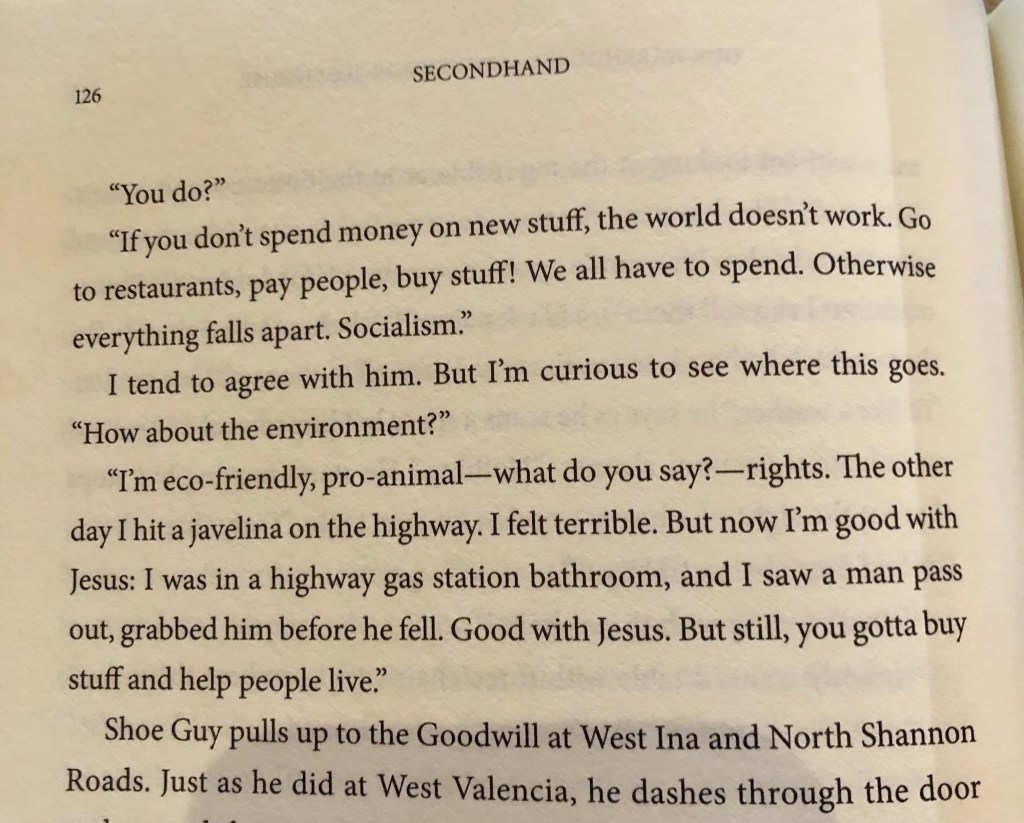
I don’t want to give away too much, since you will want to go get the book yourself. Here’s the funniest page:
Lastly, I’ll share a personal win. I know that I’ll need a school backpack for my youngest in August. I went to a local rummage sale and went to the backpack section. I found one that is good enough (some scuffs but plenty of sparkles). I’m happy about keeping this sparkly pink backpack out of the landfill for a few more years. I walked out of the sale with a load of gear that cost a total of $10. Next, I went to a coffee shop to work where I also spent $10. Used textiles and books are dirt cheap.


Great observations, thanks. I, too, have wondered about Goodwill, etc. The other day in buying a book from Amazon, instead of paying $12.99 for a new book with free (with Prime membership!) shipping, I opted for $3.99 book plus $3.99 shipping, from some Goodwill in Michigan. So they were able to monetize a donated book, by tapping into the internet
LikeLike