Many of us desire at times to overcome insomnia, anxiety, brain fog, depression, or some other mental/emotional hindrance. Some common interventions include healthy lifestyle changes like better diet, drink more fluids, and exercise (all of which we should just do anyway), and more expensive therapies such as counseling or doctor-prescribed pharmaceuticals. These all have their places, but (in keeping with an economics blog) I’d like to call attention to another treatment modality which seems quite cost-effective and harmless*.
It has been known for decades that the electrochemical activity in our brains occurs in measurable waves. “Alpha waves” are pretty well known as a state associated with calm attention, and can be attained by meditation. These waves operate at a frequency of about 10 cycles per second, or 10 Hertz (Hz). Deeper meditation and sleep are associated with slower frequencies, while intense attention and problem-solving thought operate at faster speeds.
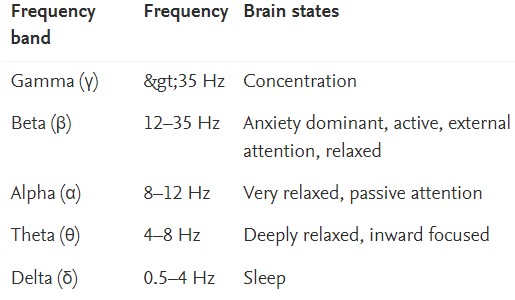
Source: Abhang, et al.
Ideally, your brain would automatically generate the right waves for the situation you are in, and for the most part it does. However, for some folks, their brains don’t make the most effective waves much of the time, and even for more normal folks, it can be helpful to tweak it now and then.
Ways To Shape Your Brainwaves
There are three main avenues for you to manipulate your brainwaves. These are indirect methods, neurofeedback/biofeedback, and direct stimulation. Some indirect ways are to practice various types of mindfulness or meditation, which usually move you towards alpha waves, or intense exercise can lead to alpha in the subsequent rest session.
A direct route, which involves training yourself, is to don some sort of device on your head that measures brainwaves or a correlate such as cerebral blood-flow or heartbeat, and feeds back to let you know what your brain state is. It turns out that humans (without being to explain how) are able to learn to shift their brain states if they are given feedback on whether they are getting closer or further from some desired target. Consumer devices are available in the $400-$1400 price range that can do this with varying degrees of sophistication and requiring various degrees of training and effort. More extensive and targeted training of specific frequencies in particular spots in the brain is done in the offices of neurofeedback clinicians, often as an adjunct to talk therapy. The neurofeedback can calm the animal-level fear/panic/emotional noise, such that the client can relate therapeutically with the counselor. This can be very helpful to address specific pathologies including depression (and here), anxiety, PTSD , reactive attachment disorder, and maybe even autism, but naturally it is expensive to go through a course of say ten sessions with a highly trained professional. Unfortunately, you cannot count on routine coverage by insurance.
Direct Audio-Visual Stimulation
A less-expensive way to achieve a desired brainwave state is to present yourself with (say) 10 Hz stimulation of light and sound. The theory is that your brain waves become
“entrained” along with these external stimuli. Hence the name audio-visual stimulation or audio-visual entrainment (AVE).
There are many YouTube videos claiming to have embedded alpha or other frequencies. These videos often have many comments from appreciative users claiming calming or other effects, so they are certainly worth a try. The price is right. However, research studies cast doubt on whether sound alone is very effective at creating specific brainwaves. Light stimulation has been shown to evoke e.g., alpha waves.
What has been shown to work well are systems where you don headphones for the sound and lightweight “goggles” (thin opaque glasses with LEDs on the inside). Studies have shown this to help with ADD, anxiety, depression, and migraines. Perhaps the most widely produced AVE devices are the “DAVID” models from MindAlive. MindAlive is headed by David Siever, who has spearheaded numerous studies of AVE.
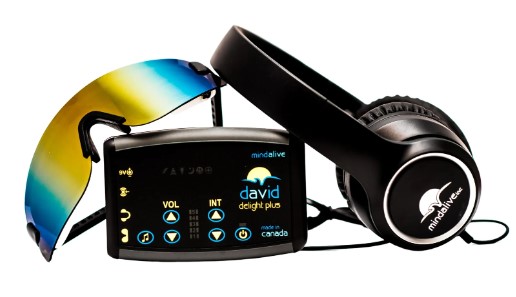
The AVE devices can quickly move you into desired brain states, in the comfort of your home, for just a modest (~ $400) up front cost. You can use them with your eyes open or closed. They are perhaps more usable for children and seniors than the neurofeedback modalities, where the client has to engage with some feedback and learn to make their brainwaves go where they should. [1] With AVE, you just sit back and relax and let the sound and light carry you along. However, AVE is something of a blunt instrument, stimulating the auditory and visual and linked centers in the brain, whereas regular neurofeedback can train say two specific spots in the brain to two different specific frequencies, and has more enduring effects.
My Experience with AVE
I have owned a DAVID for many years. I and my family members have used it off and on, when we happened to feel a need for it. We all find that straight down the middle 10 Hz alpha sessions make us feel just plain good, positive, calm, etc. This can help cure anxiety (mind too fast, hard to focus) or sluggishness (mind too slow). It only takes about ten minutes exposure to the 10 Hz to get us in “the zone.” [2] On most mornings, when I wake up feeling OK anyway, I don’t bother with it. But it is good to have it around as needed. We find the feeling from an AVE session sticks with us for a number of hours.
AVE has been shown to help with seasonal asset disorder (SAD). That makes sense because SAD is about light deprivation. I had a bit of SAD when we lived in a house with few windows, and tried my DAVID for that. It did help, but it turned out to be more satisfactory and less bother to just use a big bright sunlamp at the breakfast table.
We find the slower AVE sessions useful to combat occasional insomnia (where mind is anxious or racing) and even to help with pain. A month ago I had some serious pain from an injury, that was so bad I could not sleep. These slow programs (3.5-7 Hz) did help to divert and relax my brain and help me get to sleep. Again, the effects can be enduring. If we have used a really slow, say 3.5 Hz, program to knock us out at night, we often are sluggish the next morning, so we reset our brains with some 10 Hz alpha. For sleep, I usually prefer a 7-7.8 Hz protocol that does nicely slow and relax my brain, but does not leave me groggy in the morning.
The literature and the operator’s manual recommend slightly faster waves, e.g. 14 Hz “beta” waves as a normal morning waker-upper, like a cup of coffee. These faster “Brain Brightening” protocols have shown benefits for seniors. My family does not necessarily find 14 Hz enjoyable. It sometimes feels feels tiring.
One the other hand, the 14 Hz protocol can sometimes be quite helpful as a pick-me-up. Early one winter, I was feeling sluggish and low, not wanting to get out and exercise, and was nearly ten pounds over my normal weight. It probably had something to do with an extended road trip (stress, food) plus Thanksgiving (food) and the reduced sunlight hours, including daylight savings time ending, plus a stretch of cloudy/rainy weather. I did use a sun lamp to get more photons into my head, but that didn’t cut it. I decided to push myself and use the 14 Hz flashing lights, instead of the comfy 10 Hz, to get more of an activation. It actually worked out well. Three mornings in a row with the 14 Hz, and I felt “reset” to a more energetic, optimistic me. So score one for beta waves.
A couple of us have experimented even faster programs, around 18-20 Hz. That gave an unpleasant buzz, which persisted. I think if I had to drive a truck all night, it might be useful for keeping me awake and alert. After these high frequency sessions I soon used the 10 Hz program to reset to my nice smooth alpha. It is nice to know that if I go too high or low on an entrainment session, I can always recover by using the 10 Hz alpha session [3].
At any rate, I am a satisfied customer and I think this is a cost-effective treatment modality for amateurs to use, or for therapists to prescribe.
* If someone is susceptible to seizures, they should avoid any device like this with repetitive flashing lights.
ENDNOTES
[ 1 ] There is a newer, less-studied technique called LENS that kind of bridges between classical neurofeedback and AVE and trans-cranial magnetic stimulation (TMS). “Transcranial” means the stimulation is from coils outside your skull. Straight TMS is approved by the FDA for treatment of major depressive disorder (MDD), obsessive-compulsive disorder (OCD), migraines, and smoking cessation. With LENS, the brain waves are monitored with electrodes, and this information is used to shape special synchronized electromagnetic stimulation of the brain (from outside the scalp). This stimulation is keyed to the existing brainwaves, which may make it particularly effective, e.g. for reducing anxiety and helping with PTSD and traumatic brain injury (e.g., from military explosion exposure). This LENS technique is also called direct neurofeedback, in contrast to the standard neurofeedback, where the client must actively muster the altered brainwaves via training.
[ 2 ] Many of the canned protocols in the DAVID devices begin with about ten minutes of transitional sound and light pulses. These “dissociation” segments are intended to help users transition from their starting brain states and move to the final target frequencies. But we find these segments to be an unnecessary waste of time. We fire up a program, do something else for 8-9 minutes, and then don the headphone and glasses and dive right into the desired frequency, with only 1-2 minutes of dissociation.
One other user tip is that there is some virtue in starting with the lights a little dim (which I do by either playing with the Intensity setting, or by holding the goggles an inch away from my face), and by tapering down the brightness at the end of a session as you reenter the real world. With the David, you can push a pair of buttons to have it automatically ramp down light and sound intensity over the course of a minute or so.
[ 3 ] There is some evidence that super-fast AVE, at 40 Hz, stimulates cerebral bloodflow which can do marvelous things with the brain, such as mitigate Alzheimer’s degeneration.
 Economist Writing Every Day
2 thoughts on “Audio Visual Stimulation: Pulses of Light and Sound To Shape Your Brain Waves To Help You Sleep, Relax, Be More Alert, Less Depressed, Etc., Etc.”