At a Chinese restaurant, I got a fortune that said, “Success is in starting a new project at work.” It struck me as very funny, and it resonates with other people on Twitter.
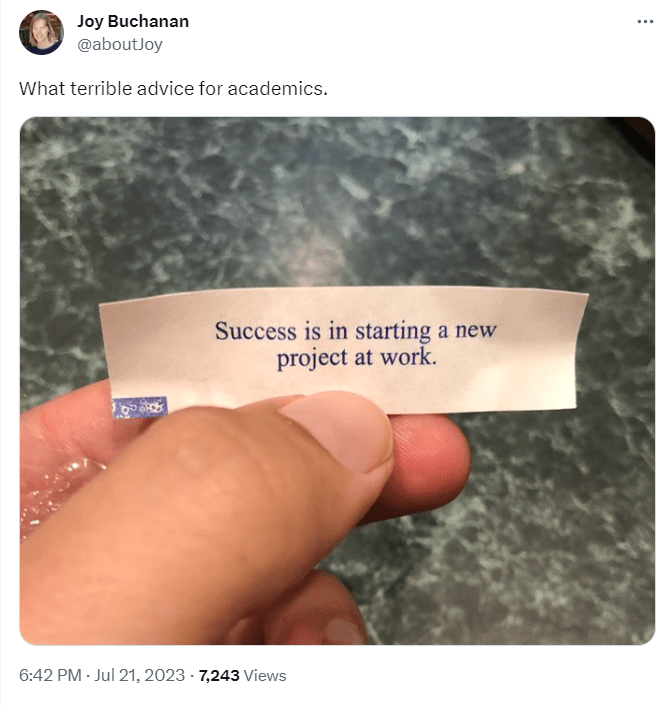
Starting a new project at work does not translate to success in academia. The danger is usually in starting too many projects and finishing too few.
Starting a new research project, whether alone or with coauthors, is exciting. You fall in love with a new idea.
The hard part is sticking with that idea until the very end of the publication process. This is more comparable to staying married. The project will see you at your worst, and you will discover that the project is not as wonderful as it seemed initially. You might end up re-writing the manuscript several times, years after the initial infatuation has worn off.
Academics do need to start projects. It is important to start the right projects. A reason to not start too many projects is to preserve time for the best work. A downside to being overloaded is that you might have to say no to a new project when an actual good opportunity comes along.
In my post on the Beatles documentary Get Back, I observed the way that the bandmates start new songs together. It reminded me of coauthors convincing each other to start a new project.
Their creative process resembles co-authoring a research paper. When Paul is working out a song and humming through places he hasn’t worked the lyrics out yet, that reminds me of the early drafts of a paper. You don’t have to have the whole Introduction written. The hook of a song is a bit like the main result of a research paper. Persuading yourself and your coauthor that you have a project worth finishing is the first step. Coauthors have unspoken agreements on how the project is going to proceed. The tacit knowledge of the collaborative process is one of the most important things you can learn in graduate school.
Darwyyn Deyo wrote several posts for us on the research process, including: “The Research Process: Identifying the Ideas that Motivate You”
Greg Mankiw’s career advice intersects with starting projects:
Advice for new junior faculty (2007)
My Rules of Thumb (1996)
This quote from Rules of Thumb was surprising: “None of this is part of a grand plan. At any moment, I work on whatever then interests me most. Coming up with ideas is the hardest and least controllable part of the research process. It is somewhat easier if you have broad interests.” He goes on to say: “I sometimes fear that because I work in so many different areas, each line of work is more superficial than it otherwise would be. Careful choice of co-authors can solve this problem to some extent, but not completely.”
He really refutes my fortune cookie with this line, “Deciding which research projects to pursue is the most difficult problem I face in allocating my time.” Success is about starting the right projects and no others.
 Economist Writing Every Day
“A downside to being overloaded is that you might have to say no to a new project when an actual good opportunity comes along.”
Exactly. My top note to myself the last few years has been “create slack”, for exactly this reason
LikeLike