I don’t like when celebrities are ‘caught’ saying deplorable things in a heated moment. Sometimes they say really awful things, specifically about observables such as race, weight, sex, nationality, odor, etc. Plenty of people have done it. I won’t mention the names or link to any particulars here.
My problem isn’t that I wish celebrities had better behavior – although I do. My problem is with the entire fallout of how we’re all supposed to take the celebrity seriously when they were enraged. When people get angry they say things that are designed to hurt others. People will say things that they don’t mean or wouldn’t normally say. And it’s not like they are betraying some unspoken belief that they’ve hidden. Angry people often say wicked things for the sole purpose of hurting someone else’s feelings. In the moment, the offender tries hard to communicate disrespect – not due to a lack of respect – but due to how it will make the other person feel.
I find the entire circumstance weird. If someone is boiling over and saying patently ridiculous things to me and calling me names, then I have a very hard time taking them seriously. All the same, context matters and words can hurt. It’s weird that we know that people can say untrue things in order to hurt us, and then it actually hurts us. Strange.
Consider the following example in which there are two students: one deciding whether to cheat on an exam, and the witness who must then decide whether to report the cheater. For the would-be cheater, there are three outcomes. 1) don’t cheat and get a relatively middling grade, 2) cheat, get reported, and then suffer the consequences, and 3) cheat, the witness stays mum, and get off scot-free. The witness prefers not to be a witness at all. They get put in the rough spot and face the trade-off of protecting the quality of their degree and protecting their social status. The below game tree describes the circumstances:
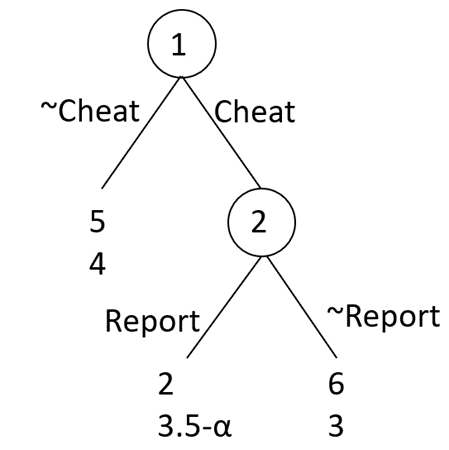
Note that I’ve made the payoff to the 2nd student the similar regardless of whether they report the cheating student. I think that this reflects reality relatively well – students are often on the fence about reporting academic dishonesty. They often make rules for themselves that justify whatever outcome. Like “I’ll report it if I see it again”, “Well, it wasn’t egregious”, or “It’s none of my business”. But what about the α? That’s the Greek letter alpha. It represents the expected costs that the cheater can impose on the witness. These costs are social in nature. For our purposes, they are the costs of eliciting the cheater’s anger and reproach.
If the cheater can find out who reported him, then he can impose a cost on the witness equal to alpha. And the bigger the alpha, the less likely that the cheater is reported. This is the circumstance that I see when celebrities are caught saying foul things. I think of them attempting to impose costs in order to get their way. The same is true for the stereotypical person who calls customer service and treats the company representative poorly. Some people have learned that they can adopt a tenor that makes interaction super costly for others such that the person on the receiving end sees it in their interest to acquiesce.
There are two morals of the story. First, people who mouth-off are trying to hurt your feelings so that you accommodate their demands. Whether they’re successful is determined by whether they can hurt your feelings. If you have a strong sense of justice, then you’ll shield your heart from their words (or fight back). Second, foul-mouthed celebrities are getting in trouble for the wrong thing. Screaming obscenities shouldn’t be a problem merely because they insulted some particular social group. Rather, intimidation by obscenity is juvenile bullying. And that’s the part that we should decry.
 Economist Writing Every Day