In the October 1980 Presidential debate, Ronald Reagan famously asked that question to the American voters. His next sentence made it clear he was talking about the relationship between prices and wages, or what economists call real wages: “is it easier for you to go and buy things in the stores than it was four years ago?”
Reagan was a master of political rhetoric, so it’s not surprising that many have tried to copy his question in the years since 1980. For example, Romney and Ryan tried to use this phrase in their 2012 campaign against Obama. But it’s a good question to ask! While the President may have less control over the economy than some observers think, the economy does seem to be a key factor in how voters decide (for example, Ray Fair has done a pretty good job of predicting election outcomes with a few major economic variables).
Voters in 2024 will probably be asking themselves a similar question, and both parties (at least for now) seem to be actively encouraging voters to make such a comparison. We still have 12 months of economic data to see before we can really ask the “4 years” question, but how would we answer that question right now? Here’s probably the best approach to see if people are “better off” in terms of being able to “go and buy things at the stores”: inflation-adjusted wages. This chart presents average wages for nonsupervisory workers, with two different inflation adjustments, showing the change over a 4-year time period.
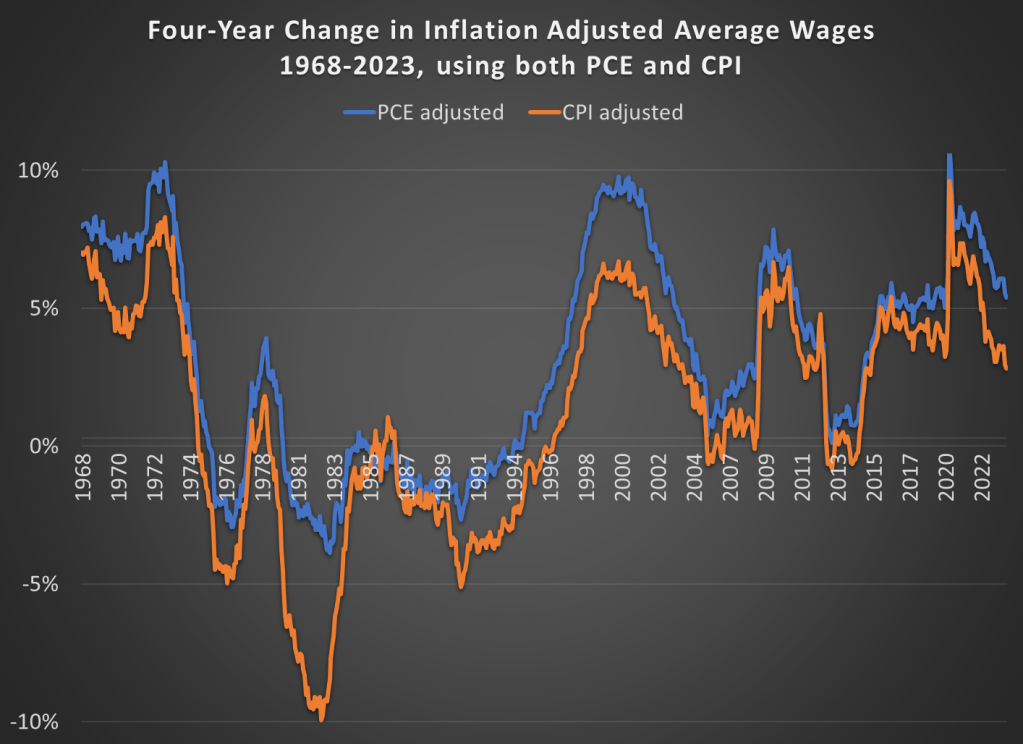
When Reagan made that famous statement in October 1980, he was clearly on to something that voters felt: inflation-adjusted wages were either 2% or 7% lower than they were 4 years earlier (depending on your preferred inflation measure). It’s interesting to note that 4 years later in October 1984, you could have levied the same charge against Reagan: inflation-adjusted wages were still lower than 4 years prior! Though “less negative” this time than in 1980: either just slightly negative or down 2% from October 1980 to 1984 (again, depending on your inflation measure).
Now let’s look at today. I know that many click-bait headlines and Tweets have been spilled over this question, but the data are quite clear: over the past 4 years, inflation-adjusted wages are up! This is also true if you start roughly right before the pandemic (December 2019 or January 2020 or thereabouts).
And not only are inflation-adjusted wages up, there are up roughly the same amount as they were in the years before the pandemic. CPI-adjusted wages are a touch below: about 3% growth over 4 years, versus roughly 4% from 2015-2019. But PCE-adjusted wages are right on track, at around 5% cumulative 4-year growth.
Of course, looking at 4-year growth rates right now isn’t quite the right comparison, since it also includes the last year of the Trump Presidency (what a strange year it was!). But projecting reasonable growth rates of wages and prices forward, say 4% and 3% respectively, by October 2024 the average worker will be “better off” in terms of inflation-adjusted wages: about 3% higher as measured by PCE inflation, or 0.5% better off with CPI inflation (just barely, there). For CPI-inflation-adjusted wages to be lower in October 2024 than October 2020, nominal average wages would need to growth slower than inflation over the next 12 months. If wages grow at least 1% faster than prices, then the cumulative effect will be that workers are better off than they were four years ago.
It’s true right now that if we start the data in January 2021, at the beginning of the Biden Presidency, CPI-adjusted wages are down slightly: about 1%. But PCE-adjusted wages are up slightly: also about 1%. But unless there is a major reversal of the trajectory of either wage or price growth, by next year these will both be positive (even if only slightly).
Finally, some of you may reasonably be wondering about median earnings, rather than average wages. Here’s my best attempt to create a similar chart with median earnings (this data is quarterly, rather than monthly).
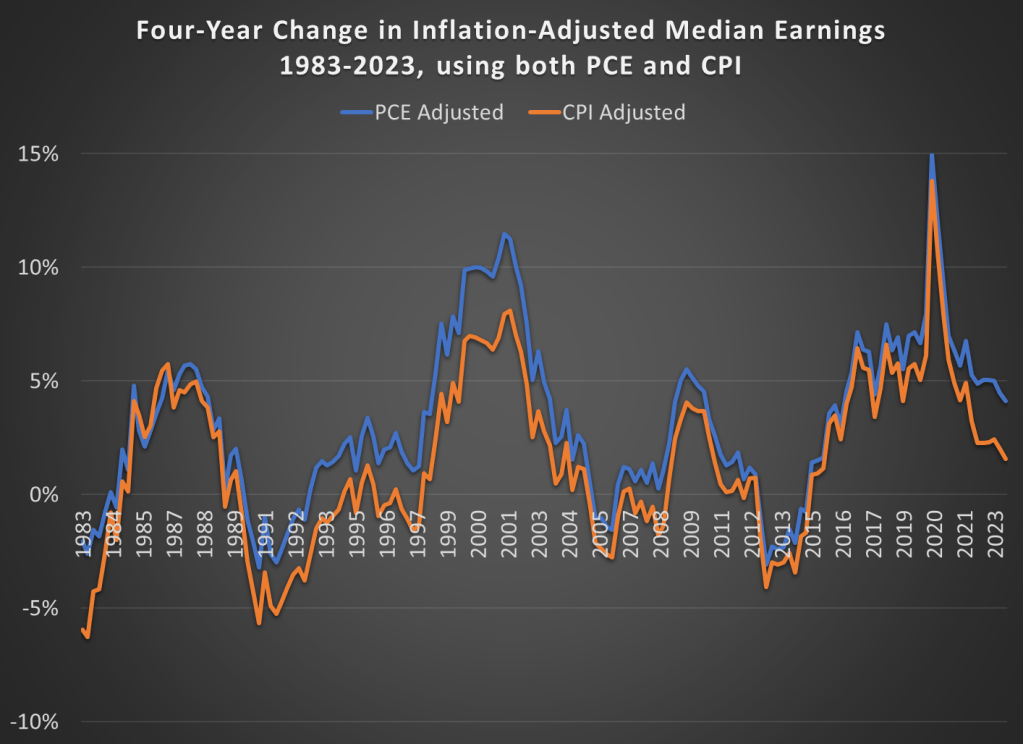
Unfortunately this data doesn’t go back far enough to do the October 1980 comparison, though other median wage data clearly shows that wages were lower in 1980 than in 1976. Interestingly, we see that once again by the time of the 1984 election, the median worker was still not better off than 4 years earlier (though getting close).
However, when we get closer to the present, we can still clearly see that real median earnings are positive in the past 4 years — in spite of the historic inflation. Here, the growth rate is not quite as robust as the immediate pre-pandemic period, especially if we are adjusting with the CPI, but still: “better off” and “easier to buy things” is the clear interpretation. And if nominal wage growth and inflation continue at the pace they have grown in the past year, 12 months from now workers will likely be better off than they were 4 year earlier.
Whether voters will actually know this is quite another question, since money illusion seems to be a real cognitive bias. In short, people think about money in nominal terms, not real terms, meaning that they don’t actually consider “whether it easier for you to go and buy things in the stores.”
 Economist Writing Every Day
“Finally, some of you may reasonably be wondering about median earnings, rather than average wages.”
I certainly was, this seems more likely than average earnings to be what matters to the median voter. Ideally it would be hourly and somehow incorporate benefits, but that gets complicated fast.
LikeLike