C.S. Lewis is known as a novelist, but he was an academic familiar with university politics. In 1944, he gave a lectured called “The Inner Ring” about how everyone wants to be accepted into an “inner ring” of friends or colleagues. Being on the fringes of a group can be a source of misery.
My main purpose in this address is simply to convince you that this desire is one of the great permanent mainsprings of human action. It is one of the factors which go to make up the world as we know it—this whole pell-mell of struggle, competition, confusion, graft, disappointment… Unless you take measures to prevent it, this desire is going to be one of the chief motives of your life, from the first day on which you enter your profession…
To a young person, just entering on adult life, the world seems full of “insides,” full of delightful intimacies and confidentialities, and he desires to enter them. But if he follows that desire he will reach no “inside” that is worth reaching.
I’ll list the items that got me thinking about “the inner ring”.
This week, Alex posted on Misandry. Are men starting to feel like it is actually the women who are in the inner ring and men are on the outside?
I’ll share a story in which I felt like I was not in the inner ring. Before I had a job, I was at a professional conference. A colleague invited me to go out with him and some guys to a cigar shop that evening. “Yes!” I said at first, because this sounded both fun and good for my career. Then I remembered that I was three months pregnant. Smoking would damage the baby’s health, so I awkwardly backed out of the event. Of course, this is not a big deal in retrospect, but it’s the kind of thing that can bother you if you obsess over the rings you can’t join.
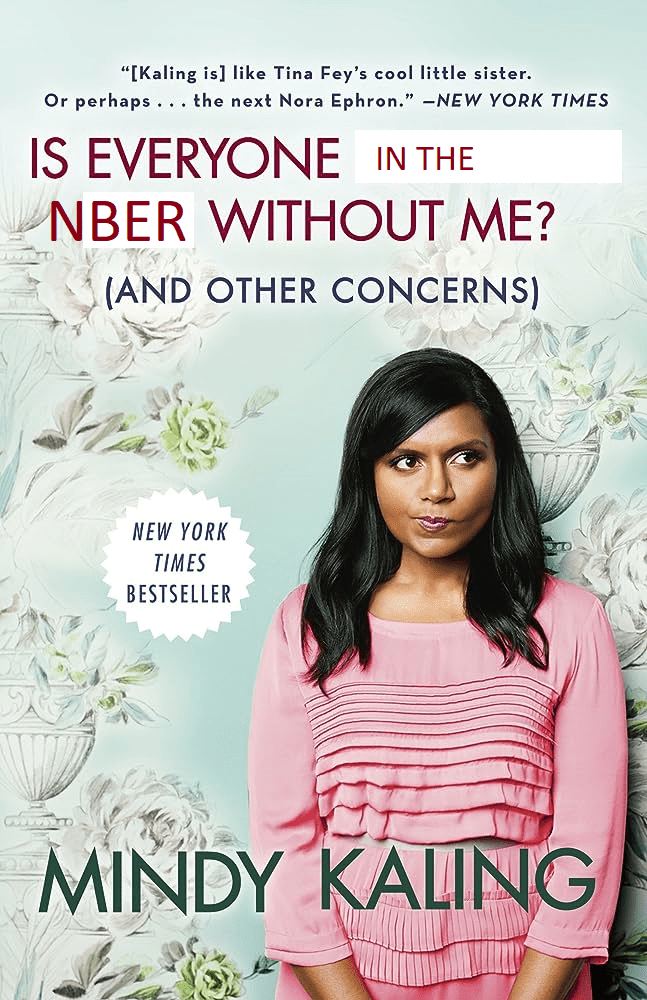
Women have long felt like they were on the outside of the boy’s club. “Is everyone smoking cigars without me?” The second item in reverse chronological order is the Barbie movie. In the movie, the top-floor meeting room of male executives at the L.A. Mattel office represents the male inner ring. The cul-de-sac of pink dream houses in Barbieland represents the female inner ring. Every character in the movie feels left out of a ring. In the article I was pointed to by Alex, John Tierney writes, “Smug misandry has been box-office gold for Barbie, which delights in writing off men as hapless romantic partners, leering jerks, violent buffoons, and dimwitted tyrants who ought to let women run the world.”
Several posts by my excellent co-bloggers are related to being left out of opportunities for networking or funding. Click through if you want to learn more about the NBER, the dark side, or grants.
The National Bureau of Economic Research (NBER) sent out its membership invitations this week. My twitter timeline quickly filled with explicit congratulations and oblique commentary. My private messages filled with…less than oblique commentary. Academia has always been hierarchical and economics has never been an exception.
In my early days, I innocently asked a researcher what the letters N.B.E.R. stood for. He remarked that it was a “money laundering scheme run out of Boston.” I essentially took him literally, because I didn’t know any better, at the time. It is easy to tell that he was never invited to be a member, else he would have described it positively.
The bureaucratic and scholarly gamesmanship that can hold back one paper and elevate another. Every story your paranoid lizard brain can dream up explaining why a node in the tournament decision tree turned against you and in another’s favor.
It’s always nice, rhetorically speaking, to end on a positive note. That’s what Lewis did in his lecture. He said that there is a form of human association that is rewarding and virtuous: true friendship. Have a good weekend, friends.
I’ve written previously on game theory, about the generality of Pure Strategy Nash Equilibria (PSNE), and the drawbacks of Sub-Game Perfect Nash Equilibria (SGPE). In this post I have another limitation for SGPE.
First, some definitions: PSNE: “No player can change one of their strategies and improve their payoff, given the strategies of all other players.” Subgame: “A subset of any extensive-form game that includes an initial node (which doesn’t share an information set with other nodes) and all its successor nodes.” Subgame Equilibrium (SGE): “The PSNE of the Subgame” SGPE: “The set of PSNE that are also SGE”
Clearly, there is nothing inconsistent about the above definitions. The reason that SGPE emerged was because some PSNE assert that a player would be willing to choose strategies that do not maximize conditional payoffs in subgames that are off of the equilibrium path. So, people often characterize the SGPE as a player ‘being rational each step of the way in each subgame’.
But, there is a problem. “Each step of the way” and “in each subgame” are not the same thing. Each step of the way implies that a player is rational at each decision – ie, at each information set. But, not every information set is a subgame! So, a SGPE can include rationality at each SGE while also permitting some irrationality at individual information sets. Since economists like to identify the bounds of their claims, let me emphasize the word can. In order to be correct, I need only identify one case in which the claim is true.
Short post today because I’m busy watching my kids, who had their school canceled because of excessive heat, like many schools in Rhode Island today.
I thought this was a ridiculous decision until my son told me he heard from his teacher that his elementary school is the only one in town that has air conditioning for every classroom. Given that, the decision to cancel given the circumstances is at least reasonable, but the lack of AC is not.
It’s not just that hot classrooms are unpleasant for students and staff, or that sudden cancellations like this are a major burden for parents. Several economics papers have found that air conditioning significantly improves students’ learning as measured by test scores (though some find not). Park et al. (2020 AEJ: EP) find that:
Student fixed effects models using 10 million students who retook the PSATs show that hotter school days in the years before the test was taken reduce scores, with extreme heat being particularly damaging. Weekend and summer temperatures have little impact, suggesting heat directly disrupts learning time. New nationwide, school-level measures of air conditioning penetration suggest patterns consistent with such infrastructure largely offsetting heat’s effects. Without air conditioning, a 1°F hotter school year reduces that year’s learning by 1 percent.
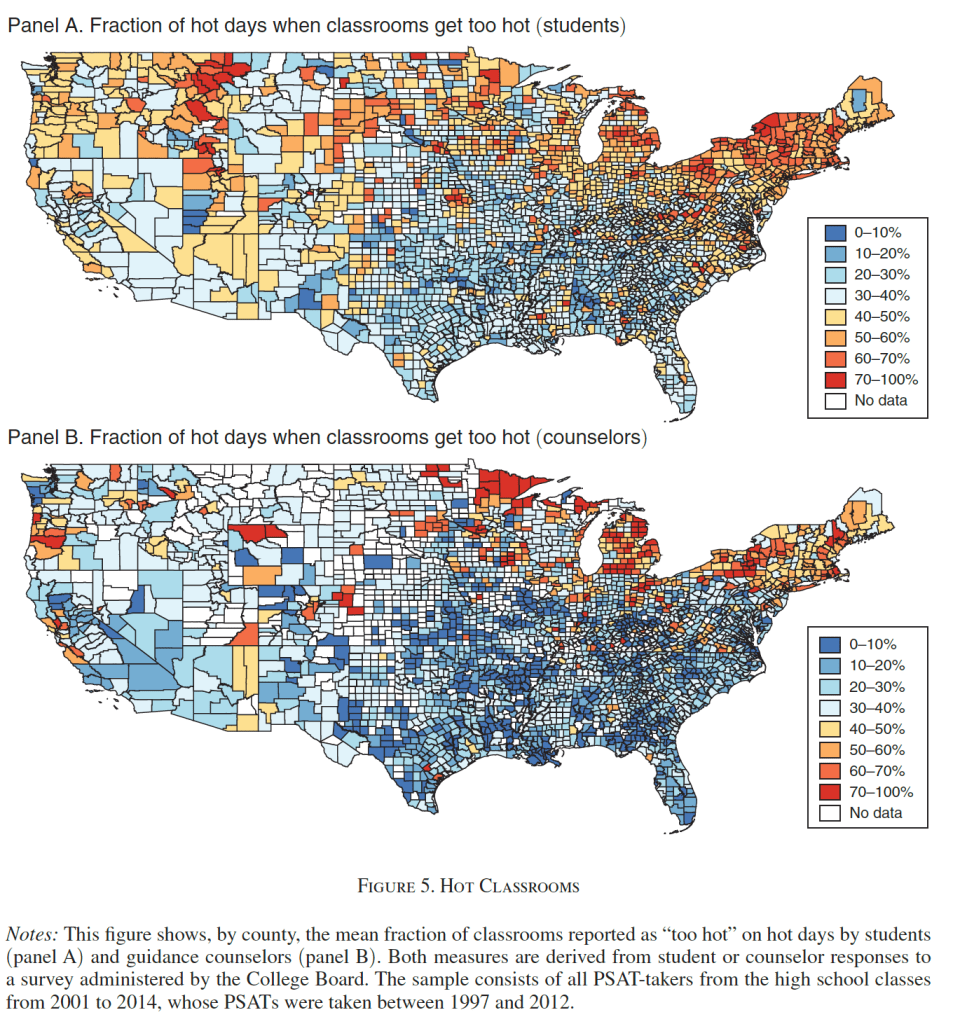
This can actually be a bigger issue in somewhat Northern places like Rhode Island- we’re South enough to get some quite hot days, but North enough that AC is not ubiquitous. Data from the Park paper shows that New York and New England are actually some of the worst places for hot schools:
This is because of the lack of AC in the North:
The days are only getting hotter…. it’s time to cool the schools.
1996 was a big year for minivans. While modern minivans had been around for about a decade by that point, 1996 marked a turning point. That year Dodge introduced what is referred to as the “third generation” of its Caravan, and it won Motor Trend’s car of the year award. That’s the first, and only time, that a minivan ever won this award. If you drive a minivan today or see one on the road, you are seeing the look, style, and features that were first introduced in 1996 (interestingly, that year also seems to have marked the peak in sales for the Chrysler family of minivans).
If you wanted to buy the cheapest possible Dodge Caravan in 1996, you would have paid about $18,500. You could always pay more for more features, as with any car, but if you wanted this “car of the year,” and you wanted it new and cheap, that was what you paid.
Dodge continued to produce the Caravan for the US market until 2020, when it was discontinued in favor of other nameplates (though it still lived on in Canada). In 2020, the base model Caravan was about $29,000 (and now only available in the “Grand” version, an upgrade in 1996).
We seem to be somewhat exhausted by all the dire predictions around Covid, now that life has largely gotten back to the normal. Shops and theaters are open, and people are once more crowding aboard those floating petri dishes called cruise ships. The most vulnerable segments of the population have mainly been vaccinated, and each new strain of the disease seems less harmful. All the anti-vaxxers I know have had Covid at least once and hence have some level of immunity, or else they caved and got vaccinated after seeing a close friend or relative die back in the winter of 2021-22. One enduring benefit of Covid is much more availability to work from home.
One of the direst prognostications was that the world would suffer a more or less permanent step down in standards of living due to “long Covid.” According to this narrative, untold numbers of healthy young or middle-aged people would remain debilitated indefinitely due to the ongoing after-effects of a Covid infection: struck down in their prime, never to rise again.
A recent review of the field in Nature concluded, “The oncoming burden of long COVID faced by patients, health-care providers, governments and economies is so large as to be unfathomable”. Ouch. The federal government has provided $1.15 billion for research into the problem of long COVID and its mitigation.
Just the Facts
A couple of facts stand out: First, in many cases, scans of internal organs have shown changes in victims’ hearts and lungs and brains, following a severe Covid infection. Second, many people have reported symptoms such as weakness, fatigue and general malaise, impaired concentration and breathlessness, weeks after the primary symptoms of the disease have resolved.
How big a problem is this? I cannot, in the scope of a short blog post, adequately canvass all the data and literature. I will just cite a few numbers and charts, and let the professional data analysts dig into the fine points.
One meta-analysis found that a full “41.7% of COVID-19 survivors experienced at least one unresolved symptom and 14.1% were unable to return to work at 2-year after SARS-CoV-2 infection.” [That number seems much higher than my personal observations would suggest]. A CDC survey found that as of July 26-Aug 7, 2023, about 5.8 % of all Americans (which is 10.4% of Americans who ever had Covid) report experiencing some effects of long Covid, with 1.5% of all American adults experiencing significant activity limitations as result of long Covid. These numbers show a modest downward trend with time.
The chart below depicts the incidence of long Covid in England, again showing a modest downward trend in the latest year:
Weekly estimates of prevalence of COVID-19 and long COVID in England. Source.
Correlation versus Causation
So: we have many people experience severe symptoms from Covid, but most resolve within a few months at most. That leaves a small but nontrivial minority of Covid victims reporting problems long after that window. A significant question is whether Covid of itself caused those long-term symptoms, or just precipitated some problem that was bound to show up anyway.
I have read poignant anecdotes of perfectly healthy young people who suffer from brain fog two years later. But I have lived long enough to be wary of generalizing from poignant anecdotes. After all, the whole anti-vaccination movement has been fueled by poignant anecdotes of, say, perfectly normal two-year-olds going autistic shortly after getting their vaccine shots.
The 2023 metastudy referred to earlier found that long Covid sufferers tended to be older, and had pre-existing medical comorbidities. Similarly, we have known since 2020 that the cohorts most likely to die from Covid were older folks (such as me!), many of whom were bound to die anyway.
In this light, the data brought forth by James Baily in his recent article on this blog, Long Covid is Real in the Claims Data… But so is “Early Covid”?, is most interesting. He noted that on average people use more health care for at least 6 months post-Covid compared to their pre-Covid baseline, which is consistent with some measure of long Covid. However, those same individuals also spent significantly more on healthcare 1-2 months before their Covid diagnosis. This seems consistent with the notion that some of what gets blamed on Covid would have occurred sooner or later anyway.
A Nuanced View of Long Covid
An article in Slate by Jeff Wise has dug deeper into the data. He noted that the survey-based datasets that have been largely used to estimate the effects of long Covid tend to be biased: those who feel ongoing symptoms are more likely to complete the surveys, giving rise to some of the largish numbers I have shared above. Newer, better-controlled retrospective cohort studies tend to show much lower ongoing incidence of symptoms, especially compared to control groups who had not had Covid. The feared tidal wave of mass disabilities never arrived:
“The best available figures, then, suggest two things: first, that a significant number of patients do experience significant and potentially burdensome symptoms for several months after a SARS-CoV-2 infection, most of which resolve in less than a year; and second, that a very small percentage experience symptoms that last longer. ”
Further, “Another insight that emerges from the cohort studies into long COVID is that it is not so easy to prove causality between a particular infection and a symptom. Almost all the symptoms associated with long COVID can also be triggered by all sorts of things, from other viruses to even the basic reality of living through a pandemic.”
Finally:
It looks more as if people who complain of long COVID are suffering from a collection of different effects. “I think there’s quite a heterogeneous group of people all sailing under the one flag,” said Alan Carson, a neuropsychiatrist at the University of Edinburgh in Scotland. Some patients may be experiencing the lingering aftereffects that occur in the wake of many diseases; some patients with chronic comorbidities might be experiencing the onset of new symptoms or the continuation of old ones; others might be affected by the sorts of mood disorders and psychiatric symptoms you’d expect to find in a population undergoing the stress of a global pandemic.
Another Slate article from last month gently debunks alarmism stemming from a Nature Medicine study of U.S. veterans who showed increased susceptibility to disease even two years after contracting Covid.
There is often great difficulty in discerning the actual organic, biochemical basis for the reported symptoms. This makes it hard to come up with a pill or a shot that might adjust the body’s metabolic pathways in order to cure them. Thus, simply treating the symptoms as such may offer the best near-term relief. To that end, a team of French researchers had the audacity to propose that much of the fatigue and brain fog associated with long Covid may be largely in our heads. In an article in the Journal of Psychosomatic Research Why the hypothesis of psychological mechanisms in long COVID is worth considering , Lemogne, et al. noted strong links between a patient’s prior expectations of symptom severity and the actual reported outcomes. The intent of the researchers is not to belittle the reported distress of long Covid sufferers, but to point towards established therapeutic methods to help treat disorders with at least a partial psychosomatic basis:
Many potential psychological mechanisms of long COVID are modifiable factors that could thus be targeted by already validated therapeutic interventions. Beside the treatment of a comorbid psychiatric condition, which may be associated with fatigue, cognitive impairment or aberrant activation of the autonomous nervous system, therapeutic interventions may build on those used in the treatment of ‘functional somatic disorders’, defined as the presence of debilitating and persistent symptoms that are not fully explained by damage of the organs they point. These disorders are common after an acute medical event, particularly in women, and include psychological risk factors, such as anxiety, depression, and dysfunctional beliefs that can lead to deleterious, yet modifiable health behaviors. Addressing these factors in the management of long COVID may provide an opportunity for patient empowerment.
In sum: A significant number of those who contract COVID suffer ongoing symptoms for a number of months afterward. Over a billion dollars of research has been directed at the problem. The severity of these symptoms tends to decline with time, in the vast majority of cases resolving by twelve months. This leaves some individuals still suffering fatigue and brain fog over a year later. Studies are ongoing to discern the organic basis of these complaints, and the exact role that COVID may have played, in the light of the fact that complaints of enduring fatigue and brain fog were not uncommon before the pandemic. We hope that following the science will bring more relief here.
Circling back to our original interest in the economic impact of long COIVD, early studies indicated that a large fraction of the population might continue to be debilitated, to the point of being unable to work, with significant effects on the workforce and GDP. Actual data (e.g., on disability claims) indicate that these problems have not actually materialized.
On this, the Day of our Labor in the year 2023, I leave you with a simple observation/plea into the void: don’t confusion condescending overconfidence with competence. I give to you Hans-Heman Hoppe stating, in public and on camera, his exasperated and deeply aggrieved belief that Paul Krugman doesn’t know what money is or how it works:
It is hilarious to use the hypothetical of "ask Paul Krugman to explain how adding more pieces of paper could make the economy richer."
Never forget that “con man” is short for “confidence man“, and part of the trick when trying to get other people to believe in you is to first project unerring belief in yourself. Confidence communication is effective in the sharing of ideas, but the real trick to all con men is what they’re selling. Or, more specifically, what the customers are buying. Yes, he’s selling the idea what monetary policy and fiat currencies are all part of a giant scam, a fugazi, because lol money isn’t real. But that’s not what his customers are buying.
What they’re buying is the idea that “I, person who holds this belief, am smarter than Paul Krugman.” I imagine that is probably a pretty enjoyable belief to hold. I would certainly enjoy believing that I am smarter than Paul Krugman, but wanting something doesn’t make it true…which, now that I say it outloud, is a nearly sufficient encapsulation of the entire human condition.
To be clear, this isn’t about Krugman’s accomplishments or status in society inviting censure or criticism from all corners. That’s just the eminence tax. It’s actually, in a weird way, about everything he had to do to acquire that eminence, in the form of arduous education, training, and research production over decades. Because what I think the Hoppe’s of the world are often really selling to their audience is a shortcut. An opportunity to believe that you, the listener, don’t have to go through such trials of human capital acquisition. You just have to hang out with me, parrot a few trivializations of economic thought, cope with a little light reading, and boom, you’re smarter than a Nobel laureate with 275k citations. All available to you for the low low price of believing Paul Krugman doesn’t know how money works.
I did go see the Barbie movie (last month I had to put up someone else’s blog about it). Kate McKinnon and the Birkenstock choice is my favorite part. You can catch part of that scene in the middle of the trailer.
Here is America Ferrera’s monologue:
It is literally impossible to be a woman. You are so beautiful, and so smart, and it kills me that you don’t think you’re good enough. Like, we have to always be extraordinary, but somehow we’re always doing it wrong.
You have to be thin, but not too thin. And you can never say you want to be thin. You have to say you want to be healthy, but also you have to be thin. You have to have money, but you can’t ask for money because that’s crass. You have to be a boss, but you can’t be mean. You have to lead, but you can’t squash other people’s ideas. You’re supposed to love being a mother, but don’t talk about your kids all the damn time. You have to be a career woman but also always be looking out for other people.
You have to answer for men’s bad behavior, which is insane, but if you point that out, you’re accused of complaining. You’re supposed to stay pretty for men, but not so pretty that you tempt them too much or that you threaten other women because you’re supposed to be a part of the sisterhood…
Movies and Money
The Barbie movie is doing well commercially. So many other special projects, such as the all-female remake of Ghostbusters, flopped at the box office. Barbie and Taylor Swift concert tickets were serving as the primary examples of spending in “Hot Profit Summer“. Congratulations to Greta Gerwig on a huge success.
Barbie has unresolved existential angst, universe portals, mother-daughter conflicts and fight scenes. To that extent, Barbie reminds me of Everything Everywhere All At Once. The big commercial successes within the same decade often share key components. Earlier I wrote about how Frozen and The Queen’s Gambitare similar.
One could write a very serious post about the Barbie movie and the portrayal of female reality. Instead, let’s acknowledge that the movie is fun, just like American life generally. No one needs Kate McKinnon (to survive). We get to watch her on TV because the world is rich now. Not only has child mortality fallen because of economic development, but life has gotten more fun.
I noted this when I reviewed the movie Austenland. The film shows that when an American woman goes to a Regency-era simulation she gets bored.
… afternoons spent on needlepoint projects were not so much painful as boring to the heroine. Boring. Matt Ridley tells us in The Rational Optimist that life in pre-modern England was more miserable than we imagine in terms of health outcomes. An underrated feature of modernity is how much more interesting the world is now that we can read widely and travel and tweet. If you were rich enough to escape endless manual labor in 1810, your options for leisure time were still very limited.
John Maynard Keynes predicted that future people would only work for 15 hours per week. Why, then, did the Barbie dolls (who don’t need money) talk so much about careers? President Barbie and Doctor Barbie seem happy.
Do we keep working past 15 hours a week because it is fun? (Tyler says it is in Big Business.)
Would it be accurate to say that professionals spend less than 15 hours a week on tasks that they truly hate? Maybe striding down a clean hallway to a meeting with coffee in hand is what we like to do? Or is that a strictly American phenomenon?
Interestingly, the human mom character (America Ferrera) does not love her job. She is not President or a Doctor. Would she prefer to be unemployed?
I want to know if the career barbies sell, but I could not find the data. The Guinness Book of World Records indicates that the best-selling Barbie is “Totally Hair Barbie”.
Sometimes you read an academic article and the author fills in the data gaps with interpolation. That is, they assume some functional form of the data and then replace the missing values with the estimated ones. Often, lacking an informed opinion about functional form, authors will just linearly interpolate between the closest known values. Sometimes this method is OK. But sometimes we can do better.
Historical census data provides a good example because the frequency was only every ten years. Say that we want to know more about child migration patterns between 1850 and 1860. What happened in the intervening years? Who knows. Let’s look at the data.
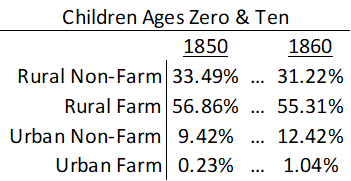
Using data on individuals who have been linked across censuses allows us to fill in the gaps a little bit. For simplicity, let’s just look at whether a child migrant lived in an urban location and whether they lived on a farm. That means that there are 4 possible ways to describe their residence. Below is a summary of where children migrants lived at the age of zero in 1850 and where the same children lived a decade later at the age of ten in 1860 given that they moved counties.
When I’m the mean time did these children move from one place and to the other? We don’t know exactly. The popular answer is to say that they moved uniformly throughout the decade. That’s ‘fine’. But it assumes that the rate at which people departed places was rising and the rate at which they arrived places was falling. Maybe that’s true, but we don’t really know. Below-left is a graph that shows the linear interpolation.
The nice thing about linear interpolation is that everyone is accounted for at each point in time. The total number of people don’t rise or fall in the intervening interpolation period. But if we were to assume that children departed/arrived at each type of place at a constant rate (maybe a more reasonable assumption), then suddenly we lose track of people. That is, the sum of people dips below 100% as people depart faster than they arrive.
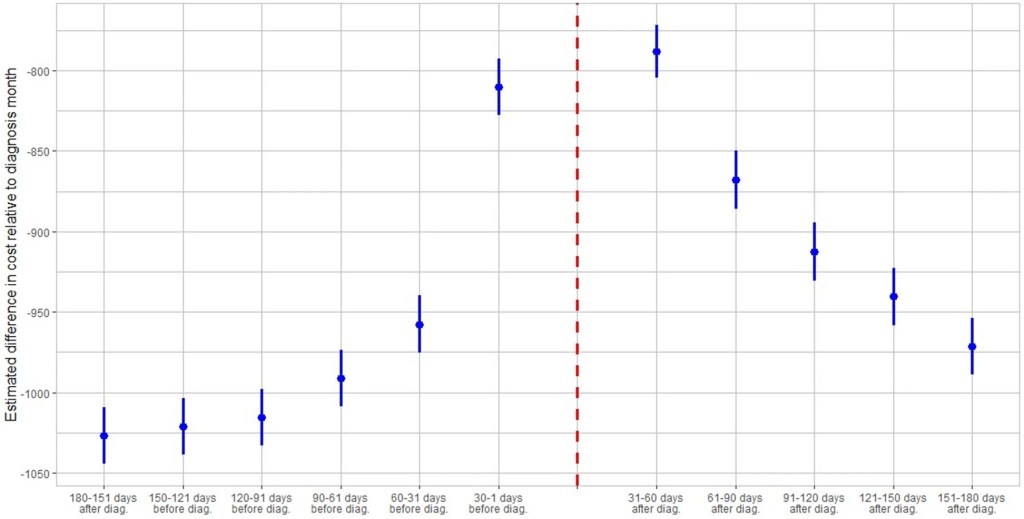
I’ve seen plenty of investigations of “Long Covid” based on surveys (ask people about their symptoms) or labs (x-ray the lungs, test the blood). But I just ran across a paper that uses insurance claims data instead, to test what happens to people’s use of medical care and their health spending in the months following a Covid diagnosis. The authors create some nice graphics showing that Long Covid is real and significant, in the sense that on average people use more health care for at least 6 months post-Covid compared to their pre-Covid baseline:
The graph is a bit odd in that its scales health spending relative to the month after people are diagnosed with Covid. Their spending that month is obviously high, so every other month winds up being negative, meaning just that they spent less than the month they had Covid. But the key is, how much less? At baseline 6 months prior it was over $1000/month less. The second month after the Covid diagnosis it was about $800 less- a big drop from the Covid month but still spending $200+/month more than baseline. Each month afterwards the “recovery” continues but even by month 6 its not quite back to baseline. I’m not posting it because it looks the same, but Figure 4 of the paper shows the same pattern for usage of health care services. By these measures, Long Covid is both statistically and economically significant and it can last at least 6 months, though worried people should know that it tends to get better each month.
I was somewhat surprised at the size of this “post Covid” effect, but much more surprised at the size of the “pre Covid” or “early Covid” effect- the run-up in spending in the months before a Covid diagnosis. For the month immediately before, the authors have a good explanation, the same one I had thought of- people are often sick with Covid a couple days before they get tested and diagnosed:
There is a lead-up of healthcare utilization to the diagnosis date as illustrated by the relatively high utilization levels 30–1 days before diagnosis. This may be attributed to healthcare visits only days prior to the lab-confirmed infection to assess symptoms before the manifestation or clinical detection of COVID-19.
But what about the second month prior to diagnosis? People are spending almost $150/month more than at the 6-month-prior baseline and it is clearly statistically significant (confidence intervals of months t-6 and t-2 don’t overlap). The authors appear not to discuss this at all in the paper, but to me ignoring this lead-up is burying the lede. What is going on here that looks like “Early Covid”?
My guess is that people were getting sick with other conditions, and something about those illnesses (weakened immune system, more time in hospitals near Covid patients) made them more likely to catch Covid. But I’d love to hear actual evidence about this or other theories. The authors, or someone else using the same data, could test whether the types of health care people are using more of 2 months pre-diagnosis are different from the ones they use more of 2 months post-diagnosis. Doctors could weigh in on the immunological plausibility of the “weakened immune system” idea. Researchers could test whether they see similar pre-trends / “Early Covid” in other claims/utilization data; probably they have but if these pre-trends hold up they seem worthy of a full paper.
Income varies a lot across the US. So does the cost of living. Does it mostly wash out when you adjust incomes for the costs of living? No, not even close. Apples-to-apples comparisons are always hard, but it’s still worth making comparisons.
Let’s use some data that Ryan Radia put together that I really like, for several reasons. He uses the 100 largest MSAs — these comprise about 2/3 of the US population. He uses median income, so outliers shouldn’t effect the income data. He uses median family income, since the more common median household income is, in my opinion, very difficult to interpret (5 college students living together are a household, and so is one elderly person living alone). And Ryan also limits it to non-elderly, married couples, and then separates the data by the employment status of each member of the couple.
As an illustration, let’s use the data for married couples with only one spouse working full-time (I have played around with the data for other working statuses, and the results are similar). Before adjusting for the cost of living, here are the top MSAs with the highest median incomes:




 Economist Writing Every Day