The Social Drug of Prohibition

Why does the average drinker consume alcohol? There are plenty of reasons, one of which is social. Alcohol, while inhibiting clarity, precision, and discretion, is a social lubricant. If you’re one of those drinking, then it’s enjoyable to be around other drinkers. Also, people build the habit of drinking *something* while socializing. We all know that prohibition resulted in bootlegging and tainted cocktails. But what were the legal alternatives? One was that you could purchase grape juice and make your own wine (that’s a story for another time). Another is to switch to another drug.

Alcohol is a depressant and arguably the most popular one in the US. It’s not a clear substitute for alcohol in terms of its direct effects on the body. However, it’s a liquid, safe, and tasty. That make is a good candidate for satisfying the physical urge to imbibe. But, importantly, it is also a social drug. People would get so hopped up on coffee and feed off of one another’s high that Charles the II of England banned coffee houses in order to prevent seditious fomentation. This brings us to an important characteristic of coffee. It’s a stimulant. You’d think that a stimulant would not be a substitute for alcohol. If anything, one might think that they are complements. Coffee helps to provide that kick in the pants after having an enjoyable night. But, the social feature makes coffee a good candidate to substitute alcohol, should the times be dire.

Illegal activity aside, people wanted an outlet for their physical and social proclivities. They wanted intoxication. Coffee provided exactly that. Conveniently, the continental US didn’t grow any of its own coffee. That means that imports and domestic consumption have a tight relationship.

Continue reading

Economic Recovery from the Pandemic

How well have countries recovered from the declines in the pandemic? It’s actually a bit difficult to answer that question, because it depends on how you measure it. Even if we agree that GDP is the best measure, how do we measure recovery? One possibility is to simply ask whether the country has exceeded its pre-pandemic GDP level. Exactly which quarter to use as the baseline is debatable, but here is a chart that Joseph Politano made for G7 countries using the 3rd quarter of 2019 as the baseline.

But we know that absent the pandemic, most countries would have continued growing (absent a recession for some other reason), so just getting back to pre-pandemic levels isn’t necessarily a full recovery. But how much growth should we have expected? It’s a hard question, but here’s a chart along those lines from the Washington Post, using the CBO’s measure of “potential GDP” as what growth might have looked like.

Using either of these approaches, it appears that the US has recovered pretty well, although it would be nice to have a comparison across countries using the same approach as the Washington Post chart does. While there is no consistent measure similar to CBO’s potential GDP figure for all countries, a simple approach is to project growth forward using the average pre-pandemic growth rate. I have done so for a number of countries, using the average growth rate from 2017-2019. In the following charts, the blue line is actual GDP levels, and the orange line is projecting the 2017-2019 growth rate forward. Sorry that I can’t easily fit all these into one chart, so here come the charts!

Continue reading

“Five Talents” Microfinance NGO Helps the Poorest of the Poor to Start Their Own Businesses

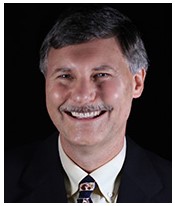
It is a pleasure to be able to report on a successful microfinance outfit that helps the poorest of the poor. I heard a talk recently from Dale Stanton-Hoyle, CEO of the Five Talents organization. (He is as nice in person as he looks in this photo).

This group was birthed at Truro Anglican Church, in Fairfax, Virginia. An Anglican bishop from Tanzania noted that he had many thousands of people under his care who were suffering so much from hunger and other concomitants of poverty that they had little inclination or energy to listen to elevating spiritual messages.  As he put it, “An empty stomach has no ears.”

Inspired by Jesus’ parable of the talents, where servants were each entrusted with some large sum of money (expressed in “talents”) and were expected to multiply that money productively, a group was formed in 1998 to help people living in the most extreme poverty to build productive enterprises.

Their approach would be classified as micro-credit, which nowadays is well-known and well-regarded approach. The modern stream of micro-credit, which is a subset of microfinance, has its roots In the Grameen Bank of Bangladesh, founded by micro-finance pioneer Mohammed Yunus in the 1970s.

Five talents describes itself more specifically as:

A micro-enterprise development organization that helps the world’s most vulnerable families escape poverty. Partnering with local churches around the world, we train men and women, mostly women living in extreme poverty, to form savings groups, take out loans, and build their own businesses.    It may seem surprising, but even those living in extreme poverty can save a little each week, start a tiny business, and fulfill their God-given potential.

In general, Five Talents does not give handouts. They support a limited number of full-time trainers, who in turn train local volunteer trainers, who do most of the actual organizing and leading. They found that when Western sources provided the initial seed capital, the money was not valued as much, and the loan payback rates were unsustainably low, around 60% or so.

So their model is to form a group of 20 or more people, and have them save their own money for at least six months. This develops tremendous accountability for borrowed funds. You are borrowing precious money from your group of friends and associates, and they all have a stake in helping your business succeed so you can repay it.

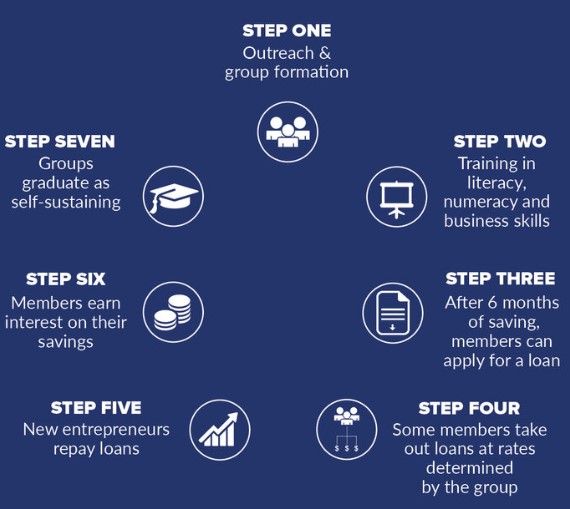
During those initial 6 to 12 months, the organization provides training: first, basic literacy (many are illiterate) and math skills which are essential for running a small business. Then, they provide training for more specific business planning and operation. This graphic depicts the process:

A typical loan might be $30-$150. This might be used to buy a goat to raise, or some beans to sell in the market. The local people can be creative in coming up with enterprises. The speaker told of a woman who was stuck in a refugee camp, who had been beaten up by life and was bitter and hopeless. All she could see were wretched poor people, and not much else. But the trainer persisted in asking her, “But what has God blessed you with?”  The subsequent conversation went something like this: “Well there is this large river nearby. And…there are unemployed men in the camp who used to have skilled jobs. I could probably pay some of them to make me a dugout canoe, then I could ferry people across the river for a fee. And…there are all these ragged children running around underfoot… I could probably buy them some fishing gear and pay them to catch me fish in the river, that I could sell in the market.” So this insightful local person was able to identify two completely new business ideas that the trainer had not thought of.

Five principles for “How to Build a Successful Business Anywhere” are:

  1. Start Small and Dream Big
  2. Know Your Neighbors
  3. Plan for Success
  4. Manage Growth Wisely
  5. Let Your Business be a Blessing


Some 80% of their participants are women. These women get a huge boost in self-confidence and community status, as well as income and food for their families.

Five Talents typically operates in concert with the local Anglican church in a country, which gives them some credibility and support and structure to start with. They are currently active in nine countries, mainly in central and eastern Africa along with Bolivia and Myanmar. They aim for countries with largest numbers of people living in extreme poverty. There is a wide range of development among so-called Third World countries. Many African countries already have a nascent middle class economy, so Five Talents directs its effort elsewhere.

According to their tracking, they have developed some 95,000 businesses so far, with a total of 1.4 million family members supported. They currently train about 10,000 people a year, and hope to increase that to 20,000 people. As with most development NGOs, the ultimate holy grail is to have your development project become independent and self-sustaining. Happily, Five Talents reports a great deal of success in getting groups to become self-funding after about one and a half years.

Redefining American law enforcement

Yesterday Noah Smith wrote a persuasive blog post about what police reform might look like. Similarly Jen Doleac wrote a thread about policing reform, in the comments of which Kevin Grier absolutely gave me the business while righteously criticizing the implication that law enforcement institutions could be even remotely trusted to reform themselves. I always find it awkward trying to respond to criticism when I essentially agree with every point being made.

I’m fine with Kevin’s criticism, to be clear, because I think it comes from the frustration that policing has arrived at it’s state along a tide of winking half-asssed internalization of some reforms exceeded only by the whole-assed petulant refusal of others. While the broader chattering classes and technocrats have been trying to adjudicate whether the dominance of White Supremacy within the culture of policing necessitated its wholesale defunding, law enforcement has managed to quietly be on an apathetic half-strike in major cities while bearing no material cost that I am aware of and remaining as militarized as ever.

What I do want to reconcile is the notion that the decentralization of policing across states, counties, and cities is an opportunity for reform because I’m not optimistic we’re going to get any meaninful action at the national level. What we can hope for, agitate and campaign for, is state and local reform. No one is getting elected to the presidency if they can have the “defund the police” label successfully slapped on them. A town, however, can fire its police and reform an entirely new force under different job expectations, with different hiring objectives (de-escalation, human services), qualifications (higher training bars), and bigger salaries. A town or small state can change the burden on police unions or even hire entirely parallel to them. We can decide that law enforcement is important work where you can make a professional salary with attractive benefits, but like other such jobs you can be fired with or without cause because someone else wants your job and might be able to do it better.

I don’t want to give the impression I think the problem of law enforcement in America can be solved with a few paragraphs. I guess all I want to do is remind you that Charles Tiebout has a pretty good point: local public goods always face the competition of those offered by their neighbors. Maybe the single most important contribution any of us can make to improving the deadly, destructive disaster that is the current state of law enforcement is to push your local government for reform. Your state could end police retention of seized property or end qualified immunity. Your sheriff’s office deputies could be at-will employees. Your city could require the police union to self-insure against civil lawsuits.

Because it only takes one place to start a Tiebout chain reaction, a place where people want to live and work that much more because they’re less afraid that the police are going to hurt their family or friends. Less likely to ignore theft and assault. Less likely to tase their teacher to death. Beat their neighbor to death. That’s sounds like a nicer place to live or start a businesss. The time for half measures is over, which unfortunately probably means the opportunity for national reform has passed. There are 18,000 police departments that can and need to be reformed.

Maybe we can start with yours.

Chesterton Views on Work in 20th Century America

One hundred years ago, the British writer G.K. Chesterton traveled to the United States for a lecture tour. He published his observations of America in What I Saw in America (1922). In an essay titled “The American Businessman”, Chesterton notes with surprise how passionate Americans appear about their professional work.

Chesterton recognizes this enthusiasm for work as more than mere greed.

This is the intro to my latest article for the OLL Reading Room. I discuss the American work ethic and Chesterton’s prescient insight into American economic dynamism compared to Britain. (Relatedly, Alex on British stagnation this week.)

Here’s a fun bit of the book that I didn’t include in the OLL article. Chesterton wrote this about seeing New York City for the first time:

But there is a sense in which New York is always new; in the sense that it is always being renewed. A stranger might well say that the chief industry of the citizens consists of destroying their city; but he soon realises that they always start it all over again with undiminished energy and hope. At first I had a fancy that they never quite finished putting up a big building without feeling that it was time to pull it down again; and that somebody began to dig up the first foundations while somebody else was putting on the last tiles. This fills the whole of this brilliant and bewildering place with a quite unique and unparalleled air of rapid ruin. 

Interested New Yorkers can find the rest online at Project Gutenberg. Delightful throughout if you like history. Amazon link to the book here.

Online Reading Onpaper

We have six weekly contributors here at EWED and I try to read every single post. I don’t always read them the same day that they are published. Being subscribed is convenient because I can let my count of unread emails accumulate as a reminder of what I’ve yet to read.

Shortly after my fourth child was born over the summer, I understandably got quite behind in my reading. I think that I had as many as twelve unread posts. I would try to catchup on the days that I stayed home with the children. After all, they don’t require constant monitoring and often go do their own thing. Then, without fail, every time that I pull out my phone to catch up on some choice econ content, the kids would get needy. They’d start whining, fighting, or otherwise suddenly start accosting me for one thing or another – even if they were fine just moments before. It’s as if my phone was the signal that I clearly had nothing to do and that I should be interacting with them. Don’t get me wrong, I like interacting with my kids. But, don’t they know that I’m a professional living in the 21st century? Don’t they know that there is a lot of good educational and intellectually stimulating content on my phone and that I am not merely zoning out and wasting my time?

No. They do not.

I began to realize that it didn’t matter what I was doing on my phone, the kids were not happy about it.

I have fond childhood memories of my dad smoking a pipe and reading the newspaper. I remember how he’d cross his legs and I remember how he’d lift me up and down with them. I less well remember my dad playing his Game Boy. That was entertaining for a while, but I remember feeling more socially disconnected from him at those times. Maybe my kids feel the same way. It doesn’t matter to them that I try to read news articles on my phone (the same content as a newspaper). They see me on a 1-player device.

So, one day I printed out about a dozen accumulated EWED blog posts as double-sided and stapled articles on real-life paper.

The kids were copacetic, going about their business. They were fed, watered, changed, and had toys and drawing accoutrement. I sat down with my stack of papers in a prominent rocking chair and started reading. You know what my kids did in response? Not a darn thing! I had found the secret. I couldn’t comment on the posts or share them digitally. But that’s a small price to pay for getting some peaceful reading time. My kids didn’t care that I wasn’t giving them attention. Reading is something they know about. They read or are read to every day. ‘Dad’s reading’ is a totally understandable and sympathetic activity. ‘Dad’s on his phone’ is not a sympathetic activity. After all, they don’t have phones.

They even had a role to play. As I’d finish reading the blog posts, I’d toss the stapled pages across the room. It was their job to throw those away in the garbage can. It became a game where there were these sheets of paper that I cared about, then examined , and then discarded… like yesterday’s news. They’d even argue some over who got to run the next consumed story across the house to the garbage can (sorry fellow bloggers).

If you’re waiting for the other shoe to drop, then I’ve got nothing for you. It turns out that this works for us. My working hypothesis is that kids often don’t want parents to give them attention in particular. Rather, they want to feel a sense of connection by being involved, or sharing experiences. Even if it’s not at the same time. Our kids want to do the things that we do. They love to mimic. My kids are almost never allowed to play games or do nearly anything on our phones. So, me being on my phone in their presence serves to create distance between us. Reading a book or some paper in their presence? That puts us on the same page.

Steal My Paper Ideas!

Since early in graduate school I’ve kept a running list of ideas for economics papers I’d like to write and publish some day. I’ve written many of the papers I planned to, and been scooped on others, but the list just keeps growing. As I begin to change my priorities post-tenure, I decided it was time to publicly share many of my ideas to see if anyone else wants to run with them. So I added an ideas page to my website:

Steal My Paper Ideas! I have more ideas than time. The real problem is that publishing papers makes the list bigger, not smaller; each paper I do gives me the idea for more than one new paper. I also don’t have my own PhD students to give them to, and don’t especially need credit for more publications. So feel free to take these and run with them, just put me in the acknowledgements, and let me know when you publish so I can take the idea off this page.

Here’s one set of example ideas:

State Health Insurance Mandates: Most of my early work was on these laws, but many questions remain unanswered. States have passed over a hundred different types of mandated benefits, but the vast majority have zero papers focused on them. Many likely effects of the laws have also never been studied for any mandate or combination of mandates. Do they actually reduce uncompensated hospital care, as Summers (1989) predicts? Do mandates cause higher deductibles and copays, less coverage of non-mandated care, or narrower networks? How do mandates affect the income and employment of relevant providers? Can mandates be used as an instrument to determine the effectiveness of a treatment? On the identification side, redoing older papers using a dataset like MEPS-IC where self-insured firms can be used as a control would be a major advance.

You can find more ideas on the full page; I plan to update to add more ideas as I have them and to remove ideas once someone writes the paper.

Thanks to a conversation with Jojo Lee for the idea of publicly posting my paper ideas. I especially encourage people to share this list with early-stage PhD students. It would also be great to see other tenured professors post the ideas they have no immediate plans to work on; I’m sure plenty of people are sitting on better ideas than mine with no plans to actually act on them.

Counting Jobs

Last week I wrote about the challenges of counting deaths. But surely in economics, we can count better, especially when it comes to something concrete like the number of people working. Right?

Maybe not. If you follow the economic data regularly, you’ll know that once per month, the Bureau of Labor Statistics releases data on the employment situation of the nation’s economy. And if you are familiar with this report, you will probably know that it is based on two separate surveys, one of businesses and one of households. And furthermore, it gives us two separate measures of employment, the number of people working for pay.

Joseph Politano has been tracking the employment situation reports, and he writes that the two measures of employment have “completely diverged since March of [2022], with the establishment survey showing payroll growth of nearly 2.7 million and the household survey showing employment growth of 12,000.” The surveys are tracking the labor market differently, so it’s not surprising that they won’t be exactly the same (they rarely are), but this sort of discrepancy is huge. Even accounting for most of the differences between the surveys, there is still a gap of about 2 million jobs.

Today, the BLS released yet another measure of employment, this one comes from the Business Employment Dynamics series. The BED is not released as quickly as the data in the employment situation report — the BED data released today is for the 2nd quarter of last year. But that’s because this data is much more comprehensive, and it’s actually the same data underlying the employment measure from businesses in the monthly employment report (it comes from unemployment insurance records, which covers most of the workforce).

What did the BED find for the 2nd quarter of 2022? A net loss of 287,000 jobs. The BED is only looking at private-sector jobs, and it is also seasonally adjusted to smooth out normal quarterly fluctuations. If we look back at the monthly data on employment, what did it look like in the 2nd quarter of 2022? Using the seasonally adjusted, private-sector jobs number to match the BED, it showed a gain of 1,045,000 jobs. In other words, we have a discrepancy of 1.3 million jobs in a single quarter. This is huge.

Perhaps some of this could be attributed to different seasonal adjustment factors, but even using the unadjusted data there is still a gap: 3,089,000 jobs added in the monthly payroll survey (private sector only), but only a net gain of 2,432,000 private-sector jobs in the BED data. That discrepancy is smaller, but it is still a difference of over 600,000 jobs. Note here that there was job growth in the second quarter in the BED measure, just not enough job growth that on a seasonally adjusted basis that it showed net growth. Another way to think of this: there is almost always growth in the 2nd quarter, but we expected it to be a bit stronger than this data shows.

If you aren’t confused enough yet, BLS produces yet another measure of employment, called the Quarterly Census of Employment and Wages. Really this is the broadest measure of jobs and is using the same underlying data as the BED and monthly nonfarm jobs in the business survey. But like the BED, it is also released with a significant lag. What does it show? A gain of 2,338,000 jobs in the 2nd quarter of last year (this includes public sector employment too). That number isn’t seasonally adjusted and compares with the CES (monthly nonfarm employment) number of 2,702,000, a discrepancy of 364,000 jobs (note: the CES will later be revised and benchmarked with the QCEW data).

What can we learn from all these different estimates of jobs? And which is right? The short answer to the second question is: they are all right, but measuring different things. The big takeaway is that there was indeed job growth in the 2nd quarter of 2022 (even the household survey shows job growth), but based on more complete data the monthly business survey probably overstated job growth, and it may have actually been pretty weak job growth compared to what we would normally expect in that quarter in the private sector (but of course, we aren’t in normal times).

Decline in Consumer Use of Cash Is Offset by Criminal Usage of Benjamins

We have all seen the decline in consumer usage of physical currency. The trend has been going on for some years, with folks finding it more convenient to whip out a credit card or just wave their phone in order to make a purchase. The drop in cash use was dramatically accelerated during COVID when we avoided physical contact with anyone and anything outside our homes, preferring contactless payments or just ordering stuff on line.

The Federal Reserve has since 2016 run an annual survey of households to track trends in payments. This data set shows the big drop in cash use in 2020, with a corresponding increase in payments by credit cards and mobile apps:

Share of payments use for all payments, from Federal Reserve’s “Diary of Consumer Choice” , 2022 edition.

Similar trends hold for the U.K.; the main alternative to cash there seems to be debit cards:

Source: BBC

Cash use continues to decline but the rate of decline seems to be slowing. Among other things, some twenty-somethings have been inspired by social media discussions to practice budgeting by using physical envelopes of physical cash for specified categories of spending.

Our discussion so far has mainly dealt with retail purchases by consumers. However, there is another dimension of cash use. As pointed out by Andy Serwer, there has been a steady surge in international demand for the largest denomination of U.S. currency, which is the $100 bill. This chart from the Fed shows that the dollar value of U.S. dollars in circulation has roughly doubled in the past decade:

Nearly all this rise is due to the insatiable demand for $100 bills, and the vast majority of that new demand is from overseas. Some of those Benjamins may be innocently sitting in foreign central bank vaults, but it is understood that many (perhaps most) of them are used by arms and drug dealers and other criminals.  Cash is used way more than cryptocurrencies for criminal activity. According to Serwer:

A million dollars in $100 bills, in case you’re wondering, weighs about 22 pounds, they say. A double stack would be about 21.5 inches high by 12.28 inches by 2.61 inches. You could carry it in a big briefcase, or as I suggested, a satchel.