Peter Lynch was one of the most successful investors of the 1970’s and 1980’s as the head of the Fidelity Magellan Fund. In 1989 he explained how he did it and why he thought retail investors could succeed with the same strategies in the bestselling book “One Up on Wall Street”. Given the meme stock exuberance of retail investors in the past few years, I thought the book might be due for a comeback.
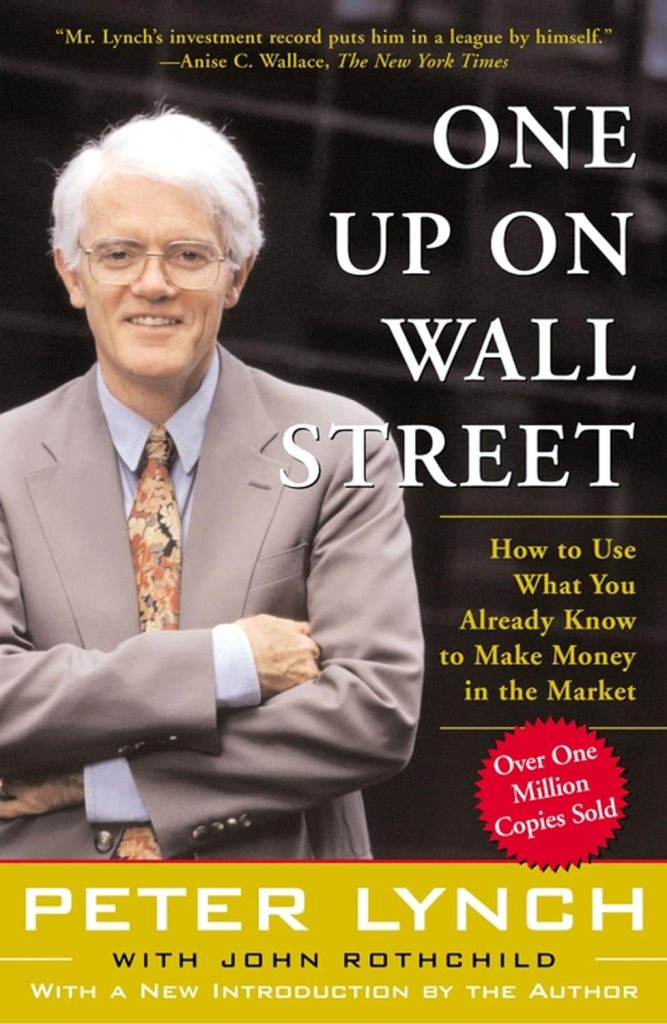
Instead interest seems flat, and when I do hear Peter Lynch mentioned it is by institutional investors more than retail. But the book seems to me like it is still valuable, so I’ll share some highlights here. This one could easily have been written this year:
Where did the Dow close? I’m more interested in how many stocks went up versus how many went down. These so-called advance/decline numbers paint a more realistic picture. Never has this been truer than in the recent exclusive market, where a few stocks advance while the majority languish. Investors who buy “undervalued” small stocks or midsize stocks have been punished for their prudence. People are wondering: How can the S&P 500 be up 20 percent and my stocks are down? The answer is that a few big stocks in the S&P 500 are propping up the averages.
I see why the book hasn’t caught on with meme stock traders:
Nobody believes in long-term investing more passionately than I do… I think of day-trading as at-home casino care.
I’ve never bought a future nor an option in my entire investing career, and I can’t imagine buying one now. It’s hard enough to make money in regular stocks without getting distracted by these side bets, which I’m told are nearly impossible to win unless you’re a professional trader.
So where does he think retail investors have a chance to get “One Up on Wall Street”?
Mostly in stocks that are too small for Wall Street. The archetypical Lynch stock is one where you notice a product becoming popular in your daily life, look it up and find that it is from a small company (so Wall Street analysts aren’t really following it, and the growing product makes up a substantial proportion of the company), check that the company has decent financials and isn’t overpriced, then buy in.
The average person comes across a likely prospect two or three time a year- sometimes more….
With survival at stake, it’s the rare professional who has the guts to traffic in an unknown La Quinta. In fact, between the chance of making an unusually large profit on an unknown company and the assurance of losing only a small amount on an established company, the normal mutual-fund manager, pension-fund manager, or corporate-portfolio manager would jump at the latter. Success is one thing, but it’s more important not to look bad if you fail. There’s an unwritten rule on Wall Street: ‘you’ll never lose your job losing your client’s money on IBM’. [Though I wonder if this has become less true as ETFs and hedge funds have displaced mutual funds and pensions -James]
Meanwhile, Lynch thinks that the supposed advantages of Wall Street don’t amount to much:
Studying history and philosophy was a much better preparation for the stock market than studying statistics…. All the math you need in the stock market you get in the fourth grade
To see what the book means for markets today, I thought I’d try to find the stock that is currently the most Peter-Lynch-esque. Mostly this means small, fast-growing, and simple:
The simpler it is, the better I like it. When somebody says “Any idiot could run this joint”, that’s a plus as far as I’m concerned, because sooner or later any idiot probably is going to be running it.
But this could still be any number of stocks. To get more specific, Lynch gives 13 attributes of the “perfect stock”:
- It sounds dull- or, even better, ridiculous [its name]
- It does something dull
- It does something disagreeable
- It’s a spinoff
- The institutions don’t own it, and the analysts don’t follow it
- The rumors abound: its involved with toxic waste and/or the mafia
- There’s something depressing about it
- Its a no-growth industry [note- industry, not company]
- Its got a niche
- People have to keep buying it
- Its a user of technology
- The insiders are buyers
- The company is buying back shares
He later adds that the ideal company is growing earnings at 20-25% per year (fast but sustainable), and trading at a PE ratio less than their earnings growth (what would later be called a PEG ratio below 1).
I used a stock screener to narrow things down from a universe of about 10,000 public companies. Restricting to small- or micro-caps cuts this to 5,000; additionally restricting to those with the right earnings growth, 82; considering only those with less than 20% institutional ownership, 12; then picking those with a PEG ratio below 1 yields….
Nothing. So there seems to currently be no ‘perfect’ Lynchian stock in our probably overpriced market. But what comes closest? First Solar (FSLR) is a bit big, with a $22 billion market cap, but it is growing quickly in a sector that has been hated recently. Pilgrim’s Pride (PPC) is growing quickly selling chicken and pork. VirTra (VTSI) is tiny (market cap $99 million) and fast growing, sells training simulations to law enforcement and the military. Looking outside the US could add a few more. Many of the best small companies that would have been public in Lynch’s heyday may be private now.
But stock screeners may be against the Lynchian spirit anyway. The main idea is simply to keep your eyes and ears open in your everyday life for the company that you suddenly keep hearing about, or has lines out the door, or keeps running out of inventory.
 Economist Writing Every Day
“…the recent exclusive market, where a few stocks advance while the majority languish. “… that actually seems to be a more or less permanent feature of the stock market in recent decades. The megacap tech companies are allowed to swallow up potential competitors, and just get bigger and more dominant and generate enormous cash flows.
The smart money has been to bet even more heavily on them rather than against them. I wish I had owned Nvidia outright instead of diluted in S&P500 funds.
LikeLike