Do you have a robot vacuum? The first model was introduced in 2002 for $199. I don’t know how good that first model was, but I remember seeing plenty of ads for them by 2010 or so. My family was the cost-cutting kind of family that didn’t buy such things. I wondered how well they actually performed ‘in real life’. Given that they were on the shelves for $400-$1,200 dollars, I had the impression that there was a lot of quality difference among them. I didn’t need one, given that I rented or had a small floor area to clean, and I sure didn’t want to spend money on one that didn’t actually clean the floors. I lacked domain-specific knowledge. So I didn’t bother with them.
Fast forward to 2024: I’ve got four kids, a larger floor area, and less time. My wife and I agreed early in our marriage that we would be a ‘no shoes in the house’ kind of family. That said, we have different views when it comes to floor cleanliness. Mine is: if the floors are dirty, then let’s wait until the source of crumbs is gone, and then clean them when they will remain clean. In practice, this means sweeping or vacuuming after the kids go to bed, and then steam mopping (we have tile) after parties (not before). My wife, in contrast, feels the crumbs on her feet now and wants it to stop ASAP. Not to mention that it makes her stressed about non-floor clutter or chaos too.
What we settled on was that she would do more quick-vacuums and sweeping and I would do the big, furniture-moving deep cleans that included vacuuming, sweeping, and steam mopping. It worked for years. She’d be happier not to have crumbs around and I’d be happy to have a deeply cleaned floor, even temporarily.
The problem is that costs are convex. As our youngest reached the age of two, the crumbs began to spread more as her independence and sense of entitlement developed. The floors were getting crummier at an increasing rate (compounded by other kids). I would sweep and vacuum when I arrived home earlier than my wife so that she was happier when she arrived, violating my ‘make hay when the sun shines’ maxim. Often, she’d vacuum or sweep again after the kids went to bed. We each spent tens of minutes cleaning floors daily. That may not sound like a lot, but again, costs are convex.
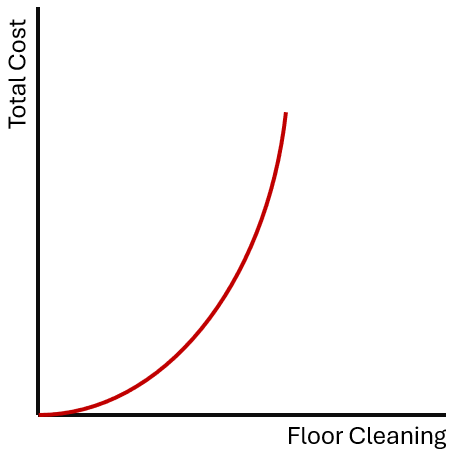
What does that mean? That means that each minute spent performing some activity is more costly that the last. Sometimes, contrarian students or redditors will incredulously and confidently proclaim that increasing marginal cost is just an assumption and an unrealistic folly of the field of economics. To which I say: Poppy cock. Economic costs are opportunity costs. That is, the dollar costs of an activity may not rise (though they probably do), but the *value* of the foregone activity increases relative to the value of the current activity. For example, I can clean the floors and still get 7-8 hours of sleep. But I can’t do both and also repair things around the house, fold laundry, and do dishes. And you can forget about sitting and resting. The more time one spends cleaning floors, the more valuable are the things that one forgoes.
With so much cleaning that had fleeting effects, life was crummy or restless or both and not sustainable. As I said, I was reticent to purchase a robo-vacuum because I didn’t want to waste my money on one that didn’t work well. Then I saw one deeply discounted for $200 and I snatched it up before I could convince myself otherwise. It wasn’t top of the line, but I didn’t need that. I just needed my family to be happier and less stressed. That was my wife’s birthday present this year. It was a very good decision.
Now, each night we spend a small amount of time readying the common space of our home so that the vacuum cleaner can do its thing. We use the ‘high power’ setting which is a bit noisier and the small children don’t like it. So, we have it scheduled for 7am daily, which works for us. Then, the adults are awake and getting ready out of its way, and the children are asleep or also busy getting ready (it will need to change once the school year resumes).
The whole house is nicer and we spend more time doing those other valuable things. Everyone is less stressed and we treat each other better. To boot, we get more floor cleaning at a near zero cost. My big deep-cleans take less time and I’m spending less time on floor cleaning overall. I’m willing to steam mop more frequently rather than telling myself that it can wait a week. Now, my first minute of floor cleaning is on corner-sweeping or steam mopping. It kills me that I was spending an initial 30 minutes of full sweeping and vacuuming only to arrive at the same level of cleanliness that the robot vacuum now provides.
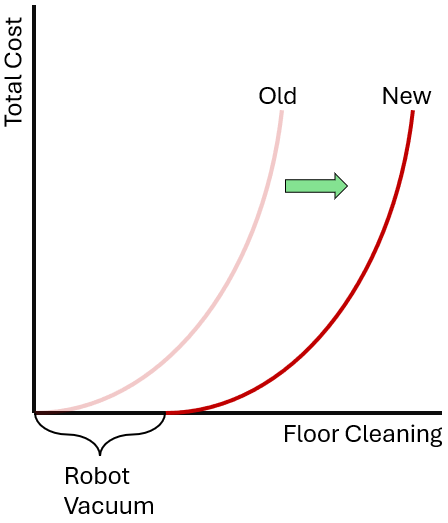
Like I said, we didn’t get the top of the line vacuum*. It has a mop function, but we haven’t used it and we suspect that it would be a waste of time and effort. You can get a very affordable model and still experience a big increase in your quality of life (especially if you have kids)**. Two hundred dollars isn’t a rich-people price. A one-time purchase of a week’s worth of groceries or a month’s worth of digital services is the perspective to have. I regret not purchasing one sooner than I did.
—
UPDATE: We have since used the mop function and the performance is not as good as a human, but it’s very much worth using and will decrease the frequency of my deep cleans. Nice.
*We purchased a Bobsweep Dustin. It has mixed reviews and a distastefully high list price that is always steeply discounted. Functionally, it works great for us.
**I dream of a world in which baby shower gifts are forward looking. Alternatively, let’s start giving gifts to parents on a child’s birthday. “Turning two? Time for a Roomba.”
 Economist Writing Every Day