The headlines often read with the criminal threats that illegal/undocumented immigrants pose to the US native population. The story usually includes a heart wrenching and tragic story about a native minor who was harmed by an immigrant and a politician to help propose a solution. There’s also usually a number cited for how many such crimes happened in the most recent year with data. Stories like this are designed to provoke feelings – not to provoke thinkings.
First, the tragic story is probably not representative. Even if it is, the citation of a raw count of crimes is not communicative in a helpful way. Sometimes politicians will say something like “one victim of a crime by an illegal immigrant is too many”. But that seems like a silly argument to make *if* immigrants reduce the probability of being a victim of a crime.
I argue that (1) immigrants who commit crimes at a lower probability than the native population cause the native population to be safer and, counterintuitively, (2) immigrants who commit crimes at a *higher* probability than the native population cause the native population to be safer.
Let’s start with some basics. Say that a criminal commits 1 crime against 1 victim per time period. Also say that everyone in the population has an equal probability of being a victim. Therefore, if there is a population of 100 and 1% of them are criminals, then there will be 1 crime committed and each person has a 1% chance of being a crime victim.* The specific numbers here don’t matter, but they let us use a concrete example.

Once we have the above, we can identify two entirely separate groups of people with different crime rates. If they are segregated, then they only affect their own populations. Thanks to some selection effect, immigrants to the US tend to have lower crime rates that the native population. Let’s say that that number is 0.1%. Therefore, if you could choose to be in one of the two segregated communities, then based only on the crime rate you would reasonably choose the immigrant community.
In reality however, the two populations are not segregated. If one of those immigrants comes to the US, then it impacts (1) the probability that anyone becomes a victim, and (2) the probability that a native person becomes a victim. Below is the math for the probability that anyone becomes a victim, now that we have that we’ve added one immigrant to the overall population. Again, I assume that everyone has an equal probability of being a victim. Since migrants and non-migrants tend to commit crimes against those in their in-group, that changes the degree and not the nature of my results. The subscripts of N, I, and T denote native, immigrant, and aggregate values.

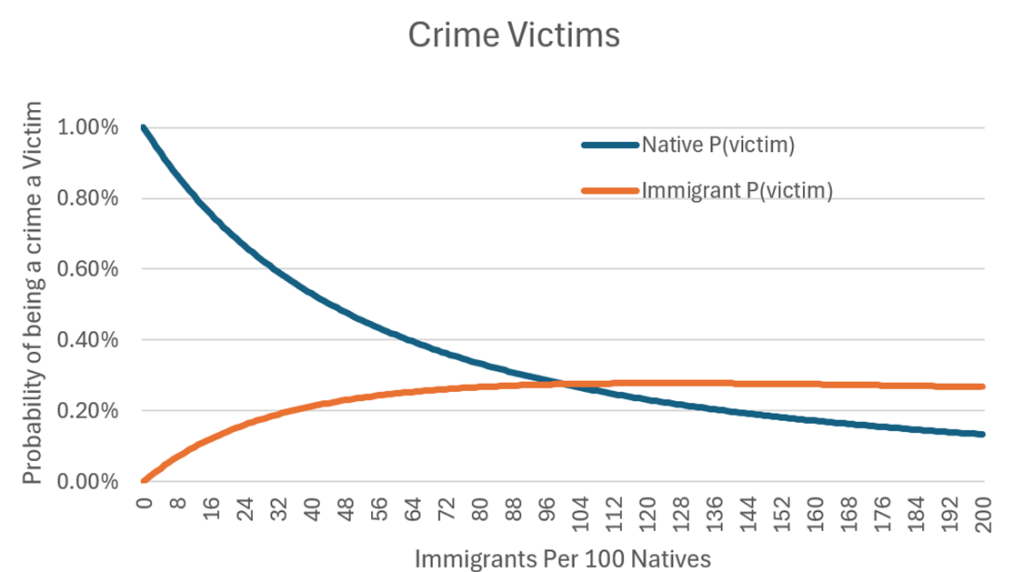
Crunching the numbers for one immigrant results in an overall probability of victimization at 0.99%. That’s a lower crime rate. Hurrah! Politicians usually don’t trot out an example of an immigrant child victim. They always choose a native one, as if to say that we should worry more (or only?) about the native population. Plenty of people would consider that reasonable. Therefore, to find the probability that a crime touches the life of native person, we just multiply the overall probability of victimization by the proportion of the population that natives comprise. Since that’s a fraction less than one, the probability of a native also being a victim becomes lower.

Given a native population of 100, the graph below illustrates that adding an additional immigrant monotonically lowers the probability of victimizing natives. That’s a fancy word that means that there is no number of immigrants at which more harm is done to the native population. The probability of an immigrant being a victim is not the same as the probability of a foreigner of being a victim. It’s conditional on their immigration. So, there are zero immigrant victims when there are zero immigrants.
I think that all of the above seems reasonable to anyone who has ever made Kool-Aid. Adding more sugar to the water makes all of the water sweeter. Adding safer individuals to your population makes your population safer. There is nothing groundbreaking there.
The counterintuitive case is when immigrants include a higher proportion of criminals. You might think that adding one of those potentially dangerous people to the population increases the probability of observing victimized natives. And you’d be right, but only partially. Let’s say that 3% of immigrants commit crimes, way more than the native proportion of 1%. Just so we are clear, those relative values are in crazy-town. Immigrants tend not to commit crimes at higher rates than the native population, much less three times higher. What is the result? See below.
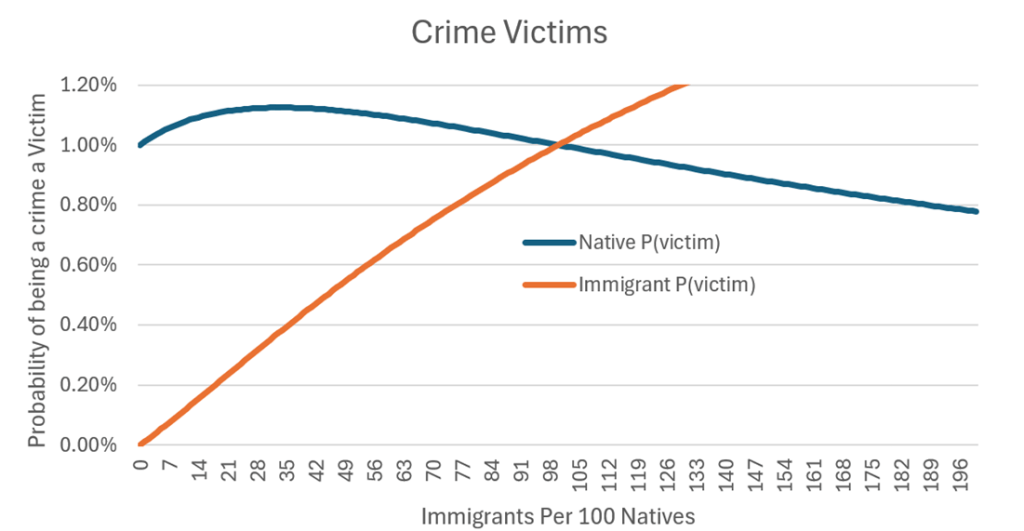
Adding an immigrant increases the probability of being a victim for the entire population. That sounds unsafe. Maybe we shouldn’t do that. But, what is the effect on the native population, for whom we should ostensibly feel a greater sense of responsibility? Each immigrant increases the total population, placing downward pressure on the probability of victimization for everyone. What’s more, each immigrant also reduces the proportion of the population that is native, further reducing the probability of native victimization. The net effect depends on the particular crime rates and ratio of immigrants. But the end result is nonlinear. The initial unsafe immigrant does make natives less safe. But adding more of those immigrants makes natives *more* safe because there are more migrants who serve as potential victims (oh look! It’s the dismal science!).**
EDIT: An earlier version of this post incorrectly conflated a lower probability of being a victim and native, in contrast to the probability of being a victim conditional on nativity.
*Yes, I know that criminals don’t tend to victimize themselves, but that’s only a problem in the case of having 1 criminal. In reality, criminals victimize one another at higher rates than the rest of the population.
**So long as the %change in crimes is less than the %change in population, the probability of being a victim falls.
 Economist Writing Every Day
I don’t quite understand the assumptions that lead you to your second finding.
Asymptomatically, the probability for one specific person to become a victim of a crime should only depend on the average ‘criminality’ of the population? If you add more people, you get more criminals that might victimise our arbitrarily fixed person, but you also dilute those crimes amongst a larger population. Overall the effect of population size on per capita crime rates should cancel out in your model?
So I don’t see how adding ‘sweeter’ ingredients would make the average sweetness go down?
LikeLike
You are right that the analogy fails in the case of higher immigrant crime rates. I couldn’t think of a good one for the high-immigrant-crime example. Admittedly, there is also some goofy language going on here that’s imposed by the political rhetoric. You’re right that all individual faces the same probability of a crime (by construction). And, as P(native) falls, P(native∩victim) decreases. In a sense, it’s a trivial point that I’ve made. But in reply to a silly point made by certain politicians.
LikeLike
Sorry, I still don’t understand. Why does the probability of being native come into anything here?
What’s the stochastic process or mechanism you have in mind?
As far as I understand by your logic dividing the native population in two, eg right hander and left handed, and doing the calculations independently for both, would also lower the probability that a member of either native group becomes a victim of a crime?
(And for that matter, adding migrants of exactly the same criminality as natives, would also improve things by your logic?)
LikeLike
it sounds like you get it entirely. The probabilities aren’t *my* logic. And the (2) point is as silly as you make it sound. The p(native| victim) falls. But what’s it worth? Little I’m afraid. Introducing the wrinkle of likely offendees by offender might extend the case (1) logic though, such that some cases of high immigrant crime affect natives less. The data would determine the relevance however.
LikeLike