As the presidential race finishes out the last two weeks, it’s clearly a close race. In the past I have recommended prediction markets, and right now these are giving Trump about 60% odds. There have been lately a few big bettors coming into the markets and primarily betting on Trump, so there has been speculation of manipulation, but even at 60-40 the race is pretty close to a toss-up.
Another tool many use to follow the election are prediction models, which usually incorporate polling data plus other information (such as economic conditions or even prediction markets themselves). One of the more well-known prediction models is from Nate Silver, who right now has the race pretty close to 50-50 (Trump is slightly ahead and has been rising recently).
But Silver’s model, and many like it, is likely very complicated and we don’t know what’s actually going into it (mostly polls, and he does tell us the relative importance of each, but the exact model is his trade secret). I think those models are useful and interesting to watch, but I actually prefer a much simpler model: Ray Fair’s President and House Vote-Share Models.
The model is simple and totally transparent. It uses just three variables, all of which come from the BEA GDP report, and focuses on economic growth and inflation (there are some dummy variables for things like incumbency advantage). Ray Fair even gives you a version of the model online, which you can play with yourself. Because the model uses data from the GDP report, we still have one more quarter of data (releasing next week), and there may be revisions to the data. So you can play with it (and one of the variables uses the 3 most recent quarters of growth), but mostly these numbers won’t change very much.
What does the model tell us?
One warning with Fair’s model: it does not predict the winner of the Electoral College, only the popular vote (though see this excellent post by my co-blogger James Bailey on using the Fair model to predict individual states). You might think this makes the model less useful, but the popular vote share of Democrats is actually a useful number: in general, if the Democrats get at least 52% of the two-party popular vote share, they will also win the Electoral College (keep in mind that that’s two-party vote, so for example Clinton won in 1992 and 1996 with well under 50% of the total vote). The one exception in the past 100 years was 1976, when Carter won a narrow EC victory with 51% of the two-party popular vote.
Right now, with data through the second quarter of 2024, Fair’s model gives Harris a predicted 49% of the two-party Presidential vote share. If you assume the third quarter data for GDP is pretty good, this could jump up to 50%. But still, given the Electoral College disadvantage Democrats have, Harris would fall short of the 52% that she would probably need. Is this a bullish sign for Trump?
Probably not. Here’s why: while I like Fair’s model, it isn’t perfect. For one thing, it tends to underpredict the Democratic candidate’s vote share. In fact, it has underpredicted the Democratic Presidential candidate’s share in 8 of the last 10 elections, an average of 1.8 percentage points. You might think this makes the model bad, but all models are bad, even though some are useful. If the third quarter GDP data is pretty good, and the model underpredicts Democrats by about 2 percentage points again, this will be an extremely close election, with Harris being right at the 52% threshold’s doorstep.
One last problem with this model: it has been especially bad at predicting the Democrat vote share when Trump is running, by an average of 4.4 percentage points. I know people say polls are biased against Trump, but this model is the opposite: Trump underperforms (this has led Fair to speculate that there is a “negative Trump residual,” but he hasn’t added a new parameter to the model yet — it’s only 2 data points).
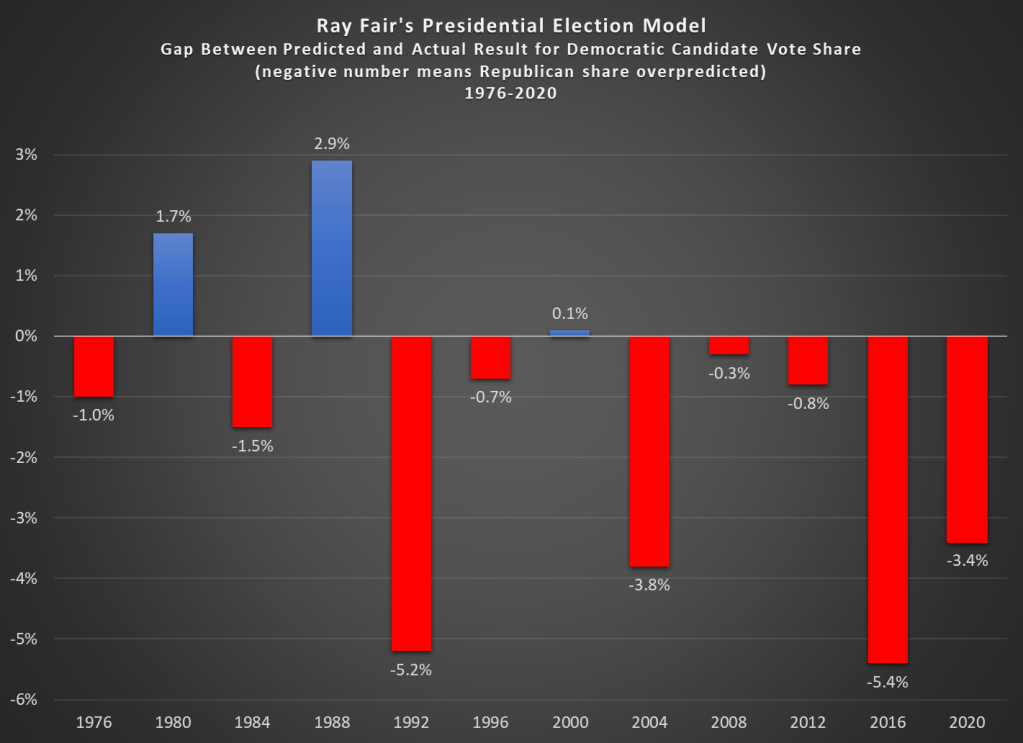
Putting all of this together, the race is extremely tight. Fair’s model predicts Harris will get 49-50% of the two-party vote, which is normally not enough for a Democrat to win (they need at least 52%). But given that the model underpredicts Democrats lately, especially against Trump, Harris’ chances improve enough that the race is basically still a toss-up. But you already knew that.
 Economist Writing Every Day
Thanks for this!
LikeLike