If you’ve ever been vegetarian or if you have ever spoken to a vegetarian about their diet, then you have probably heard or asked “How do you get enough protein?”. While it’s important for health and economic achievement to get adequate protein, not too long after comes the questions about types and sources of protein. This question is relevant for vegetarians and vegans, but also people with meat allergies and people with religious dietary guidelines that prohibit meat always or seasonally. Let’s break it down.
Some omnivores are incredulous that vegetarianism can provide adequate protein or protein quality. But protein itself is relatively easy to get and any judgmental attitudes on both sides are mostly just vibes. Legumes and nuts tend to have a lot of protein. But relative to what?
The World Health Organization recommends that an 80-kilogram (176 lb) adult should get 66.4 grams of protein per day (0.83g per kg). That’s the protein content of about a 9oz of peanuts. Protein is super important and it’s luckily not that hard to get if you eat a variety of foods. Even if you’re trying to consume double the WHO recommended daily intake (RDI), it’s an easy feat.
Below is a table of some popular protein sources. The table includes the grams of protein per 100 grams of food, which makes the protein content a percent. The table also includes the number of grams needed in order to achieve the WHO protein RDI of 66.4 grams. The last column is for our American readers who need the serving to be in ounces.
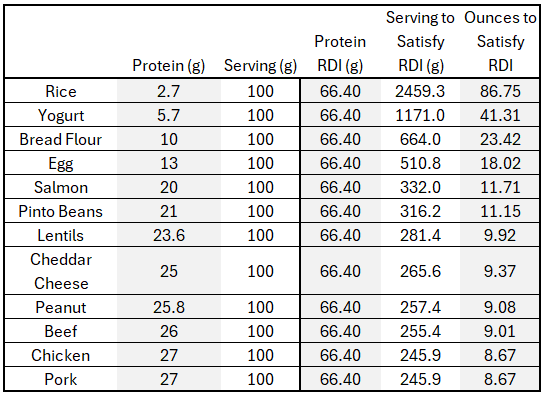
One reason for omnivorous incredulity about vegetarian diets is that nothing quite compares with meat when it comes to protein density – but peanuts are close! You’d need to eat a filling serving of lentils or a heavy bowl of yogurt in order to get the same amount of protein that’s contained in a 9oz serving of beef. Vegetarians would need to eat more food than omnivores in order to get adequate protein, but it’s not really that hard to achieve to achieve the RDI for a well-fed person. I don’t think that most people have a good sense of how much protein – or anything else for that matter – is necessary. Having said all of this, there may be good reasons to surpass the WHO RDI. Beans and rice is a staple around the world because it’s cheap and it provides more than enough protein.
All of this is fine when it comes to the mass of dietary protein. But what about the type or quality of protein?
Protein is composed of amino acids, and there are 9 essential amino acids that humans don’t produce internally. We have to eat them to survive. Meats tend to include all 9 amino acids. They’re a nice little pouch that satisfies all of the amino acid requirements. Below is a table that lists the proteins, the WHO amino acid recommendation for an 80kg adult, and the amino acids in 6oz of beef. Despite the high protein content, 6 ounces of beef does *not* provide all of the amino acids that are necessary for an 80kg adult. It’s a little short on both Phenylalanine & Tryptophan.

Recently, I’ve been experimenting with some shelf-stable proteins. Specifically, I’ve figured out a wheat gluten recipe and a pea protein recipe that I like. The latter recipe includes equal parts bread flour and pea protein powder. Generally, anytime that you include a legume and a grain, then you’re in the territory of complete proteins. If I compare 6oz of the pea-wheat mixture to the 6oz of beef, then it performs worse than beef in some areas, but better in others. In order to get the RDI of amino acids from beef alone, you’d need to eat 244 grams, or about 8.6 ounces. In order get satisfy the RDI by eating the pea-wheat recipe, you’d need to eat 300 grams. Having said that, you’d get more of every single type of amino acid except methionine.*
Coincidentally, 300 grams is about what I eat in my recipe. As you can see in the chart above, the pea-wheat combo blows the beef out of the water by most measures. The RDI is satisfied all in one meal (that wasn’t my goal, but it’s still worth noting). As it turns out, both foods end up costing the same on a per-gram basis. Eating a lot of meat has only been popular as RGDP per capita has risen. For thousands of years prior, people ate beans and rice, and got along just fine (on this margin anyway). Humans have a long history of figuring out what works. When it comes to protein, a lot of different things work.
[EDIT: Eating the 244g of beef needed to satisfy the amino acid RDI would yield 58g of protein. Eating the 300g of pea-wheat mixture needed to satisfy the amino acid RDI would yield 135g of protein. I said in a previous version that only 14.2 grams of protein per day was the WHO recommendation. It’s actually 66.4!]
*I’m not a biologist. Go find one for more details.
https://iris.who.int/handle/10665/43411
https://pmc.ncbi.nlm.nih.gov/articles/PMC4711439/
https://tools.myfooddata.com/protein-calculator/171797/100g/1
 Economist Writing Every Day
FWIW, ~ 15 grams per day is wildly different from what nutritionists would recommend. A quick google provides a Harvard article suggesting 0.36 grams per lb of bodyweight per day, so the 176 lb adult would need 64 grams, not 15.
LikeLiked by 1 person
Thanks! You are right! I adjusted updated and adjusted it to the WHO recommendation of 0.83g per kg (66.4g per 80kg).
LikeLike
Enjoy your blog!But help me understand how you got to 14.72 g for a 70kg guy? It is 0.8g/kg/bw, about 58g. See Tab
LikeLiked by 1 person
You are right – thanks! I adjusted updated and adjusted it to the WHO recommendation of 0.83g per kg (66.4g per 80kg).
LikeLike
Thanks. Nick (not sure where the exuberantxd119 is coming from 🤣)
LikeLike