When MOOCs (Massive Open Online Courses) burst onto the education scene in the early 2010s, they were hailed as the future of learning. With the promise of democratizing education by providing free access to world-class courses from top universities.
Leading universities rushed to put their courses online, venture capital poured in, and platforms like Coursera and edX grew rapidly. Yet today, while MOOCs still exist, they’ve largely retreated to the margins of education. Meanwhile, long-form podcasts have emerged as a surprisingly powerful force in American intellectual life.
Is this ironic? I wanted to learn a bit about MOOCs while I took a walk before writing this blog post. I typed “MOOCs” into the Apple Podcasts search bar.
One of the first results was: John Cochrane on Education and MOOCs
I learned about MOOCs from Russ Roberts at a reasonable pace (when I listen to podcasts, I do it at 1x speed but I’m almost always doing something like driving or folding laundry).
I consider myself a lifelong learner. I buy and read books. Like hundreds of millions of people around the world, I like podcasts. I will attend lectures sometimes, especially if I personally know someone in the room. I did sit in classrooms for course credit throughout college and graduate school. I took extra classes that I did not need to graduate purely out of interest, and yet I have never once been tempted to sign up for a MOOC.
Enough introspection from me. My viral “tweet” this week was: “MOOCs never took off, as far as I can tell, and yet long-form podcasts are shaping the nation.”
Did MOOCs fail? Many millions of people signed up for MOOCs. A much smaller percentage of people completed MOOCs. Some users find MOOCs worth paying for.
However, if you listen to the podcast with John Cochrane in 2014, you can see the promise that MOOCs failed to live up to. The idea was that many people who did not have access to a “top quality” education would get one through MOOCs. Turns out that access is not the bottleneck.
Access to information is not an issue today. Everyone has access to information. The battle for attention and influence is fierce. Podcasts are winning that battle. (Listeners don’t seem too turned off by ad breaks to help fund the enterprise.)
MOOCs fell short of revolutionizing education. MOOCs struggled to retain learners because of the commitment they demanded and the structure they imposed. One thing people thought the MOOC could deliver at low cost was accountability. It turns out that traditional universities were and are still good for that. Podcasts succeeded by offering flexibility, accessibility, and a lower barrier to entry.
Podcasts excel at passive learning, where listeners absorb information through storytelling, interviews, and discussions. This style appeals to a wider audience, blending education with entertainment.
If someone in 2014 were told that MOOCs would not become influential on intellectual life, then a possible excuse might be that the public does not want talking or long-form content. We now know in 2024 that long-form talking content can be hugely popular, in the format of a conversational podcast.
To provide more context for the tweet (X post) I show a reaction that suggests Joe Rogan’s podcast had a big effect on the election. His podcast is especially popular with men. Below is a yard sign that has been up in my town for a month. Consider whether this yard sign would appeal to men as much as Joe Rogan.
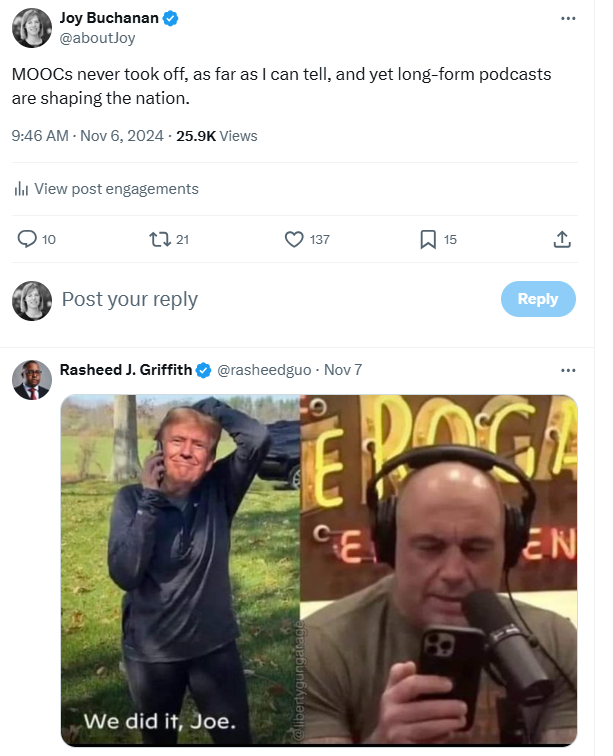

YouTube lectures and Ted talks can garner millions of views. Joe Rogan’s YouTube video of his interview with Elon Musk says it has 14.4 million views accumulated in just 4 days. What’s a MOOC? What’s a podcast? One takeaway is that people like to learn from a conversational format, if they are learning on their own time without the full benefit of being enrolled in a college course for credit.
If you’d like to hear me on a podcast, I’ve got this Apple podcast link: https://podcasts.apple.com/us/podcast/dr-joy-buchanan-on-understanding-economics-through/id1719744197?i=1000652541934
Edit: Downward pressure on the price of a tradition education may be partly a result of online competition. See Higher education is getting cheaper
 Economist Writing Every Day
Good insight: “…Podcasts excel at passive learning, where listeners absorb information through storytelling, interviews, and discussions. This style appeals to a wider audience, blending education with entertainment.”
LikeLike
MOOCs never took off because they did not add robust assessment and award valuable credentials. This is because there are few institutions who are willing to give credentials for learning that is only based on assessment and where students did not purchase a more expensive offering from them. Adding a credential to a MOOC undermines the business model of universities and they are not keen to do that. (It also will find resistance from academics) Many universities are also constrained by their accreditors. If accreditors were to change their rules to allow universities to award credit based on outputs as opposed to inputs this might make MOOCs a lot more successful. But then again they might be doing well from the existing arrangements as well.
LikeLike